"Bigger and Different": The Six Decades That Remade Australia — Mark Cully [Immigration Series]
!["Bigger and Different": The Six Decades That Remade Australia — Mark Cully [Immigration Series]](https://storage.ghost.io/c/8c/71/8c715a52-7cca-45a9-bba6-dc01735d5ec9/content/images/size/w960/2026/05/173----Greg-Kaplan---Michael-Brennan---website-hero---v1.1--13-.png)

Part 2 of a three-part immigration series this week. Martin Parkinson (economics) available here; Mike Pezzullo (acculturation, social cohesion, security) drops Friday.
Mark Cully was the inaugural chief economist at the Australian Department of Immigration (2009-2012). His forthcoming book, Waves of Plenty (September 2026), is (to my knowledge) the first truly general history of immigration to Australia. It will fill a remarkable gap in our literature, given the centrality of immigration to the Australian story.
We discuss Australian exceptionalism in migration policy:
- The only country to have run assisted passage at scale (around 3.5 million people whose fares were subsidised).
- The first country in the world to have a dedicated Department of Immigration.
- The first country to offer migrants English-language training.
- Per capita, the world's largest receiver of international students for decades.
- Today, the OECD country with the highest share of overseas-born among countries with more than 10 million people – around 32%, about 8-9x the world average, and projected to climb beyond 40%, a level likely not seen in Australia since the 1880s.
We walk through six decades that built the nation – the 1830s, 1850s, 1890s, 1950s, 1970s, and 2000s. We discuss why Australia eschewed slavery, why the 1850s might be the most important decade in the making of modern Australia, and what the White Australia policy was really about. We also explore what made the post-war migration program the most epic policy experiment in our history, whether migration has increased Australian living standards, and what history can teach us about the rise of One Nation.
Video
Sponsors
- Vanta: helps businesses automate security and compliance needs. For a limited time, get one thousand dollars off Vanta at vanta.com/joe. Use the discount code "JOE".
Transcript
WALKER: Today it's my great pleasure to be speaking with Mark Cully. Mark was chief economist of the Department of Immigration from 2009 to 2012, and he is the author of a forthcoming book, a history of immigration to Australia. I've read the manuscript, and it'll be one of the books of the year. So Mark, welcome to the podcast.
CULLY: Thanks, Joe, and thanks for the plug.
WALKER: So the title I think will be Waves of Plenty, and it's going to be published in September. It's striking that there's a huge gap in the literature. Australia doesn't really have a general history of immigration, something that covers the full sweep from the arrival of the British through to the present day. So it's a huge service that you're doing for the country.
In the book, you give a kind of macro overview of that whole history. But you also focus in particular on six decades and you provide a narrative history of each of those decades. Those decades are the 1830s, the 1850s, the 1890s, the 1950s, 1970s, and 2000s.
So, as I told you before we started recording, the book left me with a number of mysteries or questions, which we'll get to. I've got some big–picture questions, and I also want to go through each of the different decades and ask a few different questions on each of them.
CULLY: Okay.
Why didn't Australia turn to slavery?
WALKER: But we'll start with my first mystery and the 1830s.
So one of the defining features of Australia generally, but in particular immigration to Australia in the 19th century, is that there are these chronic labour supply shortages, which are a function of the tyranny of distance. I think in the book you write [that] until the mid-19th century, it was about £5 to travel from the UK to America, whereas it was about £20 to travel from the UK to Australia.
CULLY: And the amount of time it took.
WALKER: It was about three times as long.
CULLY: Yep, about three months. And you have to think about the opportunity cost of your time. You can't earn a wage aboard a ship.
WALKER: Exactly. And [travellers had] a much higher death rate as well.
CULLY: It was about two per cent. People died on the voyage on the way over. Higher for kids.
WALKER: Yeah. I mean, in some ways it was almost like the then equivalent of travelling to the moon or something.
And so, as a function of that, Australia had these chronic labour supply shortages. And colonial governments primarily tried to address those through assisted migration.
But it's striking that Australia never turned to slavery, like other countries – like America and South Africa – did, to solve their labour supply issues. And that's particularly striking because, there was a local Indigenous population. And yet we still [imported] a lot of labour from either the Pacific Islands or from the United Kingdom and Ireland.
So do you have an account or an explanation for why Australia didn't turn to slavery like some other countries did?
CULLY: People and scholars make a distinction between free and unfree labour. And you could have slavery at one continuum, and then you could kind of have, I don't know, people just being hired as employees in a labour market and covered by kind of rights and conditions at the other end. And so when you're asking about slavery, you need to frame it within that kind of unfree labour.
And so you would characterise the kind of conditions under which Aboriginal Australians did work in the labour market as being on the borderline of unfree. They had few rights. Their wages were grossly underpaid or often not paid at all. And they weren't necessarily that much different from – and we might go on to talk about – the South Sea Islanders and the way in which they were brought into Australia as indentured workers.
The chronic labour shortage only started to become an issue in Australia during the 1820s, and I guess the way I'm thinking about it is that in the 1820s, we had this report that was done by [Commissioner John Thomas Bigge] – the Bigge Report. He basically ran a kind of royal commission into the operation of the convict system. And there were some concerns in Britain that being transported to Australia did not have sufficient terror attached to it. And Bigge was sent out to investigate this.
And so there was this tension between the colonial authorities and British reformers and the British authorities as to what these penal colonies were there to do. Were they there to send the criminal underclass from the UK away to Australia, so they're out of sight, out of mind, and just keep sending them there? Or were these colonies to be – because there were two, New South Wales and Van Diemen's Land, by that point – were they there to be something different to a penal colony? Were they to become, in effect, a dominion?
At the same time, there was a push starting against transportation for moral grounds because slavery was being contested. I think it was early 1830s that the Slavery Act was passed to abolish slavery within the Empire. So the opportunity, I guess, for slavery to take off in Australia, whatever form it might have taken, didn't happen before 1830, which is when assisted passage started, and didn't happen after 1830 because slavery had been expunged in the British Empire.
There are a series of papers which look at the use of Aboriginal Australians as workers in different parts of Australia. It was well known that they worked as kind of jackaroos and so on on cattle stations. It's a fairly thin literature, I would say, so it's very hard to be definitive about it.
I guess the one thing that people know as a kind of backdrop to this is that the population numbers collapsed calamitously. There were perhaps – Boyd Hunter's done some work on this – perhaps about a million Indigenous inhabitants of Australia in the late 18th century. And by about halfway through the 1840s or thereabouts, the number of colonists had gone past the number of Indigenous Australians who had died principally from disease rather than from warfare.
I guess I'd observe that even in the United States, they didn't – not in any significant scale that I know of – enslave their own indigenous people. They brought people out from Africa to do that.
The decade that made modern Australia (1850s)
WALKER: Yeah. So, question about the 1850s. I've come to view the 1850s as perhaps the most important decade in Australian history. And I've been trying to puzzle through what it means to have so many people in a country who are there for the first time.
Maybe the most striking statistic from that period is [that] I think by the end of the gold rush decade – so we're talking early 1860s now – seven in ten people in Victoria were born overseas.
It must have been such a strange experience to live in a society where most of your fellows were not originally from the place. It almost feels like a weird Lord of the Flies kind of situation. In some very real sense, it's like you're creating a society from scratch.
I've just been recently trying to puzzle through exactly how that affected Australian culture, that influx of newcomers. And not even particular qualities of the newcomers, but just the fact of having so many new people in such a short space of time.
CULLY: Victoria didn't have any colonists except for some, you know, renegades and kind of outlaws who were sealing along the Southern Ocean until the mid-1830s when the Port Phillip District was established. So it went from kind of, you know, basically no white people to, I think it must have been 400,000-odd by the end of the 1850s.
So it went from having no white people at all ... Between 1835 and 1850, most of what is now Western Victoria and Central Victoria, Northeastern Victoria became occupied by squatters. And there were huge numbers of sheep there. Melbourne was a big town of 20-odd thousand-ish. And then after gold was discovered in 1851 … Without a policy, the default was [that] it was open borders. There were no restrictions on anybody turning up. So long as you could find a ship to bring you to Melbourne, you could come and you could start searching for gold.
And people did come from all over North America, from all over Europe, from Britain and Ireland, from New Zealand, and I guess most famously, because it's the way it played out over the course of that decade, from China. William Howitt was already a fairly distinguished writer in London at that time, and elderly, and he decided he'd come out to see what all the fuss was about, and wrote a memoir of his time there. It's so colourful and so evocative of, like you said, this land taken over by these white people searching for gold.
And it was both a kind of an upheaval of everything that had gone before, but it was also this tremendous kind of a “melting pot” in that sense that people sometimes use it in the context of the United States in the late 19th century of throwing all of these people together and everyone having to find ways of accommodating the way in which they saw the world and the way in which they interacted with one another.
And it was … the birth of Australian culture?
There was certainly a lot of swagger and a lot of larrikins. There were a lot of former convicts who had come from, particularly from Van Diemen's Land, to try to make their riches. And there were lots of colourful stories about the escapades that they got up to. And in fact, the Victorian Legislative Council tried to ban former convicts from Van Diemen's Land coming over to Melbourne because of all the uproar that was being created.
There's also an argument which people have been making for a long time, people like Geoffrey Serle, that if we think about the attributes of convicts and of assisted migrants and then compare those two groups with the people who came in the 1850s – we're comparing the British and Irish in those three groups of the convicts, the assisted passage migrants, and the people paying their own way – that last group were more middle class, more literate, and more skilled in their kind of background trades than the other two groups. The assisted passage migrants were very much labouring poor and particularly from Ireland. The Irish were very overrepresented amongst the assisted passage migrants, and the convicts were also very much working class.
So a number of those people who had come, had paid their own way in the 1850s to search for gold, had spent a lot of time at Chartist rallies in Britain arguing for electoral reform. So you see a number of things kind of flowering, particularly in Victoria but also in New South Wales in that decade around seeking kind of a broad franchise. And part of the resolution of the Eureka Stockade was to settle on a broad franchise. You see the first industrial agreement in the world on an eight-hour working day for putting up the Law Building at Melbourne University. It is a very fascinating decade. I don't know whether it's the most consequential one in Australia's history or not because there's a few contenders for that. But it was a fascinating one.
WALKER: So all of those things in terms of the sort of experiences and the composition of the migrants who arrived in that decade, I think are very important. You can draw pretty clear lines from those to the egalitarian culture that Australia is known for – for example, the Chartists and whatnot. But … it's still a mystery to me: imagine living in a country or a city where 70 per cent of the people around you are there for the first time. I'm trying to work out the importance of that fact in and of itself. And yeah, it's still a mystery to me.
CULLY: So you can see in the letters that people write home and the guidebooks that are being produced, there's kind of official guidebooks that are being produced by the Colonial Land and Emigration Commission... There are kind of, I guess, proselytisers and boosters who are talking about what it's like to move to this place. So I guess it has elements of a wild, wild west frontier in the way in which we sometimes think about the way in which the expansion westwards of the United States happened. You know, a little bit lawless, a little bit wild.
There were so many people coming that ships had to wait for two days at Queenscliff before they could get a berth to land. And then when people are landing, they're being quoted these outrageous sums of money to be able to take their bags from the Port of Melbourne into the centre of Melbourne. So they just throw them away or they have an impromptu sale down on the wharf.
There are so many people arriving that the average number of people living inside rooms in Melbourne doubles, and I think each dwelling has like eight or nine people in it. And there's so [little] housing that they build a tent community on the edges of the Yarra where there's 7,000 people at one stage just living in tents. So you really are throwing all these people together into a really unsettling environment.
But the probability that somebody could become extremely wealthy overnight was much higher than it had ever been previously, and sufficiently high that it brought so many people out.
There's a quote I have where Karl Marx is writing to one of his friends in New York. He wasn't old at that stage, but he's saying: “Those people who've gone out to Australia, they don't realise how much they've made our world shrink.” It's kind of like it's a really early statement about globalisation … That we could never have imagined this before, in the 1840s. And here he is in the 1850s, writing about this colony, Melbourne, kind of emerging overnight, and growing faster than Chicago did, for instance. I think Melbourne probably has the record in the 19th century – it grew faster than San Francisco, grew faster than Chicago – as the fastest-growing new city.
What was White Australia really about?
WALKER: Okay, one quick question on the 1890s. So if the depression of the 1890s hadn't happened and instead around the time of Federation we had economic conditions like those of the post-war era – so: close-to-full employment, good growth – directionally how different do you think the White Australia policy would have been?
CULLY: I'm not sure that it would have been any different. The level of antipathy that had developed towards Chinese migrants from the mid-1850s through to the late 1880s … was extremely high. It wasn't unparalleled, because it also happened especially in the United States. And in both the United States and Australia, you see this tension between the governing authorities … [They] are trying to broker these (effectively) trade arrangements to give them access to the Chinese market and to Chinese goods – so opening up these relationships under, you've got to say, on the Chinese side, a fair degree of duress. What we call the Nanking Treaty, they call the unjust treaty.
But on the ground, the white Americans and the white Australians, the colonists, were repulsed by the Chinese migrants. And I don't know whether there's a precedent for it in the US, but, you know, there is the report that was done, the Goldfields Commission report on the Eureka Stockade uprising, which I think dates from 1855, talks about yellow hordes. And this is an official government document. And that language and that antipathy: it's in countless newspaper columns; it's in nativist nationalist leagues that were formed; it's in riots to remove Chinese miners in different goldfields, notably in Lambing Flat.
But I think the one that really stood out for me, which predates the recession – the depression, sorry – of the 1890s, was in 1888, where a ship sailed from Hong Kong, the SS Afghan, carrying about 270 Chinese men who were coming to Melbourne, Sydney, and then on to New Zealand. They were getting off at different points.
Under duress, the Victorian governor invoked quarantine laws to say, "I won't let this ship dock in Melbourne." And it then went around to Sydney, and Henry Parkes, the New South Wales premier, said, "I won't let this ship dock in Sydney." Somebody on behalf of the shipping owners and some of the people on board took it to the New South Wales Supreme Court, who said, "You have to let this ship dock. There are people in it who have landing permits. They are already residents of New South Wales and they're allowed to come back in."
And the [NSW] premier went out and said, "I cast to the wind your landing permits, your cobwebs of technical law." And he then wrote retrospective legislation which endorsed the actions that he and his government had taken to prevent these Chinese men from disembarking. And it went all the way up to the British prime minister who said, "The people of New South Wales have gone stark raving mad."
But you have all of the ingredients that kind of prefigured the Tampa, about "we are not letting this boat disembark, come what may"; the writing of retrospective legislation to protect what they were doing. And it was wildly popular. And I mean, Parkes took that action in part because a mob of, I think it was about 10,000 people or thereabouts, had descended and were basically going to enter the New South Wales Parliament and kind of destroy it if action wasn't taken to prevent this boat from disembarking.
WALKER: That was 1888. So that's three years before the economic troubles.
CULLY: Right. So it's a story about cultural and economic protection. And there's kind of two perspectives on how to do that, but maybe we can get into that in a minute. But there's kind of cultural protection around “we don't want miscegenation” (mixing of races), and economic protection in that we don't want cheap workers undercutting our high wage rates here. And so I don't think the 1890s depression, had it not occurred, would have altered that trajectory.
WALKER: A historian friend reminded me recently [that] another set of cultural considerations that at least the founding fathers had in mind was [that] they were looking very closely at the American experience and the Civil War, and they were keen to avoid what they perceived to be the same race issues. So they saw a sort of stability, through having a very racially and ethnically homogeneous society.
CULLY: [The closest you got to it is that] that's the resolution that's arrived at in Queensland. So Queensland was the only one of the colonies that made use of South Sea Islanders as indentured workers.
WALKER: On the cane fields?
CULLY: Sugarcane, yeah. They almost exclusively worked on sugarcane fields. So it's probably more in the low 50,000s, but there were 60,000 contracts signed, as it were, if you believe these contracts are signed. But the population was maybe of the order of about 10,000 in any given year.
And the other colonies had decided, partly by reference to the United States, [that] they didn't want their colonies to become plantation societies. And in Queensland there was a real split between the north and the south. Because the north is where the sugarcane is grown and milled and turned into sugar. And the south doesn't have that. So there was this cleavage between the north and the south – and this was a real contest in Queensland politics from the mid-1860s through to 1900.
And in the end, it was the north that ended up voting “yes” for federation because they wanted to be able to sell their sugar tax-free within the new federation, rather than having to pay tariffs or duties on that sugar being sold into the other colonies. And the deal that was eventually done in 1901 was the first kind of act of industry policy in Australia. So there was a sweetener for the sugar industry in 1901 to kind of support the industry as it made this transition away from quite large-scale sugar plantations to smaller-scale operations.
But they had to give up their use of South Sea Islanders, and most but not all of those South Sea Islanders were forcibly repatriated back to their homes.
WALKER: But sorry, how is that relevant to the Australian founders wanting to avoid the American race experience?
CULLY: That was the closest that you got to it.
WALKER: Oh, I see.
CULLY: The Queensland model, for want of a better term, could have been replicated in other industries in other parts of Australia, and those governments in other parts of Australia said: “We don't want a bar of it.” They didn't want it in Queensland, and once the federal parliament had the authority over the country, it said: “No, we are not having this in Queensland.”
The most epic policy experiment in Australian history (the postwar migration program)
WALKER: Okay, the 1950s, the post-war migration program. So let me share two statements of my opinion and just give me a gut reaction to each statement. So first statement: in terms of its vision, stakes, and execution, the post-war migration program is the most epic policy experiment in Australian history.
CULLY: Broad agree.
WALKER: Next statement: Arthur Calwell was more consequential in his role as immigration minister than many Australian Prime Ministers have been.
CULLY: Qualified agree.
WALKER: He kind of fascinates me, because he strikes me as like a Lyndon Johnson-esque figure in terms of a great sense of personal agency, but also a willingness to use Machiavellian means to achieve noble ends. Because it's quite striking that he often tells noble lies to the public to bring them onside. So for example, one of those is that for every one non-Briton, we're going to bring out 10 Britons, and he knows that that is not achievable. He's just an enigmatic and charismatic figure.
CULLY: Yeah, I'd say qualified agree. He was only immigration minister for three years, 1947 to 1949, and Harold Holt replaced him as the immigration minister after the 1949 election. And I think Holt was minister for about double the amount of time Calwell was. And most of the agreements that Australia signed with European countries around opening up to migrants from those countries – a number of them with assisted passage as part of the deal – were signed … many more of them were signed by Holt than by Calwell.
But Calwell is fascinating because he's got this kind of diametric view on what kind of migrants he would prefer to have and how he would prefer to see Australia evolve. So he was terribly, terribly vindictive to people from Asian countries who were given temporary refuge in Australia during World War II because their countries were being invaded and they were able to flee and make their way to Australia. And there were maybe 10,000 of these people who were left in Australia at the end of World War II, and he said: "No, you've all got to go."
And he took this woman who had … her and her family, a large number of kids, about eight or nine kids, the O'Keefes. So her first husband had died in the war and then she married a British soldier. And that by law should have made her recognised as a British subject. But he said, "No, you've got to go." And he went all the way to the High Court to expel her, and the High Court said, "No, you can't". And then he wrote an act to say, "I can", and it went through the Parliament, and the Liberals then reversed it.
So he had that. But then he also was extremely fleet-footed and creative in setting up arrangements to bring 170,000 people who were in refugee camps after World War II into Australia from a whole mix of countries, of people who'd never previously come to Australia. So this is not the Italians and the Greeks. This is people from the Baltic states, Ukraine, Poland mainly, and from Germany. Many of them are Jews. And they're hanging out in these refugee camps. There were more than a million of them in refugee camps all across Europe. And the International Refugee Organisation was trying to work out ways of resettling these people in other countries across the world.
And that had not been Calwell's preferred path. He maybe was not even aware of it early on, or just didn't want to pay attention because Australia was not really engaged in the discussions with the International Refugee Organisation about this. But when he found that he just couldn't get enough migrants from Britain and from Scandinavian countries, and he was hearing from his people on the ground in Europe that the calibre of these people was high, he said, "Nah, let's go for it."
And so he very quickly … like, within a couple of months, he got it put before Cabinet, got agreement, [and] flew over to the UK and then to Europe personally to make all of this fall into place. And then even as it kind of kicked off, he said that what they were trying to do was to – it's a phrase economists sometimes use about skimming the cream. If you're selecting from a pool, you want to get the cream. And he was told, if you don't move fast, you're not going to get the cream. So he decided to move fast.
And then even after that first agreement, what he found was the International Refugee Organisation wasn't giving Australia a high enough priority because the US had agreed to take 200,000. So he said, "Okay, we'll match the US. Let's just make it 200,000."
WALKER: Added a zero.
CULLY: Effectively added a zero. “Let's go and do this so we can get these ships coming.” If it was the right course to bring more people to Australia, it was a fantastic deal, because Australia only paid £10 per person. The International Refugee Organisation paid the rest.
WALKER: Yeah, the US could have taken more, right? And they didn't.
CULLY: I can't recall how many the US took, but I think they honoured their agreement.
WALKER: I remember a line in the book where you say that if they'd been more open to migration in the '50s and '60s, we would have been left with the breadcrumbs.
CULLY: That's about free migration, people paying their own way. And so in the 1920s, the US basically closed its doors to migrants from Europe. And it did this by putting in – well, particularly from Southern Europe – it did it by putting in place quotas.
And so in the 1900s, there were roughly 200,000 Italians per year going to Ellis Island – you know, that archetypal migration journey – 200,000 of them a year going through Ellis Island into the US. And the United States ... said: "We're going to put a quota on the number of migrants every year based on the share of the population in 1890 when they did their census." And that meant that the number of Italians was capped at 4,000 a year. So 200,000 a year to 4,000 a year. (And Australia actually introduced quotas as well.)
The United States had shut itself off between the early 1900s and World War II. The peak of what we talk about – the era of mass migration from Europe to the New World – went from 1840 until 1914, and then it stopped. And after World War I, it didn't start again. And after World War I, a lot of restrictions were put in place in both the US and Australia.
So my point was, if the US had, after World War II, said "we're open again," many of the migrants from the countries that Australia signed agreements with – so the Netherlands, Italy, Greece, Yugoslavia – many of them would have gone to the United States instead had they been able to. But the US didn't … begin reopening to migration until the mid-1960s. So we had this window of opportunity where economic conditions were good in Australia, where the country had not been physically ravaged by war – the people had been, a bit, but the country had not – and it looked like what it had in the 1880s. It looked like paradise to get out of Europe and come to Australia in the 1950s.
WALKER: So we might have an interesting difference of opinion on this next question. But if I recall correctly, in the book you write that the perish arm of the populate-or-perish policy was weak, and even if we doubled or tripled the population size, it still wouldn't have helped much with defence. Why do you believe that?
CULLY: The first idea of the perish one was [that] a population of 20 million is sufficiently high to defend ourselves. So I think that's contestable straight away ... Obviously you're better equipped to defend yourselves with 20 million than you are with 7.5 million.
When were you going to reach 20 million by? So Menzies, when he was leader of the opposition in 1944, said: "We'll have a population of 20 million in 20 years." And Giblin – I can't remember what the L and F stand for in his name off the top of my head – Giblin was a kind of senior economic adviser in the bureaucracy during the war period, and he got out a bit of pen and paper and did some jottings, and he said, "Well, if you're going to hit 20 million in 20 years, your population is going to have to grow at an annual rate of pretty close to six per cent, and that's not going to happen." Just, that's not going to happen. It's just not sustainable to grow your population that fast.
So it's not going to happen by 1964. It's going to happen a good deal after that. And he said: "Look, probably your kind of optimal rate of fast population growth without straining capacity and allowing infrastructure and housing to kind of keep up is about two per cent a year. Half of that to come from migration, half of that from natural increase. So you're not going to get there. And now the other point I make is [that] almost the entire 7.5 million people are huddled in the southeast corner of the country. And part of the idea about avoiding perishing was about protecting the north from invasion. It's going to be difficult to defend the north even with a population that's increasing, if they're all huddled in the southeast corner.
WALKER: Okay, let me pick up on two things, two threads. So if by that time the way to defend Australia is just to defend the air-sea gap to the north, to make that extremely costly for any would-be attacker to cross, that's a very capital-intensive exercise. So it relies primarily on a navy and an air force, not an army. And presumably that's a function of GDP, so having a larger population helps with that indirectly.
CULLY: Yeah, I'd agree with that.
WALKER: That would probably be the crux of my disagreement on that, your critique of the perish arm of the argument.
The second thing I wanted to follow up on was the Giblin formulation – so the two per cent per year, one per cent from net migration, one per cent from natural increase. And obviously Calwell picks that up and then it becomes the official policy for a whole generation.
It has a very politically appealing symmetry to it. It seems like a much easier sell than saying "We'll take 1.3 per cent from net migration and 0.7 per cent from natural increase", or something like that. Do you know how he actually arrived at that formulation?
CULLY: I don’t. There is a memo in the archives where he explains it, and I can't recall what it says.
WALKER: Because it almost feels like a political decision rather than just something that falls out of the demographic modelling, the one and one [per cent]?
CULLY: Well, part of the context before then was that the birth rate had slowed in the 1930s and the demographers were worried that it was permanent. So they were saying this is a structural change in family formation preferences by husbands and wives deciding what they're going to do.
It turned out that they were wrong. Well, the structural shift they were talking about, they anticipated too early in a sense, and the slowdown in the 1930s was due to economic conditions where there was so much unemployment that people were going: "Let's not have another child, because it's costly and we're not sure whether we'll be able to raise this child well." And once the economy turned around, the birth rate took off.
So the one per cent around the birth side was kind… at that time, an optimistic reading of what population growth from natural increase might be. And I think the idea was you probably want to keep the numbers coming from migration and natural increase in a kind of balance, even though – well, you want to keep them in a kind of balance so that you have some sense around the direction of the country in terms of the share of migrants that are in the population.
And I think Giblin, like Nugget Coombs, was an artful economic adviser, and it probably was really nicely pitched to ministers. You've had a number of senior public servants on your show, so you know that part of their job is to talk to ministers in a way where ministers can latch on to an idea and appreciate its appeal. So I'm sure Giblin was being “political”, quote unquote, in the way in which he put it – but I think he was probably being artful in going: “One plus one, that's a neat way of describing this thing. You can talk about that in public in ways that people will understand, and it doesn't sound scary.”
WALKER: There's a Canadian immigration scholar, Freda Hawkins. And she says that the main difference between Canadian immigration policy and Australian immigration policy – and obviously this is a pertinent comparison, because Canada is the country we're most often compared to immigration-wise – she says that the main difference is that Canada never had the strategic imperative, the security imperative, that we did because they were protected by the big oceans and the southern border with the United States. Do you know whether that lack of the security imperative, that context, gave them poorer or different policy outcomes?
CULLY: So I read her book on the 1970s to 1980s immigration policy compared with Australia and Canada. If it's in there, I hadn't picked that up. The main point of difference that you observe between Australia and Canada from 1947 to the late 1950s is that we got the jump on British migrants.
So we had a scheme of a £10 cap. Well, it was free if you were a soldier, a British soldier, and if you weren't, the cap was £10. And the fare at that time to get to [Australia] in 1950 was probably about £100. So that was a huge subsidy for people. Canada didn't do that. Canada thought when they looked at what Australia was doing [that] it would attract the idle and the work-shy.
…They copied Australia – we copied a lot of things from them – but they copied us in setting up their own immigration department about seven years after us. And then they were pretty adroit, partly because much the same as it had been a century earlier, it's just easier to get to Canada than it is to Australia. And easy to get back if you want to go back. And so by the late 1950s, they were attracting more British migrants than Australia was.
WALKER: One of the other remarkable features of the postwar migration program is just how much effort went into very careful propaganda to encourage the Australian population to accept these migrants. There are so many anecdotes we could tell here, but the one I liked the most from the book was the millionth migrant, Barbara Porritt, who was very carefully selected and kind of almost paraded around –
CULLY: Oh, she was paraded around.
WALKER: Literally, yeah. And even when she went back to the United Kingdom for a holiday, the department officials were stressing that she might not come back, and they would go to the Porritts' place every three months to check up on them. "And how are you enjoying Australia?" The propaganda was so carefully calculated. Counterfactually, how much of a difference do you think it made to Australians' acceptance of migrants?
CULLY: Oh, that's a hard question. Slight digression: one of the most popular books in Australia in the late 1950s was They're a Weird Mob by Nino Culotta. You know this book?
WALKER: I've heard of it.
CULLY: Okay. Oh, this is a good story ...Nino Culotta was an Italian migrant who ends up working on a building site in Punchbowl in Sydney. And in some ways it's very much a kind of a celebration of Australian ockerism, about migrants assimilating to Australian ways by themselves becoming effectively an ocker and learning the lingo and how to behave dreadfully to women and so on.
And the thing about it is it's actually a literary hoax. It was written by … an Australian of Irish descent called John O'Grady. And so Nino Culotta didn't exist. He was a dentist or something for the New South Wales government. And when the book started to sell like hotcakes, the ABC contacted the publisher and said, "We want to interview him," and he had to come out and break the facade. "Actually, sorry, it's not Nino, it's John."
But the book sold millions of copies and got turned into a movie … In a sense, John O'Grady was reflecting the way in which Australians themselves thought about these people who'd come from Europe and how they were fitting into Australian society and how they ought to fit in, how they ought to assimilate. But there's tenderness there. So the book gets a mixed press because it's got various racist tropes in it and it's terrible with women, but there's definitely a tenderness towards the Italian migrants.
And the propaganda bit – I mean, obviously Calwell was the information minister in the war before he became immigration minister, and he was a person who popularised the term "New Australians". And … you still remember conversations you had with people in the '70s and '80s and they would talk about "New Australians".
WALKER: Oh really? Because it's not really a term anymore.
CULLY: It's not a term anymore. It's gone.
WALKER: I've never heard anyone use it.
CULLY: Yeah. But I heard it in my childhood.
WALKER: Interesting. So in other words, there was a kind of pervasive semi-openness to migrants and maybe that would have enabled acceptance without propaganda?
CULLY: It was a grudging acceptance, somewhat indifferent and discriminatory, but not rejection. Not rejection. And where you could cross cultural barriers because circumstance threw you into that, there was genuine kind of engagement and openness and friendliness.
I mentioned in the start of the book about my own migration story. And we settled in the northern suburbs of Adelaide in 1965. And it was a real polyglot community – well, it seemed to us polyglot, exotic. There were people from Malta, Greece, the Netherlands, Germany, Italy, and lots of Poms, Scots, Welsh, and lots of working-class Australians. And we all went to school together, we played football together, you know, we had scraps together. That's just the kind of – it wasn't kind of engineered, it just kind of happened.
WALKER: What's a good number to quantify the scale of the post-war migration program? Is it [that] we added 2.5 million migrants in about 20 years?
CULLY: [1947] to [1971], 2.5 million, yep. And more than half of them were not British.
WALKER: So if you had to boil down why the post-war migration program was so successful to the most basic set of preconditions, what would they be?
WALKER: Full employment.
WALKER: Yeah, that was my first one.
CULLY: Yeah, full employment. So I think the thing about that period is – and it goes back to that kind of argument about “populate or perish” – the 1950s wasn't really about “populate or perish”. It was really about migration as economic development.
And the people who came out, large numbers of the men and significant numbers of the women worked in factories. And they produced cars, televisions, refrigerators, washing machines in Australian factories that were then sold to the migrants and to Australians. And so they were both producers and consumers. And it was the heyday of Australian manufacturing. It's when Australia became genuinely kind of industrialised, was the 1950s. And it couldn't have done it on the scale in which it did without migration.
And then you had this, you know, the fascinating circumstance of a very conservative Liberal premier of South Australia [Tom Playford] adopting a kind of quasi-socialist economic and industry policy, which is all based around bringing in large volumes of workers who could also be consumers, whose wages were below the wages of similar workers in Victoria and New South Wales. And, you know, designing whole towns like Elizabeth – which is where I grew up, around that area – designing these whole towns to house these workers who would then work in the neighbouring factories. And then their children would go to school and then work in those factories, which is what I was expected to do.
And, you know, it worked until full employment stopped, and then it stopped working.
WALKER: I tried to write my own list, and full employment was the first item on the list. Possibly it just dominates all the other ones. I mean, the three others I had were:
- culturally a gradual process of focusing first and mainly on British migrants, but then gradually moving farther afield to then eastern and southern Europeans;
- thirdly, a compliant receiving population with the national security imperative, the assurances from the government, propaganda; and then
- fourthly – I'm not sure about this one – but an egalitarian culture.
Maybe that [culture] makes people more receptive. If you think of a much more kind of hierarchical culture. Imagine France, trying to do what we did ….
CULLY: Yeah, I'd probably almost give more weight to that one than your other two in a sense. The first lot of – there were very few people who were coming out from Britain in 1947, 1948. And so the displaced persons, 170,000 of those, you know, the ones who came and went to Bonegilla, that camp near Wodonga in Victoria, that was happening in 1949.
So there wasn't really any stage at which there was this shift away from British towards European migrants. It all happened at the same time.
Almost all the British migrants were assisted, about 90 per cent, and the numbers vary by country according to the rest. I think for the Italians it was about a quarter, and that was one of the lowest ones …
WALKER: And am I right in distinguishing assisted migrants from the displaced persons, in the counting?
CULLY: Yes… The displaced persons, we nowadays we would call them refugees. We didn't have a refugee program then. Or [a] humanitarian program. So they were called displaced persons. They didn't have homes. Their lives had been destroyed. And so they came to Australia to resettle under the auspices of the International Refugee Organisation.
The other countries that signed agreements, the countries that signed agreements with Australia, sometimes that was done with a third-party body. I think it was called the European Committee for Migration or something like that. And they did do some of the co-funding of assisted migrants. So Australia … got the British to partly pay for assisted passage of British migrants up until 1952-ish, and then the Brits said: "Hang on, this is crazy. Why are we spending all this money sending our people over to Australia when we've got our own labour shortages? We're not going to pay any more money on this."
But the Australians were very good at hitting up not only the International Organisation for Refugees but the European Committee for Migration as co-contributors to the assisted passage. So wherever they could, Australians would always hit up other governments to pay to send their people to Australia.
The 1970s: an underrated decade
WALKER: Smart, smart deal. So moving briefly to the 1970s: you told me by email that in many ways you think the 1970s is a more compelling decade than the 1950s. Reading the book, it wasn't obvious to me why. Do you remember what you had in mind when you said that?
CULLY: When I did the first kind of “what does the structure look like” on this book, I had four decades. And I added the 1830s and I added the 1970s. And it just became apparent to me, as I was going through and reading, that the 1970s was consequential in a bunch of ways. It was very significant for immigration.
So firstly, I think probably people are very familiar with the idea that we ended the White Australia Policy. The 1970s was the first time in which we introduced a formal refugee program. We had been a signatory. We had been a signatory that said we recognised that there are these people called refugees, but we did nothing to really to encourage or resettle refugees except when we were bullied by or cajoled by other countries to do so.
And particularly we were terrible at ignoring the plight of Chileans who were escaping the repression of the Pinochet regime in the 1970s and of Indian Ugandans who were being expelled by the Idi Amin regime in the early 1970s. We kind of washed our hands of those in ways that the Canadians didn't. The Canadians were very generous in both of those cases. We [went] “nuh”.
But it was when we started getting boat people, “boat people” in inverted commas, arriving in Darwin, in 1976, and provoking this kind of big discussion around “what does it mean for Australia to be a country of first refuge?” It had never really been a country of first refuge before. In a country of first refuge, the refugee protocol comes into effect. You have to take these people in, determine that “yes, they are refugees and they need our support”, and you're not allowed to refoul them. [To refoul, or force refugees or asylum-seekers to return to the country or territory from which they have fled danger, is illegal under international human rights law.] You're not allowed to send them back.
There were small incidents where this had happened … In 1956 in the Melbourne Olympic Games, a bunch of Hungarians said: "We don't want to go back to Hungary with the suppression of the uprising in Budapest and other places." … Portuguese and local functionaries who had been supporting the Portuguese in East Timor came to Australia and were kind of ignored for quite a while by the Whitlam government.
So Australia was in this untenable situation where it had to do something to work out a more systematic way, a more considered way, of dealing with this rising issue of people coming to Australia seeking asylum. And it did. And it ended up being part of an international deal, with a number of countries in the Southeast Asian region and the US and Canada and what have you. And we brought in 60,000 Indochinese refugees from the late 1970s to the early 1980s, which was proportionally more per population than any other country in the world did. And that marks the genuine end, it seems to me, of the White Australia Policy.
And then multiculturalism was introduced in 1977, formally. And it's the start of what becomes an objective system for selection of migrants and the compartmentalisation of streams of migrants into humanitarian, skilled and family reunion, and the introduction of the first points test for choosing amongst would-be skilled migrants in 1979.
Those four things are all highly consequential. Are they less consequential than the scale of migration that happened from Europe and Britain in the 1950s? Probably. When I started delving into this, I realised that I had to write about the 1970s because of those four things.
WALKER: Yeah, you'd underrated it originally.
CULLY: I had underrated it originally.
The drift into a temporary-migrant economy
WALKER: So the final decade, the 2000s. The big theme of the 2000s is this growing disconnect between the permanent migration program and the population due to the rise of temporary migrants. Are you aware of any other analogues in world history of such large populations of people present in a country who aren't fully bought into the national project or even certain of their future prospects in that country?
CULLY: So the poster child example – well, there's actually quite a number. So you have to think about, with the end of slavery … the use of indentured labour schemes to replace that in many countries across the world saw huge numbers of people, from China and India in particular [and] also Japan, go and work in other countries across the world. And they didn't have the same rights as the people living there.
You still see that play out in Fiji to this day, the tensions between the Indigenous people of Indigenous heritage in Fiji and people of Indian heritage in Fiji. They've had coups about it.
After World War II, the archetypal example are Turkish migrants, temporary migrants, going to work in German factories.
WALKER: Guest workers.
CULLY: Guest workers. Gastarbeiter. That's [where] the word came from. It's a German word, gastarbeiter. And that took decades, sometimes the three generations on, [for] the descendants of those Turkish migrants, before they were recognised as being citizens of Germany.
They're the two that stand out. Nowadays, you also have similar circumstances in several of the Gulf countries. The country which has the most Indian migrants resident in it is the United Arab Emirates, where I think there's three million Indians living in the United Arab Emirates – higher than in the United States, or about equal with the United States – and they have no rights there.
WALKER: Another interesting example was the temporary agricultural workers from Mexico in the US in the '40s, '50s, and then to '64.
CULLY: That's another good example.
WALKER: One interesting characteristic that maybe distinguishes the Australian experience is that the temporary workers in Australia, many of them, at least nominally, are here under the aspiration of permanent residency and citizenship.
CULLY: So if you go right back to 1901, the Immigration Restriction Act effectively put a ban on the use of temporary contract workers except in circumstances permitted by the minister. And then that was tightened up in an act in 1905. And we had hardly any temporary contract workers between 1901 and World War II.
We didn't need temporary workers in the 1950s and '60s because we had so many permanent migrants coming. And some of them could be temporary in the sense that they decided after a number of years they didn't like it and returned home. And there are stories, particularly of British people who got assisted passage and then spent a couple of years in Australia and then went back to Britain using it as an early prototype of a working holidaymaker scheme.
But the temporary migration programs were all designed in good faith about meeting a particular objective that, except for the temporary skilled workers one, was not related to work. And now, you know, the three big ones – the biggest one is international students, and then there are working holidaymakers, and then there are temporary skilled workers – they’re the three large ones. And they have all become de facto labour schemes as well as serving other needs.
WALKER: Yeah, there's been this drift. So the international education industry has obviously boomed in Australia. I think it reached about $18 billion per year by 2010. It's usually around our third-biggest export. The point you make in the book is that that is inflated because the ABS uses a conventional method of treating international students, where it assumes that all of their expenses are funded from overseas money, but obviously many of them work part-time in Australia to fund their living expenses. The specific question I had was: say you did count properly, do you know the kind of magnitude of the inflation, and would that be enough to knock [international education] down the rankings of our top exports?
CULLY: So yes, I do, but I'd probably make a few points there. So firstly, as you said, the ABS follows international statistical conventions in how you classify the export income from international education. There's an offsetting item in the balance of payments which captures the income that is earned in Australia of people who are not Australian citizens. I'm not entirely sure of the methodology or how it's created.
The Reserve Bank has published a paper not so long ago where they report the number. And they say currently … about 60 per cent of the export income is income generated from outside Australia and 40 per cent is generated from within Australia.
You can find means of artificially growing … of using economic policy levers to create incentives for people to alter their decisions that ends up reallocating resources to … [make] certain industries be larger than they otherwise would be. The question that you then have to ask is, is that optimal? Is that in the national interest? It's certainly in the interest of many people in those industries. It's certainly in the interests of vice-chancellors earning more than $1 million – earning, according to Paul Frijters and Gigi Foster, probably four times more than they'd earn for running a comparable institution in the United States.
WALKER: Wow, really?
CULLY: Mmhmm. You would have made similar points about the use of incentives in using migration rules as incentives to encourage people to work in horticulture, in abattoirs, in hospitality, where for various reasons those industries have trouble hiring enough people who are already living in Australia to take on jobs at the prevailing paying conditions.
So these are all choices that governments have made that have distortionary effects on the allocation of resources across the economy. And they're done in ways which are quite hidden because they don't involve the payment of subsidies or any fancy tax and transfer things. They're just straight-out migration incentives. And they're enabled by the fact that most of those temporary visas are uncapped.
And so if you are a young person with moderately good English who lives in Nepal, or the Philippines, you can probably earn vastly more than you would be able to earn if you stayed in your home country by coming to Australia, even if it's for a fixed number of years – but if you can land permanent residency, all the better.
And we have allowed that to develop over time because many people still have this mercantilist attitude towards exports, that export income is a good thing because it's good for the economy. Whereas I know you're speaking with Martin Parkinson in this series, but he will say to you: "Exports pay for imports. That's what they're for."
WALKER: So what do you think of the costs we're not counting?
CULLY: I think the costs that we're not counting are that we have a group of … So setting aside New Zealand citizens, which I think is definitely a special case, there are near enough to two million people in Australia who are temporarily here on a visa which has a specified end date. Many of them are being exploited through underpayment of wages or working excessive hours. And employers are able to get away with this because of the lure of permanent residence. Often they're sponsors, and it's their signature that's going to matter, that's going to help get the permanent residence.
We've moved away from being a so-called settlement society, where the people we brought in, who came to the country, were being welcomed as new members of this society and expected to be participants, active participants in it and in shaping the country. And now we've got these people here on a kind of transactional basis. And even after they've done their time, they still have to wait another, at least another year before, after many years already being here, before they can become an Australian citizen.
So we have, I think, maybe given too much weight to what the economic benefits of migration are without having regard to what some of the social costs are. And as well as the earlier point around “what would the shape of Australian industry look like if our international education industry wasn't so large”, for instance.
WALKER: As one mild pushback, you could say that a benefit of the rise of temporaries is that it helps people try before they buy, so to speak. And so we might end up with more committed permanent migrants that way, because it gives people from overseas the opportunity to see whether they will be able to fit into Australian society or find jobs here.
CULLY: Yeah, I don't deny that. And then there's the other benefit, which is mostly on the fiscal side. So Bob Gregory has this phrase where he says these international students are million-dollar babies, because you're getting a fully functioning, educated adult. You didn't have to spend that first 20 years raising and schooling them. And there's definitely truth in that.
I'm pointing to the strains that are evident from allowing this to develop in a fairly untrammelled fashion. And suggesting that there needs to be some rethinking about how much temporary migration you want and … some point at which there becomes a resolution in people's status where they cease being temporary and become a permanent resident, or they cease being temporary and leave Australia. And at the moment, we don't do either of those things.
Inside the chief economist's office
WALKER: So a very brief personal interlude, but you were the inaugural chief economist of the Department of Immigration. I'm very curious whether you could share some of the more interesting questions that you worked on. And you don't have to go into detail on each one, but I don't even know what your role looked like or the kind of things that you were investigating. I'd be interested to hear.
CULLY: So I started in that job right at the end of 2008 and the beginning of 2009. And it was not long into the life of the first Rudd government. And the minister, Chris Evans, wanted somebody who could help him think through the interactions between immigration and the labour market and the economy. The Immigration Department was full of lawyers and there's not a solution to a problem that a minister faced at that time that somebody in the department would write a regulation about. And he just wanted a fresh set of eyes to help him think through some of these things.
The thing that I got involved with that had the most consequence – and I worked with several other people on this – was … This was when the very first spike in international student numbers had taken off, and there were a range of overnight colleges that sprung up offering diplomas in cooking, for example, hairdressing. And a number of them were pretty dodgy.
At the time, under the existing rules in the Migration Act and particularly the rules for applying to become an independent skilled migrant … you could have basically 100 per cent probability that if you were under 30 and your English was pretty good and you enrolled in one of these courses and completed it, you would meet the points test pass mark. And there was a backlog emerging of applicants who were waiting their turn in the queue to be processed. So the current blowout that we have in bridging visas was starting to take place then as well.
And the minister wanted a review to be done. In particular, he wanted a review done of this regulatory instrument that Phil Ruddock had introduced called the Migration Occupations in Demand List. So this list was updated two or three times a year by officials in the department in consultation with employers and with the Employment Department around evidence on jobs that were in skill shortage ...
And if you could demonstrate that you had a skill – that you're in this occupation that was on the list as a cook or as a hairdresser, for example – you got 15 extra points in the points test. And that was one of the main things that tipped you over the pass mark.
And so I got asked to lead the review of that on the Immigration Department side, and then we worked jointly with colleagues in the then Department of Education and Employment. And I was coming in as a … I hadn't worked in the public service for 20 years, and I had no idea about my seniority and clout, and I had no idea about public service processes.
And I went to three meetings between us and the officials in Education and Employment, and we were just arguing about the terms of reference for the review. I got fed up, so I wrote a discussion paper and circulated it. And then [at] the next meeting, everything blew up and it was like: "You had no authority to write a discussion paper." I said: "It's a discussion paper and nobody else has seen it. We're discussing it."
You can see the outcome of that review in the discussion paper because it just articulates a very clear set of principles about how to think about skilled migration policy. And the government ended up agreeing to a bunch of proposals to end the Migration Occupations in Demand list.
And then a really important initiative which wasn't in my discussion paper but was worked up by other people in the department was to make the application for skilled migration a two-step process. So the first step was an expression of interest, and after the expression of interest you would be invited to apply. Whereas [under] the prevailing law, if you applied, you had to be given a decision, and if you were over the pass mark you had to be given a visa. So it basically tried to prevent the backlog emerging, by only inviting the number of people to apply consistent with the number of skilled migration visas you wanted to issue in any given year.
It caused a huge outcry when this came out, particularly amongst Indian authorities. I can remember we had to go and see the Indian ambassador, who said "you've left my people high and dry," to me and the minister. There [were] various grandfathering arrangements put in place, but it would all have been pretty sensible.
And then it all progressively got undone, particularly by lobbyists from the international education [sector] – the universities in the main – because the numbers went down quite a lot the following year, and they lobbied really hard. They got Michael Knight, the former New South Wales Minister for the Olympics, to do a review. And he's the one whose review came up with the recommendation for a very generous post-study work visa for overseas students. And the numbers of international students have grown to levels that I thought were unimaginable back in 2010, but here we are.
WALKER: It's funny when people talk about the influence of special interests over Australian policy outcomes, the classic examples are like the mining companies, around the mining tax. But I think the international education sector, the universities, is a very underrated example of people digging in very ferociously to defend their rents.
CULLY: Yeah.
Culture, social cohesion and integration
WALKER: I have some big picture questions. And I wanted to start with a few questions on culture and social cohesion. This is more of a comment ... but in the book you say that the two best analogues for Australia if we didn't embark on the post-war migration program [are] Sweden and Belgium, and that counterfactually Australia might look more like those countries – very homogeneous, still rich, but [with] much smaller, older populations. The Sweden analogy is a really interesting one more broadly because Sweden has a similar political culture to Australia in a couple of ways. There's the egalitarianism and the statism. There are all these strange parallels between Australia and Sweden.
CULLY: I put Sweden in there as a provocation because there's a bunch of people, you know, on the left-leaning people who hold Scandinavian countries up, especially Sweden, as an exemplar that Australia might emulate. Sweden nowadays has for quite a number of years brought in significant numbers of refugees, but it's never had migration programs like we've had.
The point I was trying to make was: migration has made Australia larger and has made it different. It hasn't made it more prosperous. We probably would still be, in terms of incomes per head, roughly the same now as we are, had we not had a big pickup in, a big boost in migration after World War II.
So the reason why I picked Sweden and Belgium is we have the same population as them, roughly speaking, around the time of World War II, and we're now 2.5 times larger than Sweden and about three times larger than Belgium. But we've matched the living standards of Swedes and Belgians basically all the way through from the 1950s to the present. So that's not due to migration; it's due to other factors.
WALKER: Yeah. I want to come back to the living standards thing because I think that's really interesting and important. What do you think's the single best measure for the speed of acculturation of a migrant group? So you could think of intermarriage, you could think of language shifts, you could think of second-generation wage premium – if you had to pick one?
CULLY: I think it would probably be how second-generation and third-generation see themselves, how they identify themselves.
WALKER: Through survey evidence or something?
CULLY: Possibly. But, you know, what are the bits of their parents', grandparents' culture that they hang on to? Do they identify as heritage-Australians or do they identify as Australians?
The intermarriage stuff is obviously a phenomenon and it's a bit tricky to get underneath and interpret. And I'm not an expert in that field at all.
WALKER: In the sociological literature, it's often used as the most important both cause and measure of acculturation.
CULLY: Yeah, whatever acculturation is.
WALKER: And acculturation is a two-way street as well, right? And there are different dimensions.
CULLY: The pushback against assimilation in the 1950s and then the embrace of multiculturalism in the 1970s was because the acculturation was only a one-way street, not a two-way street. And so migrants were expected to not speak their own language out of doors, not draw attention to themselves, not live in enclaves together, to suppress their identities.
And multiculturalism, the embrace of that, was partly a well-organised political reaction against the attempt by the dominant group, the Anglo-Saxons, to impose their cultural hegemony over the rest of the population.
Intermixture or – so for me, I'll give a trivial example – would be if you turn on the television and watch one of those contestant shows like MasterChef or The Voice, you see, evidently, people of migrant heritage, second generation, third generation. They seem Australian to me. You do not see Australia on Home and Away or on Neighbours. You see it on MasterChef and The Voice. These people from Western Sydney, Broadmeadows, wherever they are – they're people who get on with life and maybe they marry within their community as defined by their parents or their grandparents, but maybe they don't.
And the country seems to me to be richer, culturally richer, and less homogenous for that. And the critiques about Anglo-Saxon hegemony and whiteness are less salient, I think, now than they were 20 or 30 years ago. You can't go through the streets of our main capital cities without recognising that these are very diverse and mostly tolerant communities. I don't deny there's issues around so-called social cohesion and that there's evidence of discord and some fracturing. But by and large, the Australian experience with migration is probably the best the world can offer.
WALKER: I've been kind of slowly trying to write this thing, maybe it's an essay or something, on why Australia has historically been so effective at acculturating migrants. And in conversations I've had with various experts over the last year or two, one of the big explanations that comes up a lot is that Australia has always taken a mix of national and cultural groups such that no one group is large enough to form a breakaway culture like the Québécois in Canada or the Catalonians in Spain. And we haven't done this in any given period, like in any one year, but we've done it over the course of decades by moving from, kind of hopscotching from, the British to Northern Europeans, Eastern and Southern Europeans, the Turkish, the Lebanese, the Vietnamese, the Indochinese, now today Chinese and Indians. And so we've ended up with this incredibly diverse overseas-born population.
But at least since 1973, we've had a principle of non-discrimination. It seems like this hasn't been planned, it's just kind of unfolded. And if that's true, that's a really striking fact about Australia and Australian history, because one of the most important characteristics of Australia as the OECD country with the highest proportion of overseas-born citizens or residents… we have kind of stumbled into that situation very successfully.
Are you aware of – have officials or governments ever thought deliberately about the mix? And when I say mix, I mean making sure that we have not too many from different groups. I don't know whether that has ever been thought of in a deliberate way, and if so, what would the policy levers be? Because my assumption is that we haven't thought of it in a deliberate way, but I'm wondering if I'm wrong.
CULLY: Well, it's obviously – I think it has been thought about in a deliberate and quite applied way for much of Australia's history. Some of it kind of hidden and behind the scenes.
WALKER: But I meant the post-war era.
CULLY: Okay, well, all right, restricted to the post-war era.
WALKER: I'm sorry, I meant like basically from the end of World War II to today.
CULLY: Yeah, I understand. So firstly, the door was effectively closed to anyone outside of Europe, the British Isles, and North America up until 1973. So that was very deliberate – that was a continuation of the White Australia Policy. The relaxation of that policy in 1973 had no material impact on the mix of migrants until we welcomed in the Indochinese refugees.
But even within Europe, the immigration officials would select individual migrants – they would reject people. So it wasn't just "the doors are open for anybody from Italy or Greece". The door is open to this many migrants from Italy and we want them to come from the north. We don't want them to come from the South. We want them to be people with a background in skilled trades. We don't want illiterate peasants.
And then when the door was opened to Turkey, which was defined as being European in about 1969, we want Assyrians, we want Christians, we don't want dark-coloured Muslims from Turkey. So those decisions were all made by immigration officials personally in the 1950s, 1960s, and early 1970s. And it's not until 1973 when those people all lose their jobs effectively as decision makers – they now have to follow rules that are written down and codified and transparent. So prior to 1973, there was heaps of discrimination exercised.
WALKER: This was the era of the Angels and Arrogant Gods.
CULLY: That's right. Yeah, that's the title of the book by Harry [Martin], who was a migration officer, and it's a kind of memoir of his time and of other migration officers in the Immigration Department. So there's no doubt they were exercising those decisions against individuals or for individuals a lot, and that altered the composition relative to what it might otherwise have been if people had just been allowed to fill their quotas according to how they self-selected.
After 1973, there was quite a reaction against firstly the thing called the Structured Selection Assessment System introduced in 1973, and then the first points test, which was called the Numerical Multi-Factor Assessment System in 1979, about criteria that might be biased against people from certain countries. And so particularly there was a big argument about English language. And how proficient people had to be in English before they would be allowed to migrate.
And that was eventually resolved by saying, yes, as a country we do want people to be – where we can exercise some choice over the kind of migrants that we want to have. So leaving aside partner visas, it's very hard to impose requirements on "if I want to marry somebody from China who doesn't speak a word of English, what right does the government have to tell me who I can marry and who I can live with?" So they've kept away from, by and large, from interfering in partner visas. But in most other visas, there has been agreement, eventually bipartisan agreement, that proficiency in English helps people, in your terms, acculturate. So that's been quite deliberate.
WALKER: But I think this proves my claim. So if you imagine like 100 little silos representing different countries, over time it's like we've filled each little silo up no further than its brim. So we'll take this many Greek people, this many Italian people, this many Vietnamese, until we've kind of ended up with a really diverse –
CULLY: Except we haven't chosen those mixes. It's been self-selected.
WALKER: Sure.
CULLY: And it happens through chain migration. That's how it happens. And then another chain starts. So you talked about India. You know, if you go back to pre-2000, there were fewer than 100,000 Indian-born people living in Australia, and there are now close to a million. And that's happened through chain migration.
You would hop into a cab and there'd be some young Sikh driving the cab. You'd go into petrol stations and you just started to see that happen. And it's been very – chain migration happens like this a lot. It happens in small areas of a given country. It's not a national thing. I mean, you can't speak about India as being a homogenous country at all. It's way more multicultural than Australia is.
But a lot of the Indian-born migrants living in Australia come from the Punjab. They're Sikhs from Punjab. They are way overrepresented in Australia amongst the Indian-born than they are in their own country.
WALKER: Like 1 in 5 Indian migrants to Australia are Sikhs.
CULLY: I think that's right. It might even be 1 in 4, something like that.
WALKER: And whereas in India it's like two per cent of the population.
CULLY: Correct. So these things do evolve and iterate over time. It's really fascinating to look at when the peak population was for particular groups, communities of migrants – sorry, that language is a bit funny. People born in different countries coming to migrate to Australia. And you can check this at the different census dates. So the number of Italian-born and Greek-born in Australia peaked – what year do you think? 1971.
So the Baltics, people from the Baltic States peaked in 1954. People from the Netherlands and Germany in the 1960s. I would think most people's guess would be it would be much later than 1971 because it's not until the 1970s that there's a celebration of cappuccinos and pizzas and all that stuff washing through Australian culture. But that population had already by then become quite elderly. That's when you see the Nonnas in Black in the 1970s.
WALKER: But okay, so I take your point that we shouldn't have this illusion of control, like this is driven by migrants making decision to move here, and then things like chain migration. Just let me push on this further. So take, I don't know, the United States. Maybe the modal group are people from Mexico because of America's geography. And then you see how this manifests in American society. Like, you go to California and the road signs are all in English and Spanish. We don't – and maybe for us the modal group are like the British – but we don't seem to have anything like that because there's a big spread of different groups, and that is the thing that just seems to have happened accidentally.
CULLY: So I do mostly agree with that. In the appendix [of the book], I've got a table on the birthplaces of migrants and how that's evolved over time.
And in the 1860s, 20 per cent of the population had been born in England. That's to your point earlier about 70 per cent of people born overseas in Victoria in the 1850s. So at a national level, if you can think of Australia being a nation in 1861, over 20 per cent of the people resident in the population had been born in England. And then in 1901, it dropped to 10 per cent. 1947 it had dropped to five per cent. In 1961 it had dropped to two. It's just dropping down.
And no other countries since the late 19th century, there hasn't been any particular country that has dominated the population as an immigrant group, other than – the “British to its bootstraps” thing. So in 1947, the overseas-born share of the population was 10 per cent, the lowest it's been if we treat – look just at the colonist population since the early 1800s at 10 per cent, but it was culturally homogenous and British Australian… I mean, people saw themselves as British. So that crimson thread of kinship, as Henry Parkes called it, in the discussions around Federation – that thread has faded and frayed, and it's no longer so hegemonic.
WALKER: So in the last couple of months, there's been some unprecedented polling of political opinions. So for the first time in its history, One Nation is now – its primary vote is on par with the Liberal Party or the Coalition. Tied with the Coalition at 23 per cent. There was a December … Demos AU poll. Then there was an earlier poll in December [2025] by Roy Morgan [that] had One Nation at 17 per cent nationally, more than doubling since July 2025, beating the previous record they'd set in 1998 of 14.5 per cent. [After this interview was conducted, One Nation also recorded a 22.9 per cent share of votes in March’s SA state election., and an almost 40 per cent share to win May’s by-election for the federal seat of Farrer.]
So you've got an anti-immigration party now enjoying unprecedented support. How do you explain that?
CULLY: There's never been an anti-immigration party in Australia that's had any real presence or support up until now. And when I mean anti-immigration, I mean anti-immigration in the sense of anti a certain mix of migrants.
… It's not even comparable, but there was a lot of trade union opposition to migration in the 1860s, 1870s, 1880s. They were successful. The trade unions were successful in getting assisted passage to basically stop everywhere other than Queensland and Western Australia. And of course there was opposition to migrants from outside Britain because of the issues we've discussed before, around maintaining the purity of the white race and around competition for jobs. So the trade unions were the leading opposers of immigration, which is what makes the postwar migration boom under a Labor government so remarkable – a government with very deep ties to the trade union movement. So that was what was remarkable about that particular period.
The arguments about immigration have always been more concerned about the mix rather than about the level. In the past, that is. And I'm not sure whether the rallies that we've seen, the March for Australia rallies and the rise in support for One Nation, is an argument about level, or a reaction against level and against this idea that migration has been too high since the pandemic and it's pushed up house prices and it's put pressure on congestion and what have you. Is it about that? Is it about that there are too many people of Muslim faith coming in and they are not integrating in society and there's a number of radical jihadists amongst them and they're causing fractures in Australian society? So I don't know which of the two ...
WALKER: And they might be connected too — concerns about the level might have spillover effects for concerns about the mix, if that makes sense.
CULLY: Yeah, maybe. But I'm not sure what it's about, but the levels are clearly coming off. And at least at a superficial level, the kind of high-level indicators in the Scanlon Foundation's annual social cohesion survey still suggest that a very clear majority of Australians – we're talking kind of like four in five – are saying “we support multiculturalism and we support a diverse intake of migrants”...
WALKER: Which would suggest that the concern is more about the mix …
CULLY: Except they're saying we support the diverse intake. Four in five are saying we support a diverse intake of migrants.
WALKER: They say that. And then there's also net negative sentiment about migrants from Muslim backgrounds and migrants from Sudan and Iraq. So I wonder if you … take all of that together, then maybe that suggests that the concern is the mix.
CULLY: So I think there is some concern about the mix. But … the only period that I can think of in recent history that looks like now is the late 1980s and early 1990s. So there's been a question asked in opinion polls since the mid-'50s: "Do you think the level of immigration in Australia is too high, about right, or too low?"
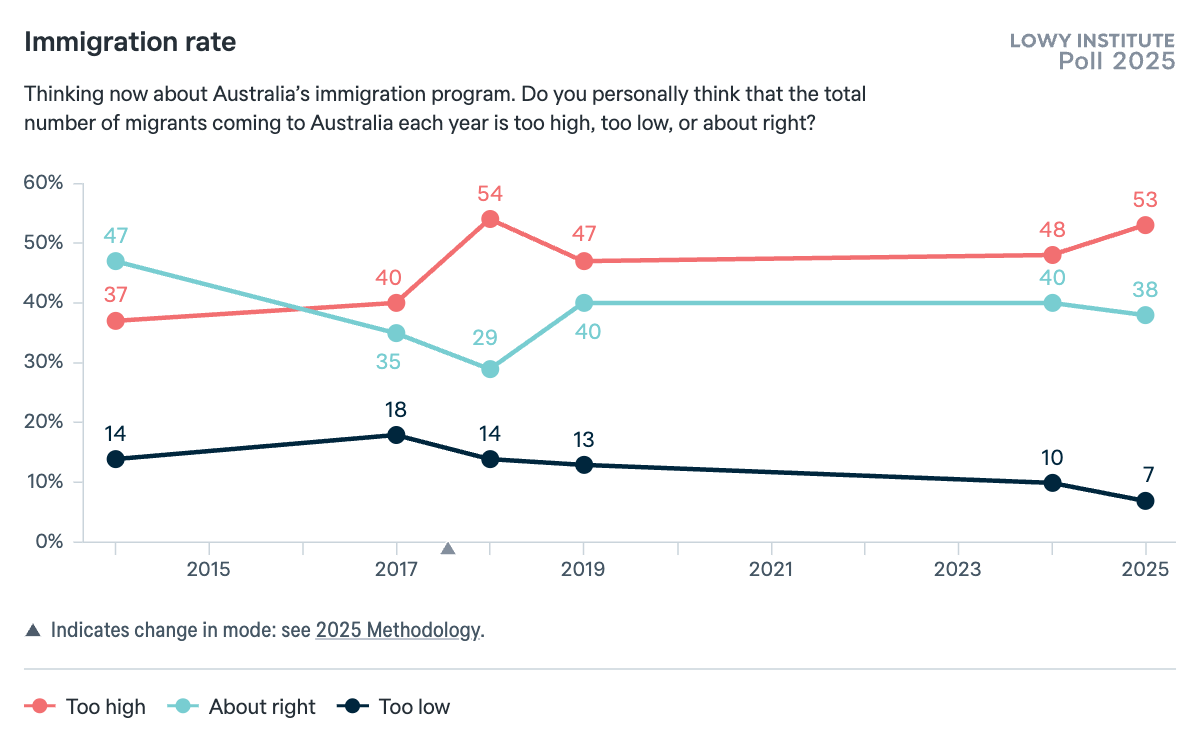
And in almost all polls in all years since that's been conducted, from the mid-1950s through to the present:
- the largest group are people who say it's about right;
- the second-largest group are people who say it's too high; and
- the lowest group is people who say it's too low.
There's been only a handful of times where the proportion saying it's too high is greater than the proportion saying it's about right. And there was a prolonged period where that was the case from around the mid-'80s to the late 1990s. And that … kind of kicked off with Geoffrey Blainey making his remarks about wanting the rate of immigration from Asian nations to slow down, then John Howard hinting at that in the late 1980s, and then Pauline Hanson being elected to the federal parliament in 1996.
So there was definitely, it seems to me, a reaction in the Australian community, some disquiet about the volume of immigration from Asian nations over that period, even though the question was about the level. Because the migration levels in that period were not high. Unemployment was high and the immigration intake had become possibly majority Asian or very close to a majority Asian from the kind of mid-'80s through that period. And I think there was a reaction against that.
And I think that was also partly fundamentally underpinned by a slowdown in the rise in living standards. And when [living standards] started to pick up again, when our little kind of productivity boom happened in the 1990s and we started to see real income gains year on year … I think that and a little bit of similar reaction to what people had had in the 1960s to the wave of migrants from Italy and Greece [with people] just going: “Well, actually these people are … hardworking, they're aspirational, their kids are doing well at school, they seem to be having a go.” And I think people probably became a little bit more relaxed about that over time and that fell away. But it looks to me maybe that there is some fracturing around the migrant intake at present. And whether it will abate as the level of net overseas migration continues to fall as it looks like it will do is, I think, still up in the air.
WALKER: At least until Bondi, my explanation for the [recent] increasing negative sentiment towards immigration had been three causes. Attach a roughly equal weighting to each, so a third, a third, a third, for want of better evidence.
- The first one was the stagnation in living standards contributing to the kind of zero-sum mindset. And that's … as you know from studying history, the first scapegoat in that situation is usually immigrants.
- The second cause was the perception of a loss of control, after the post-COVID surge, in net migration.
- And then the third, which I think is the most underrated, is negative mood contagion from the United States and the United Kingdom.
And we forget that we don't have an autonomous media ecosystem anymore. Everyone's on the same Twitter, everyone's on the same YouTube. All the Australian influencers are following Elon Musk and Donald Trump, and people kind of just copy and paste the same talking points. The immigration debate is very different over there because of the issues with illegal immigration that they have, which we don't really – but I think that kind of seeps into the Australian debate.
CULLY: So I'm not going to demur from any of that. I think that sounds plausible to me. I know lots of people are going to try and push me on questions like this about my book. But it is a work of history and I'm not a commentator, or I don't want to be a commentator about current issues, unless to the extent that there are lessons from history that might be useful.
It's difficult to know how a government might reconcile having a Racial Discrimination Act, a non-discriminatory visa policy, and how you might square that with some preferences around adjusting the mix. I don't know how you can do that without giving up one of those things. And that means that you are returning to something that is discriminatory by ethnicity or race or cultural background, faith or something. And we've said since 1973 we're not doing that. But if that's being entertained, then that means opening up those debates. And I can't imagine that's going to be pretty.
Has migration made Australia richer?
WALKER: Yeah. So to finish on some more big picture questions, but these ones aren't related to culture: are there particular periods in Australian history where immigration has made a large difference to living standards, either positively or negatively?
CULLY: So I think the way I think about this is that there are times when if we had not had large intakes of immigration, we would have had headwinds. We would have just hit capacity. We would have been operating at full capacity and not been able to meet demand without inducing more supply. That's one thing. I think we'd probably talk about the 1950s as an example of that.
The other thing [is that] I do not buy the argument that some people buy, that migration increases productivity. I just do not find the evidence on that at all persuasive. And I think there's two mistakes that are made by people who talk about how migration lifts living standards.
So one is that a lot of the gain that appears in the modelling is an artefact of the age composition of the migrants being heavily skewed young. And that gives you a lift in your participation rate that you otherwise would not have had, which manifests itself in a higher GDP per capita than you otherwise would not have had. But it's simply a function of the age of the migrants, not of their skill.
And then the second one is [that] I don't think the kind of people who advocate these things try to work through the general equilibrium resolution of bringing in larger numbers of skilled migrants in terms of how that plays out over time into the occupational composition of employment. So at the margin, if all of your intake was skilled and it was all clustered in one occupation – engineers or something like that – it's obviously those people coming in are not all going to be employed as engineers. So how does the intake alter, over time, the occupational composition of employment relative to what it otherwise would have been? I'm not convinced that it makes the overall composition more highly skilled. I just think there's a lot of shuffling in the queue for different jobs.
And in a sense, this has always been the case with first-generation migrants. They pay a penalty. Even international students pay a penalty for not having been born in Australia, and they accept job offers that are inferior to what they would prefer and are inferior to what an otherwise identical Australian-born person receives, and those effects tend to wash out by the time you get to the next generation.
So the thing I dislike about the discussions about migration in Australia is that even the analysts tend to be advocates. Well, they're either anti or pro. We don't really have anybody like George Borjas. I guess we had Bob Birrell for a while, who was an analyst who thought that the immigration intakes generally were too high. He was probably our equivalent to George Borjas. But most of the people who work on migration in Australia are a little too selective in the way in which they talk about evidence.
WALKER: No doubt. So do you agree with Ian MacLean that on net, migration probably hasn't mattered for Australian living standards? It's certainly mattered for Australian GDP, but it hasn't really changed living standards?
WALKER: So we don't get to run counterfactuals. But that's partly the argument I was making earlier on about Sweden and Belgium. So it's possible that our living standards might not be as high as they presently are. But materially, I'm not sure that it's going to be that great a difference. So I agree with Ian McLean.
The main constraint on Australian immigration over the past 200 years
WALKER: So, I have this framework in my head for thinking about our ability to accept immigrants. I think you could think of three constraints on immigration.
- The first is the carrying capacity of the continent. Maybe that's like a stock concept.
- The second is the economy's ability to absorb migrants, and maybe that's like a flow concept.
- And then the third is the rate of acculturation of migrants to the mainstream and vice versa.
If you think that that's a good framework, if you look back over Australian history, which of those three constraints do you think has tended to be the binding constraint?
WALKER: So that's a hard question … I think it's probably important to say that up until 1950, migration wasn't managed in the way in which we think about it now. The only real two ways the government managed migration was through the volume of assisted passage (which tended to move in line with the economic cycle) and by constraining the mix through The Immigration Restriction Act. So it's not until the 1950s that you start to see technocratic discussions about the level of immigration and what's optimal. And there at least on the economist side, it was about capital investment keeping pace with population growth. So it's a pace argument rather than a carrying capacity argument.
The first kind of period where you see a carrying capacity argument come to the fore is in the early 1970s, when it became faddish to advocate for zero population growth. An early manifestation of the Greens, and the Democrats, I think, were advocating zero population in the early 1970s. And you started to get the first environmentalists arguing on carrying capacity grounds that Australia's population couldn't go past a certain level.
And then … I use this story that I heard Ken Henry tell when I was in the Immigration Department, about a discussion he had on carrying capacity between him and Kevin Rudd after Kevin Rudd became prime minister. And it's such a good story. And I couldn't use it in my book until I found out that Ken Henry had told that story on your podcast. And so I've used it. And it's a great story, because there's this confusion between Rudd and Henry about the number. And Ken Henry says he thinks the optimal size of Australia's population, given the way it manages its resources and so on at the time, was 15 million people.
WALKER: Which is kind of a crazy thing to say, right?
CULLY: Because Australia's population at the time was, I think, was 21 million. And Rudd misheard him and thought he'd said 50 million and Rudd said, "Great, that's exactly what I thought, 50 million." So it's a … I guess Ken Henry was trying to pull him up. to make him think seriously about what kind of country Australia would look like if it had a population of 50 million versus 15 million.
But I don't think we've had a proper discussion really. There's been various attempts over time to kind of integrate a discussion around population policy and immigration policy, and they've always fallen over. They've probably always fallen over because of the vested interests in maintaining a relatively high immigration intake.
CULLY: So on that, Peter Macdonald told me that as far as he's aware the post-war migration program is the only time a country in history has had an explicit population plan. That is to say, a target of: “We want to get to 20 million and we're going to do it through this much migration and this much natural increase.” It's hard to verify that, but does that check out with you?
WALKER: So I think the idea of the 20 million population target fell away very quickly after World War II, and what drove high immigration levels was labour demand, fundamentally … I don't think there was a population plan as opposed to an annual process, under the auspices of the Immigration Planning Council, advising the Minister on what the right level of immigration ought to be in any given year.
There was a couple of times where they came up with a five-year plan. I think there was one published in the late 1950s. And there's been various attempts by different expert advisers to government on immigration to try to get them to agree to a longer-term migration planning framework, which de facto becomes a population policy if you accept that at least on the natural increase side, demography is destiny, and things change but there's a fair bit of constancy, so your migration policy becomes a de facto immigration policy.
So beyond the one per cent, one per cent, 70,000 people a year target, it might be true that that's not been done in any other country. The one per cent target was only met for a handful of years in the 1950s, because there was a pretty high outflow which wasn't being factored into the thinking properly. And that got called out by the Vernon Committee report in 1965, which said, if this is your target, you haven't met it for the last decade and we think it's too high a target anyhow. They wanted 0.9 per cent.
And yet there's been, as I said, various attempts to try to get governments to think about whether a long-term planning framework on migration is a good thing to do. But I can't think of any governments that have really kind of gone “yes, we'll do that” – partly because they don't really like having decisions that bind them. They don't really like having technocrats tell them what the decisions are.
You see the way the Treasurer bristles every month ... or every eight times a year, about the Reserve Bank setting interest rates. And they would much rather have the flexibility of adapting according to circumstance.
So would it be a good thing? On balance, it probably would be better for there to be a bit more certainty. It might help state governments do better planning around infrastructure and so on. It might help with making the public feel more confident that immigration is being managed well.
But it's not going to happen until there's some kind of reimagination of what a migration program looks like that factors in the level of temporary migration into its thinking and that considers use of capping the number of temporary migration visas in any given period and factors in a period of time under which people can remain as a temporary migrant in Australia.
What makes Australian immigration exceptional?
WALKER: Final question: could we just pull together a list of some of the things that make Australian immigration history exceptional relative to other settler countries? So we've just spoken about the fact that maybe Australia is the only country to have had a population plan. It was also, I think, the first country in the world to have a dedicated Department of Immigration. What are some other things that stand out to you as unique about Australian immigration history, again relative to other settler societies?
CULLY: So we're the only country that's done assisted passage on scale. I don't think many people know that it goes back to the 1830s. And I think the rough magnitude is about 3.5 million people came to Australia whose fare was either fully subsidised or generously subsidised, who otherwise probably wouldn't have come. Some of them would have come anyhow and had their fare paid for them, but a fair number of them didn't. So no other country did that on the scale in which Australia did over such a long period of time. That's probably in many ways more fundamental than having a dedicated immigration department.
English language training – Australia was the first country in the world to offer that. As you said, it started in kind of baby steps in the late … started on board ships, actually.
WALKER: And in the camps in Europe.
CULLY: And in – no, was it in the camps in Europe? It was definitely on board ships, and it was in the camps in Australia like Bonegilla.
I don't know whether any other countries have an equivalent to SBS TV and ethnic radio. There's, I mean, possibly they do in Canada. I'm not sure. But that's been something that Australia's done.
Australia got a kind of first jump on exploiting the opportunity for people from developing countries to obtain an educational qualification from a developed country ... So in absolute terms, I think Australia ranks third behind the United States and the United Kingdom, but we have a much smaller population. So on a per-head basis, we've been first in the world for a long, long time. I'm not sure if I'm missing anything.
WALKER: We were the first to do mandatory detention for unlawful non-citizens?
CULLY: So we haven't discussed this at all. We could go for another hour on the question of Australia's treatment of refugees. I'm not sure whether we were the first or not. But it is a fascinating history, and with lots of suffering involved on the parts of many people about mandatory detention.
And particularly I think what was notable, I tell this story about the cycle of history moving quickly, [of] a mining camp that was set up – I think it was a BHP camp, but it could have been a Rio Tinto camp, but I think it was a BHP camp in Port Hedland – being requisitioned to house 21 Cambodian asylum seekers who'd come on a boat and had been held in Villawood for a couple of years. And they were sent to Port Hedland because they would be out of the way of lawyers. That's why they were sent there.
And it's no coincidence that almost all of those camps were set up in areas where it was very difficult for lawyers to go and for the public to protest. And people were treated in really inhumane ways. They were treated as prisoners. And they hadn't committed any offence.
WALKER: I guess one other thing that makes us exceptional is the highest share of overseas-born in our population among OECD countries.
CULLY: It's not quite … there's funny wrinkles.
WALKER: Oh, is it Luxembourg that beats us?
CULLY: Luxembourg. Switzerland's about up there. Israel.
WALKER: Yeah, you could say like for a country with a population larger than 10 million or something, we've got the highest.
CULLY: Well, I mean, everyone thinks of – so the US, if we do the comparison with the US, the US has 50-odd million people in it who were born outside of there, and they – it's more than any other country in the world in terms of the volume of migrants they have. And there they make up about 15 per cent of the population, whereas in Australia it's, I think it's now nudging 32 per cent. And it will – given what's happening, you know, even with a much reduced immigration intake, it's still going to be rising because … it's going to outweigh natural increase. So it will continue to drift upwards.
Somebody's done some modelling. It might even be in Alan Manning's new book, and he says Australia is going to come out somewhere in the 40s, 40 per cent, which, you know, it hasn't been since probably about the 1870s, 1880s.
WALKER: Wow. Do you know when we'll hit that?
CULLY: No. I mean, you could do some back-of-the-envelope calculations, but I haven't bothered to try and do that. But it's high, right? It's high. And there's no slowing down in the appetite of people who wish to come to Australia.
I think one of the things that intrigues me, because it goes partly to this question about living standards and partly about who benefits from migration, is if you weight the migration intake by the incomes of the countries from which they come, that weighted average figure has not altered since the 1970s. And world incomes, average world incomes, have more than doubled in that time. So that means that our intake is increasingly coming from poorer countries.
WALKER: This feels important, but I don't know what to make of it.
CULLY: It feels important, but I don't know what to make of it too. Because by and large those people who are coming are coming through skilled channels or they're coming through as spouses of skilled migrants. So they've been vetted on their occupations and vetted on their educational qualifications and vetted on their English proficiency. And … many of them are doing as other migrants have done: they're either succeeding in their preferred jobs or they're doing well in their less preferred jobs, but they're making sure their kids are doing really well.
WALKER: What do you think we should make of it, that fact that we're increasingly taking people from poorer countries?
CULLY: I think that's probably true for other countries besides Australia. That, you know, in the aggregate, the overall picture is four per cent of people in the world are living in countries in which they were not born. So 96 per cent of people are. But in Australia, it's about, you know, 32 per cent. So it's kind of 8 times that four per cent. So it's a huge magnitude difference.
But in the OECD countries, that four per cent becomes about 15 [per cent].
It's been rising, and rising in all OECD countries. And I think people like Hein de Haas, who analyses these kind of movements, would say you have this kind of development hump where people in very poor countries don't have the resources or wherewithal to migrate and people in rich countries don't need to migrate, but it's the countries in the middle of those – so you get this inverted U shape about the propensity to migrate from given countries – and that more of the world now is in that hump and have the wherewithal to get to OECD countries.
And OECD countries have been since the 1990s, as in Australia, liberalising the opportunities for people to migrate to their countries as workers and as students. And the pressures for them to continue to do so because of population ageing are going to remain high. So it's hard to see that tension that exists in almost all OECD countries over migration dissipating because there's this economic need to find workers to do jobs that locals don't want to do and just to help them manage their … shrinking. Otherwise their participation rates would come off.
We have not seen that in Australia, which has been interesting and surprising in many ways, but we will, eventually, without continuing to have moderate to high levels of immigration.
WALKER: All right, let's leave it there. This has been great. Thanks, Mark.
CULLY: Okay, thank you.