Australia's Plan to Turn Compute Into Sovereign AI — Dr Andrew Charlton MP [Compute Series]
![Australia's Plan to Turn Compute Into Sovereign AI — Dr Andrew Charlton MP [Compute Series]](https://storage.ghost.io/c/8c/71/8c715a52-7cca-45a9-bba6-dc01735d5ec9/content/images/size/w960/2026/08/173----Greg-Kaplan---Michael-Brennan---website-hero---v1.1--17-.png)
This is the first episode in a multi-part series called 'Compute in Australia'. Series announcement here. More episodes to follow over the coming months.
[Recorded 7 August 2026.]
Dr Andrew Charlton MP is an Australian economist, entrepreneur and politician. As Cabinet Secretary and Australia's Assistant Minister for Science, Technology and the Digital Economy, he is one of the key leaders shaping the Australian government's AI strategy.
Andrew shares his internal model for how AI plays out economically and what a middle power like Australia should do about it. We discuss whether data centres will yield large economic rents, the geostrategic case for a compute industry, and how the government plans to use compute to climb the stack to "sovereign AI".
Video
Sponsors
- e61: a non-partisan economic research institute focused on Australian public policy. (As it happens, e61 was co-founded by Andrew Charlton before entering Parliament, though he's no longer involved.) To receive a copy of the new essay I co-authored with e61 on data centres and the compute economy, go to e61.in/joewalker.
- Vanta: helps businesses automate security and compliance needs. For a limited time, get one thousand dollars off Vanta at vanta.com/joe. Use the discount code "JOE".
Transcript
JOSEPH WALKER: Today I'm speaking with Andrew Charlton.
Andrew is Australia's Assistant Minister for Science, Technology and the Digital Economy. He's leading several of Australia's key AI initiatives, and he entered Parliament about four years ago as the Member for Parramatta.
Before politics, he had multiple careers. He has an economics PhD, he co-wrote a book with Joe Stiglitz. He was Kevin Rudd's “senior” economic advisor in his late 20s, when Australia successfully navigated the [global financial crisis]. He built and sold a successful consulting business. And he wrote what is still one of Australia's very best Quarterly Essays back in 2011.
Andrew, welcome to the podcast.
ANDREW CHARLTON: Thanks, Joe. That's a very kind introduction.
WALKER: So today I want to learn your internal model for how AI is going to play out, its economic consequences, and what the role of the Australian government should be in all of that.
None of us can predict the future. I'm sure there are many parts of the model that aren't going to play out in reality, and that you fully expect that. But I don't really care about any of that. Just the mere fact that you are thinking [something] would be so interesting for me to learn.
And of course we're going to focus mainly on compute, for reasons that we can get into.
How a minister uses AI, and thinks about its trajectory
WALKER: But the first question I wanted to ask you was just how you personally have been using the technology. I assume you're past the getting-it-to-write-a-poem-for-you stage, but how have you been using AI in your own life and work?
CHARLTON: I try to use it as much as I can. I try to use it because it's helpful. I try to use it to understand it, its strengths, its weaknesses. And I try to use it in a variety of different ways across a variety of different models.
I find it really valuable for simple things in life. I use it a lot with my kids' homework. If my kid is learning a language that I don't know or doing a subject that I don't understand, I find it really valuable. I use it to create fun games and educational games for the kids that they use. I use it for household chores, for recipes – a really wide range of capabilities. I try and use it in different ways.
WALKER: Have you been able to automate any tasks in your office yet?
CHARLTON: We need to be careful about the way that we use it in a professional sense, especially [because of] data security.
So yeah, I automate tasks, but I do that mainly on the personal side of my life, where I feel like there are less sensitivities.
WALKER: And on the personal side, are you running agents and sub-agents?
CHARLTON: A little bit, yeah. I have an agent that gives me a news digest in the morning of what's been happening in AI overnight. I connect it to my personal email and it can do some drafting tasks for me.
WALKER: I was chatting with Greg Kaplan last week and he was talking about how economics seminars are now just completely changed, because people are actually using the models to try and replicate the paper in real time, like during the seminar, and just tearing it to shreds even more than they normally would.
CHARLTON: Well, Greg Kaplan is one of my favourite people in the world.
WALKER: Me too.
CHARLTON: He is [an] unbelievably smart, nice and humble man. Certainly one of Australia's best economists.
And I'll tell you a funny story. I was going for a walk with Greg last week. And I was meeting him in a park, but as I approached him from behind, I noticed that he appeared to be on the phone. And so I just waited, and he was chatting away on the phone, and I was sort of waiting for his call to finish. And I was waiting for a little while, and then eventually I just decided I better go into his field of view so he could at least see that I was there. And then as soon as I did, he just pushed hang up and said, “Hi, Andrew.” And I said, “Oh, really sorry, I didn't mean to disturb your call.” And he goes, “I wasn't on the phone. I was just chatting to Claude, brainstorming some economics ideas.” So there you go. He uses it in his life a lot.
WALKER: [laughs] That's awesome. Is recursive self-improvement something you're tracking? So have you been listening to what the labs have been saying? For example, 80% of Anthropic's merged code is now written by Claude itself. Have you been tracking things like that?
CHARLTON: Yeah, we have good contacts inside the frontier [labs] and we learn from them about how they themselves are using the models. And they are very extensive users of their own technology. There are coders inside those organisations who are telling me how fast their own jobs are changing as they use those tools.
I was talking to somebody at one of the major labs recently who said that in their own lives, just in the last few years, the amount of coding that they do has been dropping dramatically, because the machine can do more and more of their own jobs. That doesn't mean their job isn't important, but their job becomes one less of writing the code and more of the question of taste: what is the research taste that they have that enables them to direct the research, to direct the model to do the work that they would otherwise be doing? So I guess like in many aspects of AI, it takes them up in the cognitive tasks rather than down.
WALKER: And obviously automating coding isn't tantamount to automating AI research more broadly, because more code has declining returns and there are lots of other parts of the job, like deciding which experiments to run and how to interpret their results.
But how likely is it, do you think, that at least one of the major labs hits some kind of recursive self-improvement threshold in the next five to ten years?
CHARLTON: Well, there have been lots of predictions around this. I think there's a lot of uncertainty. And I think one thing we should say at the outset of this conversation is: I think it's important for everybody, but particularly for me as a policymaker, to bring a lot of humility to some of these questions, because things are changing so quickly, and things that I thought were going to be true six months ago or 12 months ago are turning out not to be true. And things that I thought were going to move at a certain pace are accelerating much faster than that.
That doesn't mean you can't have an opinion on those things. It means you have to stay really close to them. But it does affect, I think, the way that you create policy around them, recognising that you are creating policy in an environment of great uncertainty.
The specific question you ask is one of those areas of uncertainty. People have different definitions of what AGI is or what recursive self-improvement is, and different horizons for when that might be achieved. I don't know the answer to that, but I think it's already very clear that these models are becoming incredibly powerful and the rate of their power is accelerating. And that means we're dealing with an incredibly capable and in some ways incredibly dangerous technology.
WALKER: I'm curious to understand what your role looks like at the moment. So as far as I know, you're kind of going out and working on deals with the major labs. But could you just paint me a brief picture of exactly what it is you're doing at the moment, just in terms of the character of the tasks?
CHARLTON: Sure. I mean, it's very wide, and the government's approach to AI is extremely broad. There is no part of government that AI is not changing, that AI doesn't have implications for – whether it be child safety or compute or privacy or automated decision-making across government, democracy. AI is impacting almost every area of government, just in the same way as it's impacting almost every area of our lives.
And so the government's approach to that is to really deliver our AI as a team effort. So every minister across the government is working on AI in their own area. And what's happened recently is the Prime Minister has brought that together and recognised that, because this is such an important issue, such a cross-cutting issue across departments, across levels of government, he's created the Office of AI in his own department, to be a coordinating function.
My role within that is to assist other ministers, to provide some coordination, to the extent that AI requires that, on the industrial side, and to work with different ministers around our broader government agenda.
WALKER: Having dealt by now, I assume, pretty closely and frequently with the labs and senior staff at the labs, what's something that you understand about the labs or their staff that you think most other people in Parliament wouldn't?
CHARLTON: I mean, they're interesting places. They are full of a heady sense of excitement. The people working in these models have a great understanding of the potential impact of what they're building, both for good and for bad. And some of the people who are closest to the models recognise both the opportunities and the risks.
Maybe one thing that people don't understand – this is relevant to our audience here – is just how many Australians there are building these frontier models. I was in San Francisco recently and we had a dinner of Australians working at the frontier models, and there are a lot of them in very senior roles doing some of the most important work. Very thoughtful people, quite young people in many cases, who are right at the frontier of this technology, which is exciting for us as a nation, to be making that big contribution. It's literally a thing inside this small ecosystem in Silicon Valley that there's this bunch of Australians doing some of the most important work.
WALKER: We’ve got to try and bring some of them back eventually.
CHARLTON: We've got a plan for that.
WALKER: We might talk about that.
Is diffusion a sufficient strategy for middle powers?
WALKER: So if you take, for example, the Second Industrial Revolution in the late 19th, early 20th century, one view of new general-purpose technologies – like, in that example, electricity or steel manufacturing processes – is that the way they affect the global distribution of wealth and power isn't so much … or the countries who come out on top aren't so much the countries who innovated first, but rather the countries who diffused those general-purpose technologies as deeply and widely as they could.
As just a general starting point or strategy for a middle power like Australia, is that approach of just going all-in on diffusion complete? Is it correct? Would you edit that, or tell me how you think about that?
CHARLTON: Well, let me make a broader point first, which is I think there is a lot to learn from previous general-purpose technologies and their implementation in centuries gone past. The biggest lessons I take out of those were, number one, ultimately those technologies produced an enormous amount of good. They created a lot of prosperity and opportunity and paved the way for the advances of human flourishing that we've been lucky enough to enjoy in our lifetimes. I think that's the first thing that I take away from the introduction of those big technologies.
But the second thing that I take away is that often the pathway towards those benefits was nonlinear. There were periods after the First Industrial Revolution where wages went backwards very materially, where the lifespan of people living in the UK was falling, not rising, after the introduction of those technologies. And it took a lot of time, a lot of effort on the part of governments and workers and others to turn that technological progress into social progress. I think that was true in the First Industrial Revolution. It was true to different extents in later introductions of these types of general-purpose technologies. And that for me is the biggest lesson.
How that benefit accrues to different economies around the world, to answer your question: there are certainly lots of countries around the world which benefited from the technologies that were invented in the First Industrial Revolution and invented in the Second Industrial Revolution. And those technologies were diffused around the world and created enormous benefits in the UK, in Australia, in Japan, in many other places. And you are right that one of the main ways that benefits accrued was not just through the invention, but through the adoption of those technologies. And that will be a part of the benefits of artificial intelligence as well. Countries that are able to adopt, able to integrate artificial intelligence – they will receive those benefits.
I was with a small business person last night who was telling me that they were saving hours every day by using artificial intelligence in their job. That is a big productivity boost for them that enables them to do more, be more competitive, be more successful in their business. I was at the optometrist last week, and the optometrist said to me, “Can I push a button and record our conversation, so that I can save myself a lot of paperwork at the end of this and see more patients, give you a better record of our meeting?” So I think there are huge benefits there, and adoption is part of the story, but I don't think it's the whole story.
WALKER: And what's the rest of the story?
CHARLTON: Well, the way that I've described this in the past is: as we move into the world of artificial intelligence, there are benefits from the process you described, the diffusion process. That's Australia as an AI taker, as a successful adopter. And Australia has always been a successful adopter of technologies. We were the first to take on new payment technologies – [we had] very high adoption rates of new technologies, very high smartphone penetration very early. That is valuable to us.
But there's also value in Australia not just being an AI taker, but an AI maker. There is value in us not just buying and renting this technology from abroad and using it in our personal lives and in our businesses, but in owning this technology, building it, operating it in Australia as well. And maybe there are some differences in the way that this technology rolls out and previous technologies that you identified that make it more important that we be a maker, not just a taker.
WALKER: Tell me how you think about that difference.
CHARLTON: Well, I think about some of the technologies that you are alluding to in the early part of the 20th century – automobiles, electricity. These are not inventions in Australia, but these are inventions that were able to be brought to Australia. New businesses in Australia emerged, took those technology spillovers, created their own intellectual property around them, created their own businesses around them, their own industrial capacity around them, employed a lot of people around them – factories, utilities, all operating in Australia.
Digital technologies have some similar characteristics to that, but they have some differences as well. Some of the waves of digital technology we've seen in our lifetime have been able to concentrate their intellectual property and keep it in other countries and earn a lot of revenue in Australia – foreign-owned companies operating in Australia, in many ways able to extract a lot of value without employing a lot of people. Difficult for there to be big spillover benefits to other firms. Australia doesn't have a big domestic social media company. We did have our own utilities. We did have our own manufacturing facilities. We don't have our own internet search at scale.
So there are features of the industrial organisation and the market structure of digital technologies that mean that the diffusion around the world enables more of the value to be captured in the place where that technology was invented, and less of that value to be captured in the place where that technology is adopted, relative to the technologies of the 20th century. And that changes the way we think about the introduction of AI in Australia, and makes this question of how much we want to be a taker and how much we want to be a maker of AI a more relevant question for industrial policy.
WALKER: To play devil's advocate briefly, there's kind of a worry that we're always fighting the last war here. And one potential difference between the last generation of digital behemoths and today's AI labs is that the network effects are less clear for today's AI labs. There's not much stopping, you know, me as a business just switching from Anthropic's API, or me as a user transferring my data from Claude over to ChatGPT. The labs are obviously well aware of this, and will probably try to do some things around memory to lock customers in. But tell me how you think about the difference in the network effects between those two generations, and the extent to which that undermines this concern about the rents flowing back offshore.
CHARLTON: Yeah, this is a question I think about a lot, and I think it's really important. You are right that some of the digital technologies of recent decades have had these sort of naturally monopolistic, oligopolistic characteristics. They have real network externalities that tend towards a very concentrated market structure. A lot of them are quote-unquote “free” to the user – [there's a] limited price signal, which makes switching less important. And they have big economies of scale. And so that's why the Facebooks and the Instagrams and the Googles are so dominant. Microsoft, so dominant.
And I think a lot about your question, which is: will AI be like that, where there are a small number of companies that really dominate this digital service, or will it be much more diffuse? There are, as you say, reasons to think that it's possible that there'll be a wider number of players. One is that there is a price to the consumer. At the moment, people using Claude and ChatGPT can be on different tiers. Some of them can be on a free tier. Some of them can be on a paid tier. They might be paying $20, $30 on a mid-tier. There's a lot of subsidy in that. So at some point, these companies are going to have to stop subsidising their users, and you're going to bear the full cost of the machine that you're using. It's not like search, where the marginal cost of use is very low. There's a real marginal cost.
WALKER: I paid some of that marginal cost over the weekend when my Fable credits ran out.
CHARLTON: Sure. And that creates the opportunity for competition, for companies to come in with a cheaper service that might better meet your demands as a user. I don't know how you use these tools, Joe, but you might not be solving the most complex unsolved mathematical theorems that require the highest-level compute. So there might be more targeted services – that price signal can bring competition into the market. We've also seen the emergence of a lot of open AI models, a lot of newer models that don't appear to be that far behind the frontier. That gives you the sense that there might be more competition in this market.
But I think there are other characteristics which suggest that these models are going to be very powerful. The collection of the most advanced frontier models are going to be very powerful. And there might be different kinds of externalities or other reasons that they remain pretty valuable organisations, similar to the digital behemoths of previous decades.
Comparative advantage versus sovereignty
WALKER: So if we ask how can Australia capture some of the value of the AI economy, it seems like a good place to start will be: where do we have comparative advantages? Because presumably the rents for us will flow there. So I want to talk about data centres and compute, and I want to start by talking about the economic case for a big domestic compute industry in Australia, and then talk about the geostrategic case.
I'm willing to believe, vis-à-vis the US, that we have absolute advantages in renewable energy production, especially for solar. But do we actually have comparative advantages? Or how would you, as an economist, work that out?
CHARLTON: I mean, let me make a point about comparative advantage in this industry. Most of our lives, when we think about industry policy, we think about it through the prism of comparative advantage. That's the economics that I learnt at university and practised in my academic career and in my professional career as well. And that is the task of looking at where you have relative capability in your country and focusing your country's resources, your factors of production, on those things to get the best outcome in welfare terms for your people.
But we lived in a time where the trade-off between comparative advantage and sovereignty was low. In fact, we lived in a time in the early 21st century when those things were almost pointing in the same direction. We could all focus on our comparative advantages. In Australia, that meant letting go of lots of different industrial capabilities that we had from earlier eras where we felt that we didn't have comparative advantage. We let go of a lot of our manufacturing industry, for example, and we focused on the things where we thought we had comparative advantage – services, mining.
And at that time, that involved the globalisation of all those industries. We were just buying all those things that we were previously producing in Australia from abroad. And we were doing that at a time where globalisation was giving us comfort on the prosperity side and on the security side. And so that seemed like a safe choice. We were integrating with the global economy, and we were integrating with our geopolitical partners around the world.
That dynamic has changed, and has changed in a way that fundamentally complicates industry policy. There is now a more significant trade-off between sovereignty and comparative advantage. And that trade-off is particularly acute, I think, in artificial intelligence.
WALKER: Okay, got you. It is interesting – I'm kind of adapting a point of Tyler Cowen's here – but I was born in the 1990s. I feel like for the entirety of my life, the world has been defined by two basic facts. One is a rules-based international order underpinned by a benign global hegemon. And the second has been the absence of a truly major technological revolution. (I don't think you would count the internet as a truly major technological revolution, at least in terms of its effects on total factor productivity growth – it's somewhat dwarfed by the Industrial Revolution and the Second Industrial Revolution.)
But I feel like 2026 is the first year in which neither of those things is true anymore. And I think they're also interacting in really interesting ways, which again we'll come to when we talk about the sovereignty and strategic case for compute.
Where in Australia’s national accounts will compute show up?
WALKER: But just to linger on the economic argument: where in Australia's national accounts would compute show up? So say an American hyperscaler builds and owns a data centre on Australian soil. They rent that compute to an American AI lab, and then an Australian business buys some tokens from that lab when it's using that lab's model to do something and produces some kind of good or service. Where does that compute show up in GDP?
CHARLTON: Well, we just had our recent national accounts that came out.
WALKER: And sorry – beyond the kind of obvious investment and CapEx?
CHARLTON: Well, I mean, it's important to dwell on that, because that’s a big part of the story.
WALKER: Well, dwell on that a little bit.
CHARLTON: I mean, I don't think we can dismiss the CapEx, because this is one of the biggest investment booms not just in our lifetimes, but in modern history.
WALKER: Globally this year, about a trillion US being spent on data centre CapEx. And I think by the American hyperscalers, it's like $670 billion US, or 2% of US GDP.
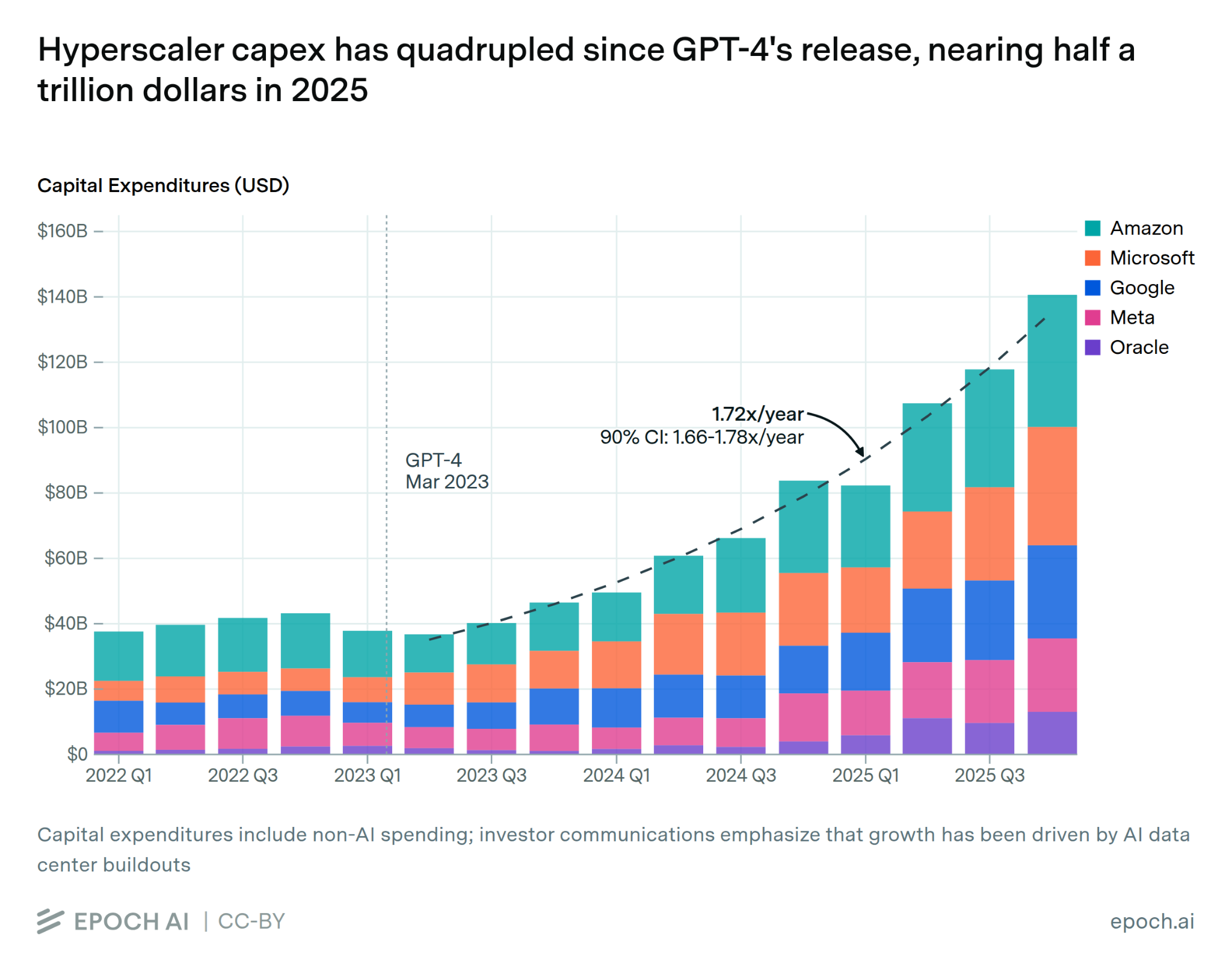
CHARLTON: Yeah, it is hard to overstate how big this investment boom is. I mean, if you think about the investment booms that people would have in their heads: this investment boom is getting up to 2.5% of GDP. We had a big investment boom in the '90s around the rollout of fibre optics – this is three times as big as that. We had a big investment boom around the world in the '50s and '60s around the rollout of the national highway network – this is probably twice as big as that. We had a big investment boom around electrification in the 1920s and 1930s – this is probably a little bit bigger than that. You have to go back to the rollout of the railways in the 1880s and 1890s to find a global investment boom that is bigger than the AI investment boom.
And that tells you something very profound. To have a CapEx investment of that scale occurring right now – that means that there is a really big change in our economy coming, and investors are willing to pour close to unprecedented resources into that change.
So, to answer your question, we are seeing that in our national accounts. Other countries in the world are seeing that in their national accounts. In the United States, they released their GDP [figures] – more than 100% of their GDP growth was AI-related. In Australia, we had a huge boom in private sector CapEx. A big part of that boom was data centre investment. But to answer your question, the private sector CapEx part of our national accounts went up in our most recent results. But a lot of that CapEx is imported. This is data centre operators importing chips.
And so we also had a big increase in our imports, and the imports substantially offset CapEx investment in our national accounts. [That] doesn't mean there isn't a positive benefit to us, but you are seeing the big data centre investment that's starting to come into Australia already on both sides of the national accounts.
WALKER: Yeah, that makes sense. GPUs are probably the main cost factor in a data centre, right?
Okay, so after we've constructed the data centre and Australian businesses are using it via American AI labs to do stuff, where does that show up in the national accounts, that compute?
CHARLTON: Well, I mean, let's use your example. So you were buying Fable credits this week, you said.
WALKER: Degenerate behaviour. [laughs]
CHARLTON: So that appears in the national accounts as an import. That is a services import. Already that import might be around $5 or $8 billion across the economy, adding together individuals, small businesses, large enterprises, and government. So that is a pretty material size of import. You can think of that as being even bigger than our wheat exports. So already this is a big number, a big new import into Australia of people buying access to compute. And that number is growing extremely rapidly – by some measures, by 20 or 25% a quarter. So this is a really large new category of imports for Australia.
Australia as a global inference compute hub
WALKER: Do you expect latency to continue to matter for inference compute?
CHARLTON: This is one of those things that's moving really quickly. I think there was a view not very long ago that latency was very important, and that had a really big impact on the type of compute that would be located in Australia and where it would be located in Australia. The challenge Australia has is [that] we have a lot of space, a lot of energy potential, but we are a long way from the rest of the world, and that energy potential is a long way from Australia's cities in some cases. And the conclusion of that was that there'll be parts of Australia that would have great potential for inference compute infrastructure but not meet the latency requirements.
I think that is starting to change. I think the global view of that is starting to change. And there are now significant workloads for global inferencing that are being allocated to Australia, partly because the technology is improving and partly because there is a growing amount of non-latency-sensitive inference workloads. And that creates a really big opportunity for Australia. I mean, we are very well connected.
I think the thing that we need to understand when we think about Australia's position in global compute is that every company in the world is now basically trying to do the same thing. That is, they are trying to put down compute to meet the fastest growing demand in the world. And one of the areas of the fastest growing compute demand in the world is India. Now, how do you connect India to the United States? Well, you need to have some very long cables that go across oceans, but those cables can't go through the South China Sea. So Australia becomes a pretty important location connecting Singapore, India, the United States. And that's why we've had big investment in subsea cables into Australia. And it creates an opportunity for Australia to be a hub for some quite large global workloads.
And I think we're starting to see the opportunity there in inferencing and in training. And Australia [has] actually been quite a competitive location for that. Now, we've got a long way to go in capturing that opportunity, and even further [to] go in making sure we capture that opportunity in a way that benefits Australians, benefits local communities, benefits our country. But if you think about the global geography of compute, that's our opportunity.
WALKER: One big example of latency becoming less important for inference compute has been inference-scaling: asking the model the same question but using more inference compute, so letting it think for longer to try and eke out better performance.
And of course, agents have played into this as well. So it doesn't matter if your answer is coming back a few milliseconds later if the model's going off and doing work for you for 20 minutes or something like that.
Do you expect those trends to continue?
CHARLTON: I do. Agents can be pretty patient. They're not staring at their watch. Sometimes they've got to do things quickly, but sometimes they can be pretty patient. And I think as workloads become more complex, actually consumer demand to get the answer immediately changes. We recognise that actually it's going to take a bit of time, and if it's going to take two minutes, it may as well take four minutes. So I think there is a big change in the spectrum of sensitivity of inference into latency, and that's going to create opportunities for some of those workloads that'll be placed in places where the opportunity to do things that require less latency is greater.
WALKER: And so, given the centripetal forces are a bit overrated with respect to inference compute – so you don't need to co-locate the data centres in the country where the end users are as much – it seems important here that a lot of the compute being used in data centres on Australian soil will be being used by people in other countries, like for example India. Do you have a sense for the balance of Australian versus overseas usage, if we had gigawatt-scale AI data centres here?
CHARLTON: I mean, well, let's start with what we know, and that is what's happening now. And what's happening right now is that Australia has quite a large and very rapidly growing data centre footprint. However, only a small proportion of that are the most advanced GPUs. Compared to other countries, we have a relatively small set of clusters of advanced GPUs – there isn't good data on this, but let's say in the low thousands.
WALKER: And we don't have any gigawatt-scale clusters.
CHARLTON: We don't have any gigawatt-scale clusters.
When you compare what we have today to other countries – in a big advanced data centre in the United States, you'd be talking about tens of thousands, if not multi-tens of thousands, of GPUs. So just to anchor the conversation in where we are right now: a lot of the demand for compute from Australia is being serviced abroad. That's before we get into “will Australia be servicing foreign demand?”. The truth right now is that our domestic demand for compute is in large part being serviced abroad.
WALKER: From data centres in Southeast Asia or wherever.
CHARLTON: [The] United States. Because that's where the most advanced GPUs are. And we still have relatively small – both in absolute and relative terms – relatively small clusters of GPUs in Australia.
How big will compute rents be?
WALKER: Do you view the supply of compute as being quite elastic over the long run?
CHARLTON: That is a very hard question to answer, Joe. I mean, right now we have a very concentrated supply chain. We have a relatively small number of companies that are able to produce the most advanced GPUs, and that is creating significant constraints in terms of access to the most advanced chips. But there is technological innovation all the time. People are inventing, coming up with new types of chips. Whether that leads to an explosion in the future of different types of compute and there's a big expansion, I don't know. That will depend on our ability to innovate, develop new suppliers, provide the critical inputs. At the moment, all of those things are pretty constrained. We'll have to see how it unfolds.
WALKER: And putting aside how they're distributed, how big do you think the rents from a compute industry in Australia could be? Is it going to be something on the order of the mining boom, or a bit less than that?
CHARLTON: Well, this is a really important question, and I think it's probably worth breaking down the value chain of a data centre. For every dollar of tokens that you buy, just thinking through where that dollar goes in the supply chain.
Now, I think a lot of people think that energy is a really big cost, and it is in absolute terms, but in relative terms it's far from the biggest cost in the dollar that you spend. So if you spend a dollar on buying tokens, you are probably only spending about 5 to 10 cents of that on energy. And these numbers are challenging, because different types of workloads and different types of data centres are different – so this is very much an average of an average – but you might be spending 10-odd cents on energy, maybe less.
You might be spending less than 10 cents on the infrastructure.
You might be spending 20 to 30 cents on the chips.
A big share is what you might call the rents, or the cost of the model – going into developing the next model, paying for the researchers.
So when you think about where the value sits in that dollar that you spend – and this is really important for Australia as we think about where we want to play in this space – a relatively small proportion of that dollar is in the infrastructure and energy, and the biggest share of that dollar is in the intellectual property and the management. And we need to think about where we want to play as a country.
Because our experience – to take your question to a different era – our experience in the industries that Australia has been good at in the past… Think about the mining sector, for example. Now, the most common thing that anybody says about the Australian economy is, “Oh, you export raw materials, you export coal and iron ore, and then you import the finished goods. Australia doesn't add any value.” That is just the most common cliché about the Australian economy. And it's a cliché because it's true.
However, we've done pretty well in that game of exporting raw materials and importing finished goods. Even though a lot of that value-added – taking that iron ore and turning it into cars and microwaves and washing machines – is done abroad, we've done pretty well. And the reason we've done well is we've been able to capture economic rents, because the cost of producing iron ore in Australia is very globally competitive. And so we are able to capture very significant rents in the export of those raw materials. And that has been a big part of our national prosperity. So even though we don't do all the value-added – which it would be good if we did that, but we don't do a lot of it – we've still been able to make that work for our people, deliver us prosperity.
The question that you're getting at here is a really important question, which is: where will we sit in the AI value chain, and will we be able to extract rents from that position in the value chain in a way that keeps us a prosperous nation in the future? That's an important question. Will the things that we appear to be good at today in that value chain – energy, infrastructure – will we be able to do those things? Yes. Will we be able to extract rents from them, or will they be commodities in the global supply chain? Unanswered question. Important unanswered question.
WALKER: Do you have a hunch?
CHARLTON: Well, it will depend on whether we are able to do those things in Australia at a price that is below the global marginal cost. And if we can, then we will extract that difference as rents. And if we can't, we will be a provider of a global commodity that doesn't have rents.
Time to power
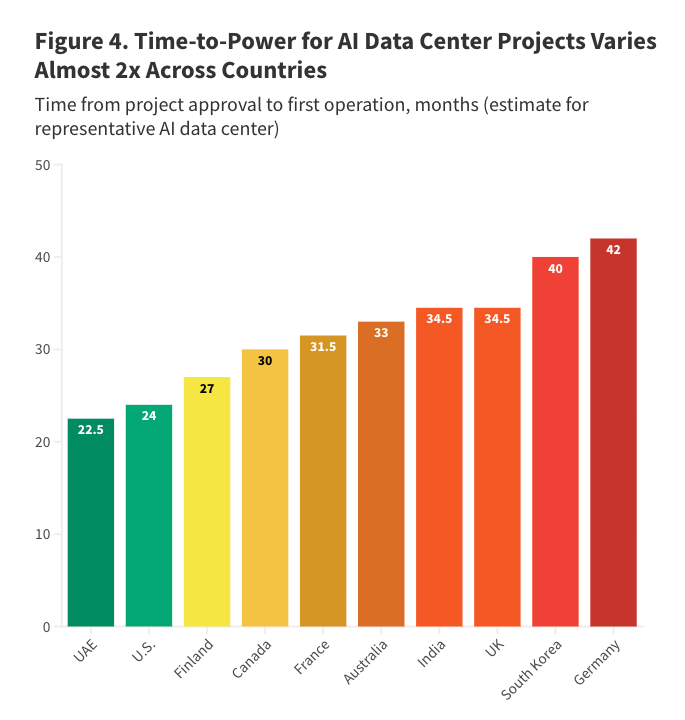
WALKER: Did you see this report by the Carnegie Endowment, where the core point was that the thing that matters most to hyperscalers is time to power? I think the logic is something like: because the GPUs are the main cost component and they're so expensive, and GPUs are priced similarly globally, really all that matters is just getting them utilised and earning revenue as soon as possible. I think a 100-megawatt data centre makes about $200 million US in its first month. I don't think it maintains that over the full life cycle, and then the chips need to be replaced eventually.
But the cost of pushing those revenues into the future – at any reasonable discount rate – is very high. The capital just sits idle, can't be repurposed. The chips only come in at the very end of the construction. And then also, the sooner you can get your data centre up and running, the sooner you can be serving inference to customers, the more revenue the labs can be making, the better models they'll make, the more models they'll have to make more better models. And there's a kind of positive flywheel there.
So time-to-power just dominates everything else.
And in the analysis in this report, [of] the countries they looked at where compute is plausibly a big economic opportunity, the country that came out on top was the UAE. Its time to power is about 22.5 months. Just behind was the US at about 24 months. And then Australia’s at 33 months.
If we wanted to be really competitive there and drive our time to power down from 33 months to 24 months or less, what do you think are the biggest levers there?
CHARLTON: Look, time to power is important. It's important for any capital investment, whether you are building a shop or an apartment building or a factory. If you are building it but not able to turn the lights on and get it operational, then you are losing money. That's true in data centres. It's true in every other piece of CapEx that an investor might sink money into.
I think there's another thing here that's important as well, and that is not just the time, but the predictability. If we have processes in Australia that take a bit more time or a bit less time, investors can plan around that. They don't need to have the chips sitting idle. They can schedule the arrival of those chips in line with the development of the data centre. I think the hardest thing for the operators here is unpredictability: when they're starting a project and then have to stop because they're waiting for an application to go through and they're just not getting it. Or there's a hurdle that they can't get past, and suddenly they need to have the chips sitting there without them being turned on.
So when you think about how does Australia become competitive in this space, which is sort of the root of your question: I think it's definitely making sure that we don't create unnecessary delays. But another part is making sure that there is predictability in that process. I don't think we should be bending over backwards to avoid all the important things that we have as regulations and requirements in this country for putting down compute – things like dealing appropriately with local communities. Some of these are on Indigenous land; some of these require cables that traverse private land. We are a democratic country, and processes need to go into managing all of those stakeholders. And it's appropriate that that happens. I don't think we should be cutting corners in that space, but I do think we can improve the process and predictability of delivering those outcomes.
And I think for investors, if it's predictable, that is a positive thing. And I think that actually builds social licence. So, I'm not in favour of cutting corners in ways that speeds this process up. I'm in favour of speeding it up in a way that improves the efficiency of the process. And I'm in favour of improving the predictability of the process. And I think the combination of those two things will be very valuable for investors and cause them to invest more in Australia.
WALKER: Is it conceivable we could get our time to power down to 24 months or less?
CHARLTON: Look, possibly, but there's going to be a wide range of different circumstances for that. It depends on the location. It depends on the availability of the energy source, whether you are building it from new. It depends on the length of the supply chain. There are very significant waits for some of the components in that energy supply chain. It depends on the connectivity. Data centres don't just need energy, they also need cabling. Some of that cabling requires going over a lot of private land. So there's a wide range of different outcomes.
I think for us, making that as efficient as possible and as predictable as possible is the role of government. But I've got to be honest with you, I wouldn't want to see us do that in a way that loses social licence, because we are running roughshod over local communities or transgressing the values that we have in Australia.
WALKER: No, definitely. Time to power will be endogenous to the social licence.
CHARLTON: Correct.
WALKER: So the Institute for Progress, a think tank in Washington, had this idea – I think a couple of years ago now, maybe last year – of special compute zones, gesturing of course at special economic zones. The idea was for America, but other countries can borrow it. The idea would be geographic zones, I guess, set up by the federal government, where data centres can be built and approvals are fast-tracked and it's easy to connect them to the grid, et cetera. Have you heard of this idea, and what do you make of it? How could it apply to Australia?
CHARLTON: Yes. To be honest, I think it's going to happen endogenously. And that is because data centres need those two things: they need power and they need connectivity. And those data centres will agglomerate – particularly [when] we're talking about the big data centres. They will agglomerate in locations where both of those things are present. And I think we are already starting to see the beginning of that. It makes a lot of sense for them to agglomerate where they can share that connectivity infrastructure, share that grid infrastructure.
And from the government's perspective, we are also keen to make sure that these data centres are located in places that deliver benefits rather than harms for local communities. And if that is in areas where they are not close to housing, where they are not impacting agricultural land, that's a good thing as well. So I think we will naturally see agglomeration of data centres around those critical inputs. And the government is certainly encouraging of that. But I think the driver of that agglomeration will come from the data centres themselves.
Taxing compute?
WALKER: Have you thought much about how we would tax compute? So the AI tax rules are very unwritten at this stage. But compute is obviously incredibly scarce at the moment. And if it really is true that there's only a handful of countries that are primed for building out gigawatt-scale clusters quickly, and Australia is one of those countries, could we perhaps even tax compute directly – like 1 cent per token, or whatever it is? Have you given much thought to exactly what that could look like?
CHARLTON: Yeah, it's a bit hard to tax tokens. I've seen proposals like this, but tokens mean different things to different companies. So it's pretty challenging to tax tokens. Not impossible, but pretty challenging.
The Prime Minister gave a speech about compute and the benefits to Australians just two weeks ago. And he put your question in the broader context, which is: how do we make sure that the big compute build-out delivers benefits to Australians and doesn't deliver harms to local communities? That is a broader question than the direct tax question. But it's the most important question. And he outlined a few elements of an approach in Australia that would be a world first, that would make sure that we capture those benefits and avoid those community harms.
One was around energy: making sure that these data centres make a positive contribution to the grid, rather than what we've seen around the world, which is a negative contribution, where they push up power prices for local communities. Another one was water: making sure that these data centres make positive contributions rather than taking away potable water from local communities. Another one was around intellectual property: making sure that Australian copyrighted material is paid for, not taken for free. Another one was around location and housing.
So the Prime Minister has done what no other country in the world has done, which is step in early and create a framework, a national framework, for these big AI data centres that sets the terms for them, in a way that ensures that Australia will benefit and ensures that local communities will avoid some of the harms that we've seen around the world, where these data centres have been rolled out in ways that have been unplanned and unmanaged.
Data centres and the social licence
CHARLTON: And those harms are not theoretical. Those harms are very real. We have seen in the United States, where in some cases the data centres have been not well managed, we've seen them push up power prices for local communities. The largest electricity grid in the United States is the PJM grid, and in that grid, power prices for consumers have gone up by more than 60%, and a large part of that price increase is due to the additional loads of data centres on that grid.
We do not want to see that happen in Australia, and if it did happen, data centres would lose their social licence. So we are determined, across all of these elements, to make sure that Australia is benefited by this massive new global CapEx boom, and that we step in early, set the terms of that investment, and avoid harms to local communities.
WALKER: Do you have any people working on how to address data centre nimbyism directly? And are there any particularly unusually creative ideas you've heard for that? So, for example, there's this school of thought, mainly coming out of the British YIMBYs, that beauty and architecture actually are a big bottleneck for new housing supply. And there's some survey evidence that shows that people do actually care about the appearance of their buildings. And if we could somehow – I don't know – lower the marginal costs of producing ornamentation, or release the stranglehold of architects who are just kind of pandering to other architects on how our public spaces are designed, and maybe have more popular tastes, we could get more housing at the margin.
And there's kind of a debate about how important that is, but it's interesting to apply that to data centres. I mean, they're notoriously not beautiful buildings. And I think Matt Clifford in the UK spoke about when he was leading the AI team in Number 10 Downing Street, one of his more whimsical ideas was to run an architectural prize for data centre designs.
It seems to me like one of the big risks here is data centre nimbyism, or just letting that genie out of the bottle. We saw the 12-month moratorium on new data centres in New York State. Compute is going to be really important, so maintaining that social licence is really important. A lot of effort needs to go into how we do that. Beyond the Expectations, what are some other ideas you have there, or some creative things you've come across in your travels?
CHARLTON: Yeah, I'm just imagining the architectural prize for the most beautiful data centre. Cue applause.
Look, I agree with the premise of your question. I think compute is a really important industrial capability for Australia. I think it's essential that if we want that capability, that we maintain the social licence for it.
I wouldn’t, and I'm not suggesting that you did, but I wouldn't dismiss community concerns as nimbyism. I think many of those concerns are very real. I've spoken to people who live very close to new data centres, and they are worried about the impacts of that data centre on their home, on the nearby schools, childcare centres.
WALKER: Yeah, when I say nimbyism, I'm thinking of, for example – there's a lot of just pure misinformation around water usage. So you might've heard of these memes, like “every ChatGPT query uses a bottle of water”, or stuff like that.
CHARLTON: Yeah, there's a lot of misinformation. I accept that.
WALKER: But there are definitely legitimate concerns.
CHARLTON: Yeah, but there is a lot of misinformation in Australia about the current impacts of data centres. But there are real examples around the world of terrible consequences for local communities – local communities who've had their power prices pushed up. There are genuinely families in the United States who have had a data centre cluster move in close to their home. They turn on their tap and the water is coming out with less pressure, and dirty. So these are not perception problems. If this isn't managed well, these are real problems.
So what is our approach to that? Well, as I said, it's definitely not to dismiss those concerns. It is to introduce a framework that can give Australians confidence that the Australian government is going to make sure that those things do not happen here.
So let me give you an example. In energy, we have said to the Australian people: number one, right now data centres are not pushing up your power prices. They are 2% of the grid. They are going to grow quickly in terms of their energy use, but we are going to look you in the eye and tell you that we are going to put in place a regime that ensures that that growth does not increase your power prices. What does that regime look like? One, it means requiring that data centres bring additional power, at least as big as, if not greater than, what they're going to use. So that means that the data centres are not competing with Australian households for electrons – they're bringing their own electrons. Two, that the data centres pay for any additional costs of network connection. And three, that they help us with grid stability. If you put those three things together, we can say to Australians: data centres are not today, and will not in the future, increase your power prices.
So you say to me, how do we as the government think about maintaining social licence? Well, it's by addressing the very real concerns that people have with a strong regulatory framework that gives them confidence that we're going to make sure that those concerns don't come about. We're doing that in energy. We're doing that in water.
Now, in terms of the physical presence: I agree, a lot of people will think these data centres are ugly. A lot of the big data centres that we are going to see in the future, however, are going to be in quite remote locations, away from communities, away from agricultural land. And [for] that type of industrial capacity, probably the physical appearance of it will be less significant.
WALKER: Makes sense. So Epoch AI thinks it's plausible that by 2030 there'll be about 100 gigawatts of AI compute globally. You would love to see at least what percentage of that located in Australia?
CHARLTON: I don't know the answer to that, but I'll tell you how I think about it. I think we want to have as much compute in Australia as we can that is (a) consistent with not delivering those harms that we talked about – not pushing up power prices, not affecting local communities, not taking away potable water, not consuming land for housing – and (b) delivers the maximum value to our country in terms of prosperity and sovereignty.
So in practice, what does that mean? Well, it means that we think this is a big opportunity. [The] big opportunity you just described, we think, will be a great source of future prosperity for Australia. But we're not going to go after that and grab it blindly. We're going to set the conditions, which means that when we get that opportunity, we deliver it in a way that maintains that social licence. I think if we don't do that, we'll fail. I think if we went out there and just tried to grab as much compute as possible and didn't think about the social licence, we would very quickly end up with a big public backlash that actually ended up putting us further back.
And we have seen that around the world. We have 11 states in the United States right now which, after a huge unplanned, unmanaged expansion of data centres, are now either implementing or considering moratoriums on data centres. We saw in Ireland, after data centres started to consume 15% of the grid, there was a moratorium on data centres around Dublin. We saw Singapore rush in and then have to pull back and stop new data centre applications. We don't want to see that in Australia. We want data centre investment, but we don't want to rush in, lose the social licence, and then have to back off.
That's why the Prime Minister has set this Australian standard – world first – to make sure that we can capture a big share of the investment you described, and keep it captured in a way that maintains a social licence and delivers benefits to Australia.
So I don't have a number. My answer is: we want as much of that as possible which is consistent with our national interests, benefits to our communities. I'm hoping that by putting those national standards in place, that number can be significant. But there's no arbitrary number. It's about the social licence.
WALKER: Under the constraint of not causing those harms and not negating the social licence, what's your gut sense for how much AI compute we could be hosting here? Like, how many gigawatts? I mean, would you be disappointed if it was less than one gigawatt?
CHARLTON: Look, what I'll say is that I think we have enormous potential. But I'll say a bit more. I think we have enormous potential, and subject to everything I've just said about benefits and local community, we have enormous potential. Why? When you talk to the hyperscalers, they want a few things. They want energy – Australia has that. They want access to land – we've got a lot of land, particularly in remote areas where we can do this and not impact local communities.
Most of all, if they're going to put down an asset that's $20 billion or $50 billion, they want to make sure that that asset doesn't become stranded. They want to make sure they are putting that asset in a place that is stable, where they can have confidence in its security, in the laws of the nation. That's the biggest thing. There's a lot of talk about power and water and land, but stability is the biggest thing in your mind if you are allocating a $50 billion lick of capital to a big new data centre cluster. Australia offers those things. We offer the key inputs – land, energy, connectivity – but we also offer the stability, a Five Eyes nation of security. That is a very attractive proposition.
So Australia has the ability to attract a very outsized share of the global compute boom. But because of those attractive features, it means that we can be choosy and selective. Because we are attractive, we can be, up to a point, selective about what we require of those data centres: where they go, how they connect to our grid, what they contribute to local communities. And that's what we're building right now. We're taking advantage of the fact that we are an attractive location, but being smart about it, to turn that attractiveness into local benefits. That's the process that the Prime Minister is leading today, in how we capture the biggest share we can consistent with our national interests.
The geostrategic case for compute
WALKER: Right, let's talk about the geostrategic case for a large compute industry in Australia. So tell me how you think about the different geostrategic and sovereignty benefits to Australia. What's your taxonomy of benefits here?
CHARLTON: Well, we talked briefly before about the geostrategic era that we're in. You were born and I went to university in the '90s – an era of unparalleled optimism in globalisation, where we were embracing economic integration. The Cold War had ended.
WALKER: History had ended.
CHARLTON: Francis Fukuyama told us that history had ended and we were on a monotonic pathway towards open democracies and free markets. That turned out not to be the case. And now we have to rethink the vulnerabilities in our economy that were created by that era of globalisation. Not that there weren't benefits from it – there were – but there were also vulnerabilities created. And now we need to layer that into the thinking that we have about our industrial structure and our comparative advantage. And on top of that, we need to layer in questions of sovereignty and security.
I guess to make this practical: we are sitting here in the middle of the Iran War, which gave Australia a very significant shock in relation to our vulnerability and dependence on foreign oil. Oil is a really important input into our economy, and we import a lot of it. And the closure of the Straits of Hormuz was a stark reminder of that vulnerability.
Fast forward ten years from today, and artificial intelligence – the tokens flowing around in our economy – will be at least as important to our economy, potentially much more important, as oil is. And the question for us is: how do we think about that dependency? Are we happy, as we might have been in the 1990s, to say we're going to import all those tokens, import all that compute, from abroad, because we have comparative advantage in other things? Or are we going to say: actually, the world has changed. Now [it] requires us to think about vulnerabilities in supply chains, sovereign capabilities, and we need to think about our national security. And that requires us to be less sanguine about where critical inputs into our technology are coming from.
My view is that we should think through this very carefully and have a pretty strong focus on domestic sovereign artificial intelligence, for both of those reasons: both to reduce our economic vulnerability and to maximise our sovereignty.
WALKER: Okay, so you are talking about sovereign AI models.
CHARLTON: I'm talking about sovereignty across the whole stack.
WALKER: Wow, okay.
CHARLTON: Starting at energy, going right through to the data centres and the compute, right through to the training and post-training, right up to applications. I'm talking about sovereignty at every level. That doesn't mean that we need to own every single piece of that stack. It doesn't mean that we can't import different components or leverage foreign technology and capability. But it means that the question of how much of each element of that stack is sovereign has a big impact on our economic vulnerability and a big impact on our security.
WALKER: Okay, so let me ask some questions going up some of the layers of the stack. Just to make this concrete, I think one risk you're contemplating here is if we don't have enough inference compute to run our critical infrastructure. So pretty soon AI is going to be so deeply woven into the substrate of society that it's a utility like water or the internet – in the same way that 40 years ago or 30 years ago, if you turned off the internet, people wouldn't have noticed it that much. If you did it today, there'd be death and disruption, because it's just integrated into so many services and how we run society. I think we can make a pretty safe bet – or we should make a bet – that AI will be like that in a few years' time. And so we want some kind of domestic compute capacity to ensure that we can continue to run models and we don't get cut off, because we don't have enough inference compute here. And maybe the weak version is you want enough to run critical infrastructure. The stronger version is you want enough for Australian businesses to be able to continue to use AI at some kind of reasonable cost. Okay, so that's one benefit.
Just to play devil's advocate on this: aren't we just moving the risks up the supply chain? Because we still don't control the chips, and one of the big monopolists in the hardware layer is TSMC, which is in Taiwan, which is obviously a very fraught region. So how do you think about that problem of we're just pushing the risks somewhere else?
CHARLTON: I think about reducing as much risk as we can across the stack. And you are right that, as we stand today and in the short term, there are elements of that stack where we are reliant on foreign imports. Chips is a good example. But I think right across the stack, we need to be thinking about how do we reduce our vulnerability.
In some parts of the stack, we will reduce our vulnerability by having Australian-owned, built, operated parts of that stack. That will be appropriate in some areas. In other parts of the stack, we might reduce our vulnerability by diversifying the critical inputs and looking for a range of different partners. In other parts of the stack, we might think about reducing our vulnerability by relying on foreign providers, but having those foreign providers located in Australia. There are a range of different ways that we can build up our domestic sovereignty over the AI stack, and we should be thinking carefully about pursuing all of those. There are big trade-offs here. There are trade-offs between sovereignty and efficiency and cost. But we're no longer in a world where we don't have to think about that trade-off.
WALKER: So, for example, would you look at trying to get chip fabs built in Australia?
CHARLTON: Look, I think we need to see where the technology goes. Australia has some great capability.
I think where I would start is thinking about sovereignty at the bottom of the stack, and that means making sure that we have the best use of our enormous renewable energy potential.
Above that, thinking about the outstanding Australian data centre companies that we have, who are in many cases really at the global frontier, and building the infrastructure in Australia.
Above that, thinking about Australian models. We have a lot of Australian startups. We have some very successful Australian models – not competing with ChatGPT and Claude at the moment, but successful models in different niches doing very important work.
I think we have a long way to go in the model landscape. [There are] lots of new options in terms of open-weight models that can be made relatively sovereign – hosted, airlocked in Australia, even though those parameters might have been trained abroad.
We have options in applications. We have a great startup industry in Australia, lots of university researchers.
So I think right through the stack, we need to be thinking about how we build sovereignty and capability.
And sovereignty is on a spectrum. At one end of the spectrum, you've got owned, built, operated in Australia by Australians. And that might be appropriate for some applications – think about some aspects of national security or government activity, or particularly sensitive areas of health or other personal data. But you've also got Australians operating foreign open-weight models in Australia. You've got foreign hyperscalers with big pieces of kit in Australia that are on our soil, regulated in Australia. There are lots of different ways for us to get different degrees of sovereignty, and we need to be thinking about all of those.
Compute for access
WALKER: So to talk about the frontier model layer: the risk to our sovereignty here is that our access [to] frontier models gets cut off. And this is no longer hypothetical. In fact, we saw this with Fable-5 in June, where it reportedly jailbroke, and the Trump administration issued an executive order saying that Anthropic couldn't release it to foreign citizens. And so access was cut off altogether.
Going forward, you can imagine at least three pressures on frontier labs and American administrations that might lead to further revocations of access, even to US partners and allies like Australia. One might be [that] the models, as they get increasingly powerful, are misused. And so American administrations obviously don't want those models to be public. Another might be that adversaries or even partners are trying to distill the model weights. A third could be [that] compute is really scarce, and so it needs to be rationed, and we can't have the Australians using Fable 8, because that means American citizens can't. And that's a big problem. We were talking about how important AI is, and it's going to continue to be, for our economy. And so maintaining some kind of access parity seems like a good goal.
One idea that's been proposed here is this notion of compute for access. And at a very broad level, it might look something like: when we're setting up data centres in Australia, whether they're owned by domestic companies or foreign hyperscalers, we structure some kind of a deal with a frontier lab who is renting that compute, that says: we want access parity while you're using the compute in this data centre. This compute's precious to you, and in return for that access parity, we'll let you obviously use this inference compute at your leisure. But if you revoke our access, then we have the right to throttle the data centre's access to the grid, or perhaps even just step in and kind of turn it off or repurpose it and use it for domestic sovereign AI, or something like that. What do you make of this idea of compute for access?
CHARLTON: Well, our goal here, as we've just talked about, is to reduce our vulnerability as AI becomes a critical input into the economy. And what you describe – compute for access – is one way to seek to reduce that vulnerability, by having some leverage in the relationship you describe.
My view is that there are lots of different ways that we can reduce our vulnerability and increase our leverage. The type of model you describe might be one way. There's a long way to go in those relationships, and foreign governments … who also would be a party to some of those arrangements.
Another way would be to have a diversity of different models that Australia's critical infrastructure and large enterprises are using, so we are not subject to a concentration risk around a single model or a single supplier of models. Another way would be for us to have Australian domestic sovereign AI models that we build for different applications that are important to us – that we build, own, and control. That's another way of reducing that vulnerability. You could imagine us also having different arrangements where we have open-weight models that are operating in Australia that we control, even though they were produced abroad.
So I think all of these are important considerations for us to think about in the geopolitics of compute, but they all really are roads leading to the same destination. And that destination is: how do we make sure that Australia has capability, sovereignty, and leverage – and all of that reducing our vulnerability in a world where this is a critical input into the economy.
Parlaying compute into sovereign AI
WALKER: So let's talk about sovereign AI now. I'm going to go out on a limb – tell me if I'm wrong – but I feel like one model you might have is ascending the stack: starting with a domestic compute industry and then parlaying that into sovereign AI. Am I on the right track there?
CHARLTON: Yeah. The oldest industrial policy trick in the book is you find what you're good at, and then you find where in the value chain the rents are. And you use the leverage of what you're good at in order to climb up to the part of the stack where the rents are. I think that is industrial policy 101.
WALKER: So I want you to make this really concrete and take me through the chain from a lot of inference compute in Australia to sovereign AI. So, for example, are we parlaying the compute in a physical sense – like, are we repurposing the chips? Are we parlaying it in a fiscal sense – like, some of the rents we've somehow taxed, and then we're using those to fund the sovereign AI? Exactly how are you thinking about using compute as a stepping stone to sovereign AI?
CHARLTON: Yeah. Just before I answer that question, let me link this back to what we were talking about before, which is where the value is in the AI supply chain. I think it is yet to be seen whether there's a lot of economic rents in the compute component of that that Australia will build, own, and control.
WALKER: But even if there are quasi-rents, you can still take those and then go on to the next thing, right?
CHARLTON: Correct. Even if there aren't rents there – which we don't know yet; there's still a long way to go. The question is… we know that that is a capability that we have. We know that Australia is going to be very good at compute, because we have the natural advantages that we just talked about – energy, land, security, et cetera. So we know that we have a real advantage there. We know that at the moment, and probably going into the future, a lot of the rents will be higher in the stack, in the models and applications. So how do we use the strength that we've got in that lower part of the stack to get up to the top?
Well, in a number of ways. We have been clear about this. So we put out the expectations of these large data centres. We did that in March this year. And some of those expectations were about the things that we described earlier in this conversation: how are you going to use water, how are you going to use energy. But there was one in there called Expectation 5. [It] didn't get a lot of attention. But it's important.
Expectation 5, that we are applying to these data centres as they come in, is: if you want to build a data centre in Australia, you need to contribute to our AI and digital economy ecosystem. How are they going to do that? Well, if you come in and build a big compute cluster in Australia, we might, for example – and we're still working through how these will apply; that's part of the National Cabinet process that we're going through right now, but I'll use examples – for example, we might say: well, are you going to bring some of your research capability to sit alongside that compute? Are you going to build an ecosystem cluster around that compute? Are you going to be involving Australia's research institutions?
At the moment, a lot of these big companies, they treat Australia's research institutions as customers, not as partners. They want to sell compute to Australian research institutions. They don't want to have a partnership relationship of co-developing intellectual property. We want to change that relationship. So how do we use the fact that all these big companies want to put compute in Australia? How do we get them to bring it here, but [make] a condition of bringing it here that they contribute to Australia's capability in research, in startups, through the stack? It might be the things I described. It might be providing access to compute on favourable terms to Australian researchers, to Australian startups. There are a myriad of different ways that we can think about – and that we are thinking about – taking the strength that we have in attracting data centres and turning that into a growing and more capable AI ecosystem around it. That is a big part of how we propose to generate value from our strength in compute.
WALKER: So we would be physically parlaying some portion of the compute into training sovereign AI.
CHARLTON: You could imagine this happening in many different ways. And we are explicit about this in Expectation 5. You could imagine that the data centres are providing compute on favourable terms to Australian researchers who are generating new Australian models, to Australian startups who are generating new Australian applications. You can imagine us requiring those data centre providers to bring some of their own research capability to Australia, to partner with our local universities. There are lots of ways – and we're exploring all of them – that we can take our strength in the part of the stack where we have comparative advantage and build out from there into parts of the stack where we know there are going to be significant rents and significant sovereignty benefits.
WALKER: So one of the problems here is that inference compute and training compute are becoming meaningfully different. Like, the data centres are increasingly using different chips, and training isn't possible [at scale] in Australia at the moment – or it's substantially blocked by our copyright regime. So we don't have to go into this, because you're probably constrained in exactly what you can say – you're a member of the cabinet – but presumably something needs to happen with copyright first, for this industry policy 101 play of compute to sovereign AI to really work. We need to solve the copyright issue to enable training compute here, right?
CHARLTON: Well, the Prime Minister was really clear about this a couple of weeks ago when he gave his speech. He said that our principles here are that we want to protect Australian creatives. Going back to your fundamental question, which is what is Australia going to get out of this: well, one of the things that we're going to get out of it is making sure that Australian intellectual property – the creativity of our media, artistic sector, musicians – isn't given away for free. And the Prime Minister's been very clear. He wants to make sure that our regime provides control and compensation for Australian creatives. And the Attorney-General is leading a process that will deliver that to Australian creatives in a way that is consistent with our objectives around compute.
I'll say one additional thing, though, which is it's not correct to say that there is no training occurring in Australia. We have Australian startups and very successful Australian AI businesses that are training and have acquired datasets to train on – licensed those datasets, purchased those datasets. Think about some of the medical AI companies that we have that are training in Australia, building in Australia, and now exporting to the rest of the world. Physical AI, which is not using copyrighted material. So there is a big landscape here around AI training. Australia wants to be successful in that landscape. The Attorney-General is leading a process on copyrighted material, and there are other parts of that landscape as well.
What does sovereign AI actually mean?
WALKER: So, concretely, what do you mean when you say sovereign AI? Because people mean 15 different things when they say sovereign AI. And presumably you don't mean us building our own frontier AI, right? Because the costs are just so immense there. I take you to mean like a fast-follower kind of model?
CHARLTON: I mean, I alluded to this before, but let me flesh it out a little bit. When I think about sovereignty, I think about it in the deepest and broadest sense. I mean the full spectrum of sovereignty, from Australian models built, owned, trained, operated in Australia … but I also mean – there is a degree of sovereignty in having a foreign model which is located in Australia, which has a big compute facility in Australia. So sovereignty is a big spectrum, and we need to be thinking about how we maximise our equities on every point of that spectrum. And I think about sovereignty across the stack as well, right from energy through to models and applications. Your question specifically is: should Australia have our own version of ChatGPT?
WALKER: Yeah.
CHARLTON: Well, we don't today, but we do have Australian models being built. There's an Australian model being built called Matilda. There are other Australian models which are not competitors to ChatGPT, but are really successful and important Australian models operating in different verticals and niches. So we have Australian sovereign models.
I think we're seeing a big change in the landscape of models that's occurring right now. The competition between closed models and open models has the potential to create a lot more options for Australia – a wider range of possibilities for how Australians could build sovereign models. In some cases, that might be partly using open-weight models from others and building and customising on top of them. Most of the countries around the world that are building quote-unquote “sovereign models” – and I think this is really important to recognise – are not starting from scratch. They are taking existing models and they are customising them for their own domestic circumstances.
WALKER: Like existing open-source models.
CHARLTON: Correct. So you think about the Koreans, the Singaporeans – they are customising existing models to incorporate in some cases their own language, in some cases their own cultural and intellectual information. So the growth of open-weight models creates a lot of possibilities. The question isn't just: will you build an Australian competitor to ChatGPT or not? It's: what will the full landscape of different AI models look like? What is the wide range of different ways that those models can be built, owned, and operated? And how do we make sure that Australia is playing in as many of those spaces as possible?
WALKER: Is it inconceivable to you that we would ever build a frontier model here? Or what would it have to take for that to be true?
CHARLTON: I mean, let me answer this question the other way around: what problem are we solving by building a model? And let me give you some examples. Some countries are solving the problem of national characteristics. These models don't incorporate enough of their language, enough of their traditions. So they're taking an open-weight model and they're building a sovereign model which has customers. And those customers are customers that want those national characteristics inbuilt into a model. So they've got a market and they're building a product to meet that market.
Other examples of sovereign models – why you would build one, who's the customer, who's using it – is national security. You need a sovereign model because national security demands that you have a high degree of control over that model. That might be in the public service; it might be in national security.
So the question of what Australian sovereign models we would build comes back to: what is the use case for that model? Who's going to use it, and what are they getting out of it? I can imagine us building sovereign models in different use cases. Sovereign models that are applicable in national security environments. Sovereign models that are applicable in areas where people really want local characteristics. Sovereign models – some of which, as I said before, we already have – in different verticals where Australia has particular strength. I hope that we have a lot of sovereign models and Australian models in areas where we're really strong, like agriculture and mining. I can see lots of Australian entrepreneurship in those spaces, building models using Australian expertise.
So there is a big landscape here. For me, it starts with who's the user of it – not building an Australian ChatGPT for the sake of it. What's the reason for us to build that? Who's the customer for that? And how do we build something which best serves that customer?
WALKER: For those sovereign models, what conditions would have to be true for it to be the government's job to be building those, as opposed to just letting the market provide them?
CHARLTON: Yeah, good question. You would have to be providing some benefit from that public subsidy. Now, you can probably pretty easily imagine what that benefit might be in the national security environment: great value in us having Australian capability in that space which, at different levels, we have a lot of control over. You can imagine, in very sensitive areas like with Australian health data, where it might be very valuable to have a degree of sovereignty over the way that AI interacts with that data. As I said, some of these countries are doing it for national, cultural, and intellectual reasons, and that provides a motive for public subsidy. There might be grounds on transparency or privacy or equity that we want to have Australian models that have some component of public subsidy. So there has to be some reason for us to invest in those. And you can see different elements of those reasons emerging.
WALKER: Okay, so say the government funds and builds some kind of fast-follower model with some of these applications you've talked about – for example, national security. What does good enough look like here? How do we know if we've succeeded? And how do you think about the importance of having frontier capability?
So, okay, let me – in a lot of domains, call them adversarial domains, what is good enough for a model isn't defined by some kind of absolute standard, but is measured relative to the capabilities of the adversary's model. So a classic example would be cyber warfare. If we've got, you know, whatever our national cyber model is – Koala 3 or something – but it's going up against Fable 8, that's not good enough, because it's going to be outmatched and overwhelmed.
You could imagine similar zero-sum dynamics for a lot of economic activity as well. So for things involving negotiation or lawyers: if the other side is better advised or better represented by its AI, the Australian sovereign model isn't good enough, because its performance, its capability, is being measured relative to the frontier model that it's coming up against.
Tell me how you think about the importance of the frontier here. What does good enough look like?
CHARLTON: I mean, this is the crucial question. I've spent a lot of the last few months talking about the importance of sovereignty, for the reasons that you and I have just discussed – because I think it's important to our prosperity, I think it's important to our sovereignty. But, you know, we could build an Australian public Facebook and no one would use it. So what matters here is: how are we building something that is going to find a use case and find a customer? That's going to vary.
We already have Australian models. Let me give you one example. Harrison AI is an Australian model. It is a diagnostic model in radiology that was developed by Australians and is now used in hospitals all around the world. Why do they use that? Because it's the best. Because it's incredibly good. We will have a range of different models like that in Australia, produced by the more than 1,000 AI startups, some of whom will be successful. In the public sector, we'll have models, no doubt, that deliver capability to Australians. And the reason that they find a customer is because that customer requires something that no other country can provide, which is domestic sovereignty and control.
So these models need customers, they need use cases, and that's the constraint. We're not building these models for their own sake. We're building them because they are going to be used, and they will need to meet the benchmarks of those users. And that benchmark might be because it's the best. It might be because it's the cheapest. It might be because it's the most secure. But these models will need to have properties that make them successful in the market.
WALKER: So when it comes to just economic activity in general, and how useful sovereign AI could be just to the average Australian business: one kind of positive argument for sovereign AI is there are a lot of pretty simple tasks which businesses are actually using state-of-the-art frontier models to do right now, which they don't need state-of-the-art models for. Like, a simpler, fast-follower kind of model would be good enough. And so maybe one way to think about the benefit of these sovereign models is: if you ordered all the tasks in the economy according to their complexity, maybe the simplest 20% of tasks can be done by a sovereign model. And that's kind of a nice backstop for us, but we use frontier models for the other more complex tasks. And the access is still a question there, but at least we know we're not going to be totally screwed if we lose frontier access.
I guess one concern I have about that is whether the capabilities gap between whatever sovereign models we have and frontier AI continues to diverge. For example, if we reach a recursive self-improvement scenario. Or, you know, presumably whichever Australians are building the sovereign models will be using frontier AI to build those models. They'll be using things like Claude Code and Codex. And so access to frontier AI is important for building the sovereign models. But also, the distribution of tasks in the economy is going to be influenced by whatever the frontier is. And so if things are very dynamic and changing quickly, maybe you just do end up in these kind of wilder scenarios [where] you do end up needing the frontier for a lot of really important stuff, and that kind of sovereign layer just really dwindles in its relative importance. Yeah, I'll just lay all that out there. Pick something out of that.
CHARLTON: I think there's an important thing in that, which is – I mean, you put the suggestion that Australia will be able to – I mean, you didn't put it in this way, but I'm paraphrasing, hopefully not mischaracterising what you said – you said Australia won't be able to compete with the really fancy end of the model spectrum, but maybe we'll be good enough to compete at the dumber end of the spectrum.
WALKER: Yeah. We can, you know, for a few million bucks, we could probably, fine-tune an open-source model, right?
CHARLTON: So I fundamentally disagree with that. I think that, for want of a better term, the dumb end of the spectrum is going to be as competitive globally as the smart end of the spectrum. It's going to be competitive on cost.
So just because Australia can produce a model at that helping-me-with-my-kids'-homework end of the spectrum, rather than [the] solving-an-unproven-theorem end of the spectrum, doesn't mean that I will use an Australian model. Just in the same [way] as any other industry. There will be a huge global competition to deliver low-cost AI and win in that space.
That is currently where China is doing very well. Chinese models are proliferating around the world, not because they are the best models necessarily, but because they have a huge cost advantage. And China is pursuing an industrial strategy in artificial intelligence which isn't too dissimilar from their industrial strategy in many other goods that we've seen around the world, from automotive to anything else.
So at that less sophisticated end of the spectrum, I think the competition will be just as fierce. But instead of being competition on functionality, it will be competition on cost. And if Australian businesses want to play in that space – which I hope they do – they will have to be at the cost frontier. They'll have to be extremely capable, successful, efficient businesses competing in that space. So I think when we think about where Australian models will place, there'll be no soft underbelly of this industry. There will just be a spectrum of excellence, and the most expensive models will be competing on capability, and at the other end of the spectrum there'll be fierce competition on cost. Australian businesses that are successful in the digital world are successful because they are the world's best at some point along that spectrum – either amazing functionality or outstanding efficiency. And our businesses who we want to compete in this space are going to have to be on that spectrum.
WALKER: Maybe the crux here is you think there are seriously declining returns to intelligence. Would that be fair to say?
CHARLTON: Explain what you mean.
WALKER: So, like, for a lot of businesses, what's scarce isn't intelligence, but it's integrating it into their workflow, or using it in a way that makes them more productive. But there are all these messy human factors and other bottlenecks that limit how useful that intelligence can be. And just throwing more and more intelligence, more and more capable models, into businesses doesn't get the same marginal output. And so, for that reason, the kind of fast-follower sovereign AI truly is good enough for a lot of businesses. Does that make sense?
CHARLTON: I mean, I think there'll be a wide spectrum of models. To return to something that we said earlier: nobody has an incentive to switch out of Google for their internet search, because Google's free. In this space, AI is not free. These frontier models are very expensive, and they're going to get more expensive as we start to face their true cost.
That's going to create an opportunity for competition. So you are not going to be wanting to use the most expensive model to do your everyday tasks. That's going to create competition at the low end, but that competition is going to be fierce. It's going to be cost-based competition. And there'll be different models that you use for different applications. When you want to do something that requires a huge amount of capability, you will open your phone and use Fable, or whatever is the best possible model at that time. And that will cost you a lot of money.
When you want to plan what's for dinner, you might open a much cheaper, much simpler model to give you that advice.
And the same will be true in businesses. The same will be true in government.
WALKER: I think my point about there are adversarial domains where having a frontier model really matters still stands. I still don't feel satisfied that we've got a plan to ensure frontier access parity for those kind of things.
CHARLTON: Yeah, well, there are different strategies to get that capability, and you can see different countries around the world pursuing those strategies. One strategy is alignment, where you align with a frontier country, and through that alignment and that closeness, you gain access to their technology. Another one is leverage, where you have some critical input that is required, and you are trading that critical input for access.
WALKER: Like compute for access.
CHARLTON: Like compute for access. Or Taiwan has the chips; Australia might have the energy – some critical input that gives you leverage and reciprocity. Third, you could try and build it yourself. And there are countries around the world that are trying to build their own models. So there are different strategies on how you make sure that you have that capability. I think Australia is pursuing elements of all of those. We have good alignment, great allies. We have critical inputs in compute that will be valuable in the supply chain. And we also have a lot of sovereign capability that's growing, and which we're using our strength in other parts of the value chain to continue to expand.
WALKER: Okay, so say we decide that we just can't continue to rely on America for frontier models, and as a backstop we, the Australian government, want to build some kind of fast-follower model – it's not going to be able to compete, but it's better than nothing. How do we attract, how do we compete for talent? You know, the big labs are offering salary packages on the order of tens of millions of dollars for senior staff. That's sort of what you're competing against. So how do you get the talent to build the sovereign AI?
CHARLTON: Well, a minute ago we talked about our Expectation 5, which is about how we use our strength in compute to grow our ecosystem, to invest in our researchers, to invest in our entrepreneurs, to support the range of capabilities we have right through the stack. Building that ecosystem generates that pipeline of talent. We don't need every single person in that talent pipeline to come and build sovereign AI, but the stronger that ecosystem is, the more capability we'll have.
WALKER: And then, so with that fifth expectation, we are presumably building into the contracts some kind of compute capacity that gets reserved for us. If those data centres are owned and leased by hyperscalers, presumably we're always going to be outbid by American AI labs who are just starved for compute. And so the way around that is that we reserve some of that compute for us. Do you know roughly what enough compute is, if we were using it to build our own sovereign model?
CHARLTON: Yeah, well, we're working through both the instruments – so we haven't locked in on the particular instrument you described, but we're working through what the right set of instruments are to satisfy that Requirement 5, that these AI data centres contribute to Australia. And we're thinking through what the demand side of that equation looks like. What is the compute that Australia's going to require for our research sector? What is the compute we're going to require for our entrepreneurs building new businesses? What's the compute we're going to require for our national security and public sector?
WALKER: And do you know roughly how much compute?
CHARLTON: I think it's changing a lot.
WALKER: Yeah, it's going up?
CHARLTON: Yeah, I think it's changing a lot. So thinking through what that demand side looks like is the work that's happening now. And then thinking through how we're going to match that demand with supply from various sources, including requirements that we put on through Expectation 5, is another part of that.
Orbital compute
WALKER: Last question: how much have you been watching what's happening with the possibility of orbital compute – so, data centres in space? How much does that worry you, that this could just leapfrog terrestrial data centres entirely?
CHARLTON: I feel like there's a couple of big technological steps that would need to happen between now and then. I see elements of the value proposition – that solar energy is strong and abundant, that there's no requirement for land use and other things – but there are also huge costs in build, launch, and communications. I think this is one of those questions where there's a lot of technological possibilities, but we have a way to go to see how it develops.
WALKER: All right, really enjoyed it. Thanks, Andrew.
CHARLTON: Thank you. Cheers.