How Can Australia Get a Piece of the AI Action? — Danielle Wood


Danielle Wood is an Australian economist and the current chair of the Australian Productivity Commission.
I caught up with Dani to chat about how she's making sense of AI and its implications for policy. We discuss:
- whether AI will be more like the internet or the Industrial Revolution,
- where in the AI stack the profits will ultimately flow (and why it might not be the model layer),
- why diffusion is the "main game" for Australian policymakers,
- whether there's a case for government support of data centres,
- why the AI jobpocalypse story is too crude (and why humans may still have jobs even under transformative AI),
- whether AI will turn out to be a normal or abnormal technology, or both,
- and why in either case Australia shouldn't follow the EU in legislating an AI Act.
Video
Sponsors
- Effective Altruism Australia: how Australians give to GiveWell's top charities — tax-deductibly, and with 100% pass-through. Until June 30, 2026, EAA is matching new donations up to $300,000. Donate at eaa.org.au/joewalker.
- e61: a non-partisan economic research institute focused on Australian public policy. To receive a copy of the new essay I co-authored with e61 on data centres and the compute economy, go to e61.in/joewalker.
- Vanta: helps businesses automate security and compliance needs. For a limited time, get one thousand dollars off Vanta at vanta.com/joe. Use the discount code "JOE".
Transcript
JOSEPH WALKER: Today I'm speaking with Danielle Wood, who is the current chair of Australia's Productivity Commission.
Dani, welcome to the podcast.
DANIELLE WOOD: Thank you for having me, Joe.
WALKER: So just as quick context, how would you describe the Productivity Commission to people listening in from the UK or US? Because, internationally speaking, it's a unique institution.
WOOD: Yeah, we are pretty unique. I describe us as the government's think tank. So really our job is to make sure that government has high-quality, evidence-backed information in front of it. And we span obviously economic policy and productivity, but also social policy and environmental policy.
But we look a little bit different in the sense that we're also designed to be independent. So we sometimes have to tell government hard truths or challenge them in terms of where they're at on policy, and our independence from government allows us to do that.
WALKER: I remember reading a story about how Gary Banks, who was the first chair of the Productivity Commission, discovered that in a gambling reform debate in the US, people were citing evidence from the Australian Productivity Commission because all of the evidence in the US was paid for by different lobby groups or vested interests. So people just didn't know who to trust, so they ended up citing evidence from the Australian Productivity Commission.
WOOD: I love that. I mean, that really goes to [the fact that] our job is to bring that national interest lens. And there are just so many policy debates which are like gambling where you have these really active vested interests. But our job is to pull together all the arguments, all the evidence, do that broad consultation and then give government our best version of what's in the national interest.
Is AI as big as the Industrial Revolution?
WALKER: So today we're going to chat about AI, and this is not going to be an exhaustive chat about the economics of AI. We're just going to poke around a few different topic areas that I find interesting at the moment. But generally, I'm very excited to learn how you're making sense of this unfolding technology, even just in very broad, gestalt ways.
So first question: I was catching up with a friend on the weekend and we were talking about how big of a deal AI is going to be. And when I use subjective probabilities I'm always being semi-ironic – but I said I give AI a 90 to 95% probability of being at least as big as the internet, and maybe a 20 to 40% probability of being at least as big as the Industrial Revolution – by which I mean that it could lead to a regime shift in the underlying total factor productivity growth rate. So I don't know, maybe the growth rate moves to 3 to 5 times the historical average in the same way that through the Industrial Revolution it went from nearly 0% to modern rates of about 1% or above.
So, 90 to 95% probability of being at least as big as the internet; 20 to 40% probability of being at least as big as the Industrial Revolution. How do those probabilities sit with you?
WOOD: Look, I think that is the right way to think about the plausible set of outcomes. I mean, we think it will have a meaningful impact on productivity. It's general-purpose technology like the previous waves. The internet was one, ICT more generally, electricity, steam – all of those things have through history fundamentally transformed the economy and touched different sectors.
The conservative view, which is probably your internet parallel, is, “hey, there's just a whole lot of different tasks that it can do more efficiently.” And we did this exercise for some work we did for the government last year on productivity that said, okay, well, “let's look at the evidence on these sort of task-specific efficiencies. Let's look at, you know, the number of tasks across the economy that might be affected.” And you get a , “well, it could improve labour productivity by about 4% over a decade.” So that's pretty meaningful. It would actually be almost a doubling of where we've been over the past decade, albeit from quite a low base.
The Industrial Revolution parallel, your 3 to 5 times total factor productivity, is a more fundamental change than that. And I think you start to get that sort of scale of impact in a world where AI actually changes the innovation process itself. So we know that over time it's innovation that drives total factor productivity. If it makes us better at doing innovation, if it starts to speed up the rate at which we find new goods or new ways of doing things or ways of solving social problems, then you're in that extraordinary world that you're talking about. And I think that there is a real chance. I'm not good at putting probabilities on things, so I don't know if I'll be as specific as you have been, but I think that is a world that we could be in with this technology.
WALKER: I think that's the crux, right, between the optimistic and then super optimistic case. It's whether AI can automate R&D itself.
WOOD: Yep.
WALKER: So 4% labour productivity growth over the next decade, is that the upper bound or the base case?
WOOD: No, I mean, I think we said that's a conservative case. So it's using a pretty standard methodology. It's sort of taking conservative end of estimates on task-specific efficiencies. So I think that is very achievable.
WALKER: So that's 0.4% per year on average?
WOOD: Yeah, that's right.
WALKER: As an increase to [the baseline].
WOOD: Yeah, and that’s about what we’ve been growing at on average over the past decade.
WALKER: Hence it's roughly doubling what we've done in the last decade.
WOOD: Yep.
WALKER: And is there a more optimistic scenario there?
WOOD: We didn't model one. But there's certainly people around that have come up with closer to the sort of 3 to 5 times TFP estimates that you're talking about. But that does, as I say, rely on much more impactful AI in terms of changing innovation processes.
The labour market implications of AI
WALKER: Let's talk about the labour market implications of AI. So until about a month ago, Dario Amodei had been going on TV saying that AI is going to eliminate up to 50% of all entry-level white-collar jobs. And over the last 2 to 3 years, I've been talking to a lot of my technologist friends, some working in AI labs, and there was always this view that AI is going to bring about this very sudden jobpocalypse.
And I always had this – well, not always – but increasingly had this sense that the economics were going to be much more subtle than that, and my technologist friends would have benefited from talking to my economist friends – and vice versa. But I think that has, has increasingly happened over the last year or two.
But what are some frameworks that you like at the moment for thinking about AI's impact on jobs?
WOOD: Great question, and I think you're exactly right. I think the technologists are at the cutting edge, they're living and breathing it, they may be seeing it play out in a very small set of networks where technology adoption is much faster and looks pretty different to the rest of the economy, let alone… as we start to talk about shifting preferences and things, as we will in a moment.
But the earliest framework that's been around for thinking about this and the earliest modelling on jobs effects was really around what happens to particular tasks. And so Jobs and Skills Australia has done this exercise for Australia which basically divides every job into tasks and says, okay, which tasks are the ones that are most likely to be automated by AI? And then they say, well, what's the bundle for particular jobs? How at risk is a particular job given that set of tasks?
So what they found when they did that exercise was they said about 4% of jobs in Australia were highly at risk of automation – i.e., most tasks can probably be done by AI. So things like data entry, you can imagine those jobs probably disappear. And from a policy perspective, we have to work to look after those workers and transition them.
You then have a bigger set of jobs, which was about 31% in the Jobs and Skills Australia estimates, which are likely to be augmented. Some of the tasks can be done by AI, some are human. And there, really the challenge is how do you upskill people to be working with the AI?
So that's the sort of first-cut framework people used.
There has been now a lot more thinking about what I would call second-round effects and more sophisticated models. So one is really that it sort of depends on the number of tasks and how tightly those tasks are bundled together. So there's a new book coming out called Messy Jobs, which is really this idea: if you've got a lot of different tasks and they're quite different, that's going to be harder to replace with AI. And the tight bundling is really about: are there some of those tasks that are still very much human tasks, and they can't be separated even from the ones that can be done by AI?
The example that's sometimes used here is the radiologist. AI can do the scan reading as well as, probably better than, a radiologist. So everyone said, okay, well, these guys are not going to exist in 5 years. But what we've seen actually, at least in the US, is the numbers have gone up. And the idea is that the tasks are tightly bundled. It's the communication with patients. It's the accountability. If something goes wrong, I need to have somebody who takes responsibility for getting the answer wrong, including through the legal system. And so we still need that person. And so they still end up having that same span of control. So that's tightly bundled.
The second point is around how do these things actually play out in markets? So if we imagine that we've got a lot of augmentation going on, things are getting more efficient to produce, those services become cheaper, how do consumers respond to that? And in some sectors, if you've got high elasticity of demand, we're actually going to consume more of that product. And whatever labour is left will be in higher demand. So it's not always clear-cut that just because some parts of the job are replaced by AI, that labour demand will fall. So you’ve got that consumer response that you need to build in, and that's going to look really different across different sectors.
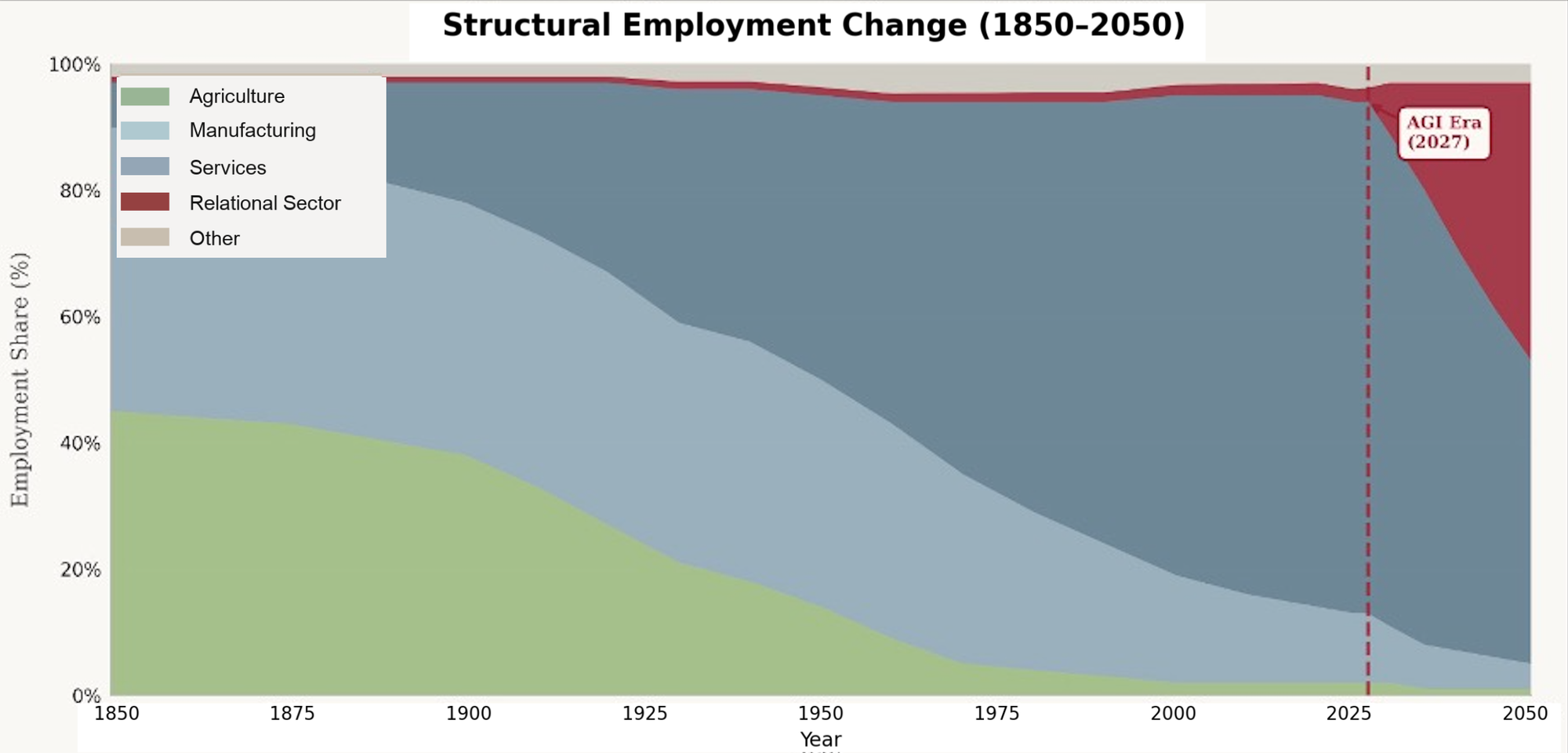
And then another way of thinking about it, which I think is really fascinating, a little bit more speculative, is through the lens of: how might this start to shift preferences in the longer term? And so in a world where we have abundance of a lot of things, we can read all of the AI-generated books for zero cost, we can access any music in the world for nothing. This is all being generated by AI at basically zero cost. Might we start to value the human element and things produced by humans more? So this is a fantastic, really interesting academic – I'm not sure how to pronounce his name: is it Alex Imas?
WALKER: Yeah, I think that's right.
WOOD: He's written about what we might see is the growth of the relational sector. So things that are uniquely human, which is everything from care to creative outputs, to craft, artisan bread, whatever it is, things with that human touch might actually be more in demand and more valuable, which in turn supports labour market outcomes in those sectors. So it absolutely is more nuanced, I think, than those tech doomsday scenarios, but much more interesting, much more exciting. But of course, lots of implications for policy in all of that.
WALKER: Absolutely. So interesting. Okay, let me pick up on a few different threads. First one is the bundling, which I think is interesting. And you mentioned radiologists, which is a canonical example. Another good example is: I think even a few years ago, GPT-4 was scoring in the top 10% of takers of the bar exam. But being a lawyer is more than just repeatedly taking the bar exam, and there's this very tight bundle of different parts of the job.
And actually, I think if one or a few of those tasks in the bundle can be automated, it makes the worker more productive, and so it should actually increase wages.
WOOD: Yep.
WALKER: So another interesting implication of that is obviously employers have an incentive to automate jobs for which there's just one task left in the bundle to automate, because then they're going to immediately reap all of the cost savings of that. So it seems like for a lot of roles for which their tasks are being automated, the wages go up and up and up until the last moment where the role then just gets fully automated. So there's this “everything's looking rosy, and then displacement” dynamic. Does that make sense? And then how should policymakers be thinking about that?
WOOD: Look, I think it does make sense for some roles, but not all. And I think there's still going to be a whole lot of roles for which that judgment, accountability, piece just cannot be automated. Until we have a totally different set of institutional settings around accountability… And that's a long way—
WALKER: We're still going to need someone to blame.
WOOD: Yeah, indeed, indeed. And I think we still, for trust, are going to want humans in the loop in a whole lot of areas. But there probably is a subset of roles for [which] that pattern that you've just suggested might hold true. Truck drivers is another one of the examples where people have been saying for a long time, “these jobs will go”. Well, yes, the machine can drive the truck. Increasingly as robotics improve, maybe AI plus robots can load and unload the truck. Looking after the truck, the safety thing, making sure that the truck doesn't get stolen, the load doesn't get stolen – those are things which people have found quite hard to replace. But maybe, if that's all that the human is doing that's left, maybe it is worth the investment in trying to find alternative ways to do that. And you get more of the scenario that you're talking about that tips over into being fully automated.
So I suspect there may be certain roles and professions where that happens, and it just means you hit a tipping point, and then you lose those roles. And so policymakers, of course, as always when there are these sort of structural shifts, have to think about how do you create opportunities for those people elsewhere. But I don't think that will be a across-the-board phenomenon.
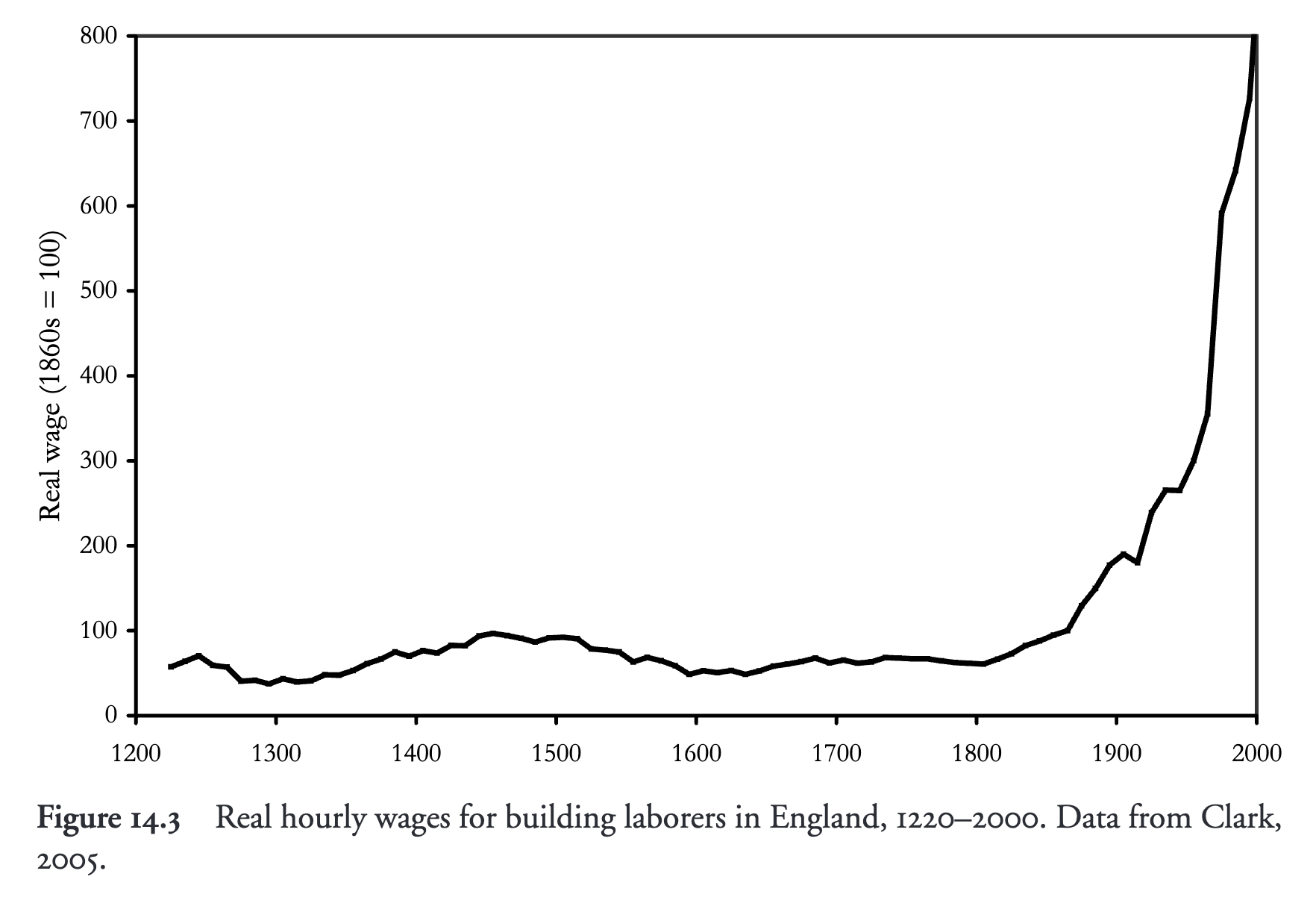
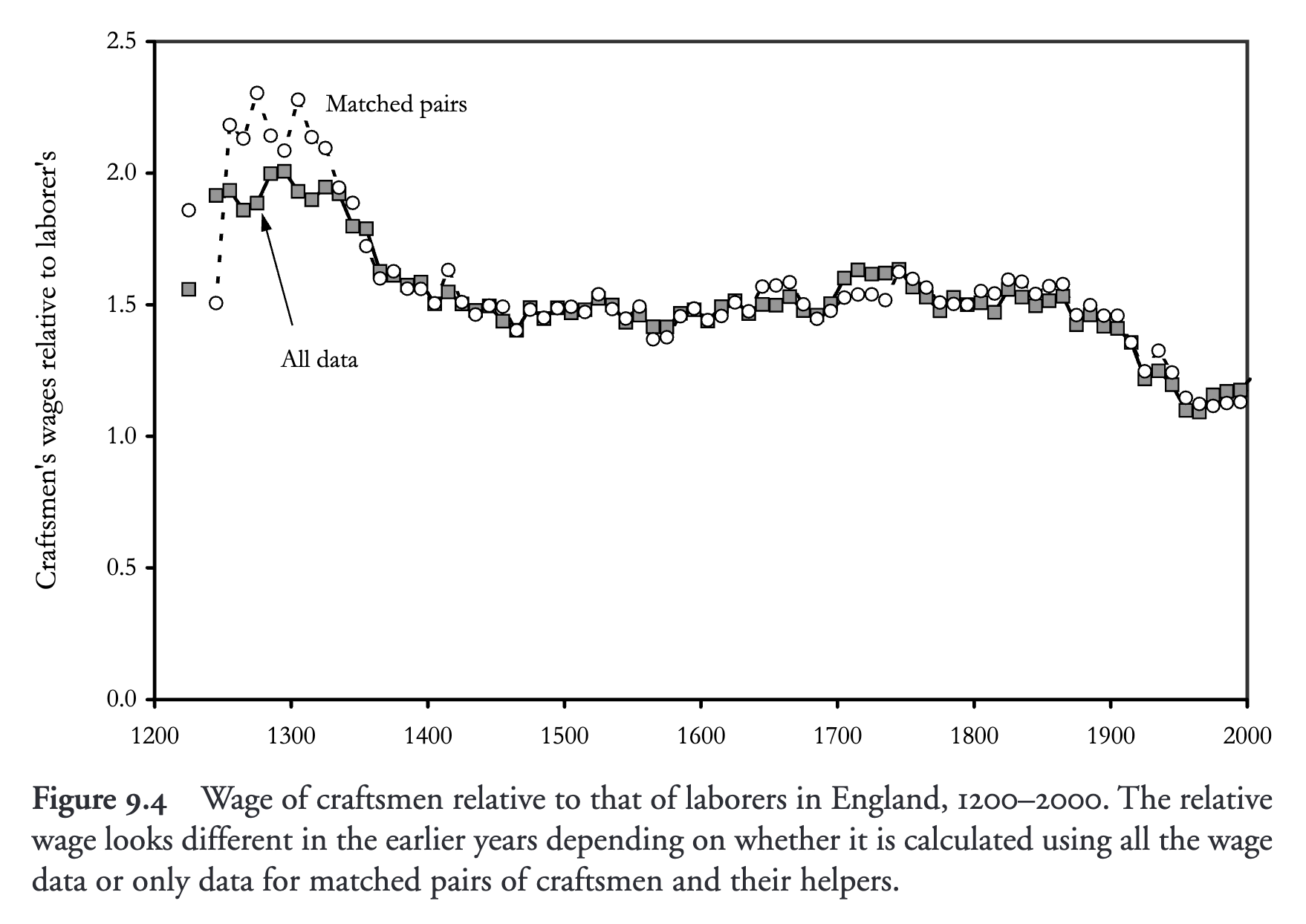
WALKER: Yeah, the truck drivers and warehousing personnel examples are interesting because they're towards the lower end of the skills distribution, which is a narrative violation given so much of the talk is about knowledge workers being displaced. It's interesting – I guess this is more of a comment than a question – but about a month ago I recorded an interview with Greg Clark, the economic historian. I'll put it out in a month or so. But one of the surprising insights from his book on the Industrial Revolution, A Farewell to Alms, is that the biggest beneficiaries of the Industrial Revolution were unskilled workers. Their wages rose relative to skilled workers.
I think the three reasons he gave for that were, firstly, a lot of kinds of unskilled work involve dexterity, which we haven't mechanised yet. Secondly, a lot of them require social intelligence, which again, very hard to mechanise. And then thirdly, the demographic transition began a bit before the Industrial Revolution, and that curtailed labour supply.
But yeah, again, just counterintuitive: the unskilled were the biggest beneficiaries in terms of the relative rises of their wages. But now this transition seems that it might be different to that potentially.
WOOD: I think that's really interesting because it's sort of the opposite of the narrative that I have heard, that over time we think a lot of technologies have been skills-biased in the sense that they've displaced the lower paid, less skilled workers and created the job opportunities for higher skilled workers. So that's a really interesting counter-narrative.
I think most of the narratives I've heard on AI is it's not clearly skills based. It's more about the nature of the work. So if you're doing something that is repetitive, if it's, as I said, rather than a big bundle of tasks, it's sort of one task – so this is the computer coders example – much easier to replace. And you can imagine some of those jobs are at the sort of lower income, lower education end of the spectrum; some are, like the coders, very well paid, highly skilled work that could be replaced. So I think we're expecting less of that skills bias.
I think the bias that people are more worried about is what I call the seniority bias, which is the point that you raised before. If the skills that are not easy to replace are around judgment and expertise and accountability, how are we going to train new people coming into a profession or an area where historically the way they have built those skills up is doing the grunt work, and that grunt work is the work that is easily picked up and replaced by AI. So I think, to the extent that policymakers are worried about biases in technology, it is this question of seniority bias, and are we going to wipe out job markets for a whole lot of young people coming into different professions?
WALKER: So on the more speculative aspect of the demand side, am I right in thinking that the reason there likely will be elasticity of demand for what Alex Imas calls the relational sector is that many of those goods and services are inherently positional, and so demand for those can't be easily satiated?
WOOD: Yeah, that's right. So the scarcity in itself is the value. Lots of really interesting studies that show I value something more if other people can't have that same thing. And so if I want to use the best personal trainer that I can see on Instagram, by definition, not everyone can have a session with that personal trainer. I can signal my taste by getting a tailored coat or consuming a particular type of beer. So there's all of those very human impulses still exist in this world. And what's scarce is this human touch.
WALKER: He also has this cute point, which is that in this world, Baumol's cost disease becomes a feature, not a bug, because it's a way of keeping humans employed.
WOOD: Exactly right. Exactly right. So yeah, it's what keeping people busy. And yes, their wages are high, but hey, we've got abundance everywhere else. So the economy supports that.
Industry policy for AI: when to intervene, when to step back
WALKER: So let's talk about AI and industry policy. So let me just tell you generally how I'm thinking about industry policy at the moment. I can see good reasons for using it in principle, like if there are positive externalities or if there are coordination failures or if the government needs to provide some public goods. And it seems like the main critiques are very practical and heavily context-dependent. And so if you can execute industry policy well, then it can be good.
I think the thing I just don't know yet is whether there are any best practices that we can draw out of the success stories, because I want to know about the graveyard of failures and whether they were also using the best practices. So at least to this point, am I thinking about it [correctly] so far? Am I asking the right questions?
WOOD: Look, I think you are. And I mean, so what's industry policy? It's trying to nudge economic activity in a certain direction or support a new or existing sector. And why might we do that? You pointed to the sort of traditional set of arguments. There might be market failures. It could be learning spillovers. It could be agglomeration benefits. There could be need for certain public goods. So I think those arguments are well known and well accepted.
I think it is an implementation challenge, but it's very real. So by definition, when governments are doing this, if you're doing something more here, you're doing less of something else, which is often not thought about when we're thinking about industry policy. So in a world of constraints – constrained capital, constrained labour – if we're pushing people to this part of the economy, this part is shrinking. So it's actually really important to think about the net economic impacts. And so many of the studies of success or otherwise focus on, were we successful in growing this sector? But when studies have gone and looked at the global economic impacts, they said, actually, overall you can't actually see any benefit or it was negative overall.
There's a fiscal cost if we're talking about some of the production subsidies or grants or any of the levers that governments might use. And we have to take into account the cost of that as well. And there are just a lot of implementation risks.
The biggest one, I think, is that you end up creating a whole set of firms that are very reliant on government intervention. They want that grant, they want that subsidy, and they waste a lot of resources going to governments and trying to find ways to get governments to do what they want. And that is money that's not spent on innovation and pushing forward. So you have real risks of distorting overall economic patterns, which I think need to be taken into account. So it's not to say that you never do it, but I think you do it pretty sparingly and where you think you've got a really solid case.
WALKER: So in addition to what you've just said, what are some lessons you think we should draw from our experience of supporting the car industry?
WOOD: Look, I think a really important one is the need for off-ramps. And if we think about some of the reasons we just said that you might support an industry like auto manufacturing, it is around learning spillovers. So it takes us a while to work out just how we do this and different businesses benefit from those learnings. We might be creating a ecosystem where you have multiple different firms and supply chains and workers that shifts you down the cost curve over time. But all of those are temporary arguments for support.
There's very little in the way of long-term case for government support and industry policy except for a subset which is around national security resilience. But that was not the car industry arguments.
I think the challenge was we weren't economic in a global sense at producing cars. And so governments stayed on the hook for those types of production subsidies. And increasingly they found it really hard to withdraw them. Those companies had a lot of sway. There were obviously a lot of workers in those sectors that had to go through difficult transitions once that government support was pulled out because the sector just wasn't capable of standing on its own feet.
WALKER: Do you have a sense for whether AI at the category level – so not thinking yet about specific industry policies – will pose unique challenges for industry policy?
WOOD: There's different levels that you can look at it. So I'm really interested in the diffusion question, which is, by the way, the vast bulk of innovation policy in Australia is around diffusion; about 1 to 2% of what we do is new-to-the-world innovation. A lot of it is picking up what is elsewhere and embedding it inside our sectors of the economy.
WALKER: Which is kind of what you expect for a smaller economy, a middle power, right?
WOOD: Exactly. I mean, great that we do that new-to-the-world, but so often I think we pick up policy debates from the US or other places which just look a lot different. So the diffusion question is really important. Should we think about industry policy for a set of AI applications or areas where we might play in the AI supply chain? I think it's hard to justify outside of what I would call horizontal policies, policies that apply to new firms and innovative firms, but aren't AI-specific. So government does a lot of R&D support, and that's about trying to get the benefits of innovation and spillovers.
There were a number of things in the federal budget this year actually around loss write-offs for startups, which is about sort of cash flow for new firms. There were things around early-stage venture capital incentives. Those things that say, okay, well, we know that new fast-growing firms are a good thing in the economy. We're going to try and address some of the pain points for those types of businesses. A lot of those AI firms will fall into that category, but it's not specifically targeting AI firms or AI applications, if that makes sense.
WALKER: That makes sense.
WOOD: And that is consistent, I think, with a lot of the literature on industry policy that suggests doing those horizontal type policies that are good for business in general, or good for innovative business, will tend to have bigger benefits and less risks than doing really targeted kind of “picking winners” interventions.
WALKER: It strikes me another way that AI might pose unique challenges for industry policy is just that if we do get that upside growth that we were talking about at the beginning, then it increases the opportunity cost of industry policies. Does that make sense?
WOOD: So are you talking about industry policy elsewhere in the economy, or industry policy for AI?
WALKER: Generally, including AI.
WOOD: So, I mean, there's a general issue in industry policy that as countries get richer and more productive, you increase the opportunity cost. And that's the point that I was making before: if you're supporting businesses in this sector, you're moving capital, you're moving resources. There's a higher cost to doing that because what you're doing elsewhere is already productive.
So to the extent that AI makes us really productive at doing a whole lot of other things, it may well make any sort of industry policy intervention a more costly thing to do.
Where will the profits flow? Chips, models, or applications?
WALKER: So my sense is that at the moment Australian policymakers are very exercised by this question of how do we capture some of the value of the AI economy and stop a disproportionate amount of the profits flowing offshore. They're thinking about preventing what Andrew Charlton calls the “Uberisation of the economy”, where in the last generation of tech behemoths, not many of the profits were captured within Australia.
And if we simplify the AI value chain into three layers of the stack – so there's the hardware and infrastructure layer, then the model layer, and then the implementation and application layer – my sense is that the conversation in Australia about how can we capture some of the value, is focused on the top and bottom of the stack, specifically data centres and applications. Does that check out with you?
WOOD: Yeah, I think that's exactly right. I think what's pretty clear, we're not going to be playing in chips. That is a very massive economy of scale business, and there's not many places that are doing that. Data centres, we are absolutely playing, and we can talk about this. There are good reasons for that. We're very unlikely to be in the frontier model business. Again, it's the scale. But I think we could be very successful in the AI application area, just as we've had a lot of success in software as a service.
WALKER: True, true. So let's start with the application layer, and then I'll come back to data centres. As you know, [data centres are] sort of a small hobbyhorse of mine at the moment. But on applications, one concern I have with the "let's build at the application layer" vision is just – and maybe this is naive – but won't the major labs just leapfrog any niche applications that we build with increasingly powerful new foundational models? I'm just thinking back to the early days of ChatGPT where people would build all these wrappers and then with a new model release they would just get sent straight to the startup graveyard overnight. Are there principled reasons that I shouldn't be worried about this question?
WOOD: I mean, I think… what are the problems that those apps are trying to solve? Often it's an understanding of ways that businesses have structured themselves and processes, the human bit that those apps go to, which I still think the frontier models aren't always going to be the best for. So I suspect there will still be a role for them. It's a good question. But I think it's going to be if they can actually find ways to solve the very real world problems sitting there inside businesses or for individuals that the frontier models can't jump to. Then that's going to be where they create the value-add.
WALKER: I think it definitely will make picking winners more difficult.
WOOD: Absolutely. I mean, I think this would be an extremely high degree of difficulty thing to do in this space. Let's be honest.
WALKER: And then maybe the totalising version of the argument where it's just almost everything in the application layer you build is potentially vulnerable. Maybe that really relies on some sort of transformative AI premise where it's AGI or something like that. So that's probably more speculative.
WOOD: Yeah, maybe it's an AGI. That's right, where we're all, you know, building our own business applications and solutions, using it because it's so powerful. But I do think that's probably a way off.
WALKER: Yeah. So one reason that we might be just naturally less worried about the Uberisation of the economy with respect to LLMs is just that in contrast to the previous generation of tech behemoths, the LLMs aren't… the network effects are largely absent from these businesses. I wouldn't say totally absent. And there are still some ways of potentially locking in customers. Like, for example, if my LLM can remember me in previous conversations and I can't export that memory very easily and transfer it to a different provider, then I might be locked in. But if customers aren't locked into LLM providers, that might lead us to expect that profits are competed down for those companies. Does that make sense to you?
WOOD: Yeah, I think that's exactly right. I mean, the network effects of things like social media platforms were overwhelming. And in those highly networked markets, you do get tipping. And that's exactly what we saw. So you end up with one or two big providers that have a lot of power.
Here, I think you don't really have network effects. You do have some things that might push you towards lock-in and lack of ability to switch, but they're much less powerful forces than we saw of previous waves of technology. So I think that's exactly right.
I think policymakers should be alive to the risks of companies doing things which could create stronger lock-in. They should be alive to mergers and acquisitions. That's something that I think with the benefit of hindsight, some of the antitrust regulators in the US said, "maybe you wouldn't have let Facebook buy Instagram", those sort of things. When something's emerging, it can look low risk, but can create greater consolidation and market power. But I think, based on what we know about the economic dynamics of these models, there is less risk of serious consolidation or less risk of monopoly power than we saw in those previous generations of tech platforms.
WALKER: And if that is true, then hopefully it would mean for Australia that more of the value will flow to the implementation and applications layer of the stack.
WOOD: That's right, that they wouldn't be extracting the monopoly profits or rents out of those players that come into the market at that layer.
WALKER: So another way to think about how much value will accrue to the implementation and application layer versus the model layer is just to ask what is the marginal value of intelligence itself. How much of a bottleneck is intelligence for firms? And if it's high, if the marginal value is high, then that would favour the model layer, I think.
WOOD: Yeah, I think that's right. And obviously that will look pretty different across the economy. As we've been talking about with the labour market effects, there are a whole lot of other things that aren't straight intelligence-related that go into value creation from different jobs. So that's right, to the extent that is the binding constraint that will favour those companies, but then the competitiveness of the market comes into play there. So to the extent that a customer can still up and switch, you'd expect some of that to get competed away.
WALKER: As a thought experiment, take the Productivity Commission, because that's the organisation you know best. How big would the marginal product be for you at the Productivity Commission of moving from, say, today's models to transformative AI models? Is intelligence the bottleneck for you?
WOOD: It's a great question, and it would depend how fundamentally we wanted to embed it into our work. So at the moment, if I think about the way we're using AI, it's to help with our research, to help with coding and data analysis, to summarise market information submissions, meetings that we have. So the shift to transformative AI just makes those things a little bit better and a little bit faster. It's not the bottleneck.
I guess the fundamental transformation would be if we had AI running the end-to-end research process and reports, and it did all the things – asking the questions, going out, doing the research, somehow running consultations, coming back, forming recommendations, handing them to government. Basically, I don't exist in that world, nor do my colleagues. So, yes and no. I don't know whether that answers your question. But it goes to that point we're making, I think. There's ways to use technologies which are about task-specific efficiencies and speeding things up, and that's exactly how we're using it. And there are ways in which it's a total transformation of the way you deliver things.
WALKER: So the economist Luis Garicano, who is the same economist who wrote the book Messy Jobs, which you mentioned earlier, he has this idea that middle powers should collaborate to build a CERN for AI, to fund and build open-source models that are pegged one or two tiers behind the closed-source frontier models. And the logic is that it puts a ceiling on their pricing. It prevents them from tacitly colluding because customers can always just opt for a less capable but much cheaper open-source alternative. And then that is going to let profits flow down to the downstream layer of applications and implementation. What do you make of this idea?
WOOD: Look, it's an interesting concept. And we've had this debate in other parts of the economy for a long time – whether governments should have their own bank or their own super fund, which creates a competitive dynamic such that others have a stronger competitor that they have to respond to.
I think probably the added argument here is, what if it's not just people exploiting a strong competitive position, but they're acting in a way, because of geopolitical reasons or other things, that's detrimental to countries' outcomes and national security. So this is a safety net that we have this neutral global platform that people can access that isn't controlled by a company or a government in the same way.
So look, I think it's an interesting proposition. It would be expensive. I think there's no question about that. These frontier models seem to cost a lot to build, although China did theirs, well, at least reportedly significantly more cheaply. It would require quite a degree of coordination and cooperation amongst middle-power economies. So look, I wouldn't discount it as an idea, but I think you'd have to do a lot of careful work and a lot of thinking through costs and benefits.
WALKER: So on this question of diffusion, I've got a double-barrelled question. Can you think of any historical examples where policy has made a big difference, either positively or negatively, to the optimal diffusion of a new technology? And then does that have any lessons for AI diffusion?
WOOD: Yeah, so as I said, I think diffusion is the main game here. And ultimately whether we reap the benefits of AI is going to depend on businesses actually adopting it and changing their practices to incorporate it.
So a good example in Australia in history is called Agricultural Extension Services. And these services have been around and provided by government for about 100 years. And this is a very old concept, which is the idea you've got a whole lot of farmers, they're very diffuse groups. So government would go out to farms or meet with groups of farmers and talk to them about what they know about technology in ag – which could be new crop varieties, it could be pest control, it could be land management techniques – so that farmers have the best information about how to employ new ways of doing things on farms.
And those services over time have been judged to be really effective at actually shifting farmer behaviour. There's been some positive evaluations. And one of the reasons people posit that Australia has got such a great record on agricultural productivity is that we've been really good at diffusing those ideas. And actually when those extension services were really powerful was when they would take information from farmers back to researchers so they'd understand the actual problems on the ground on farms, research efforts would go into "how do we control pest X?" And then that information was then fed back to farmers again. So you had this innovation loop.
So what does that mean for AI? Well, probably the biggest challenge with diffusion is going to be around business information and then management capability, the actual capacity to roll out those changes. So you can imagine these extension services which target small and medium businesses, the ones that tend to have the challenge here. We see big business adoption is powering ahead. They've got the resources and the capability to do it. But small and medium businesses may benefit from these types of services that government offers, which looks at their business model and works with them on the best way to implement that.
There are lighter-touch interventions, which is just providing base-level information across the economy. And we already have AI Centre for Excellence, which is doing this. It says, "here's what an implementation plan looks like for AI technology". Anyone can go to the website and access that. Extension services are a little bit more bespoke and hands-on. But that may be something that we want to think about when we're thinking about diffusion here.
WALKER: Yeah, it's super interesting. Do you have a sense for whether AI will – even without some extra assistance from government – diffuse much faster than previous general-purpose technologies? So I was thinking about this yesterday. I mean, on the one hand, I have a sense that it could be the first self-diffusing general-purpose technology, in a couple of ways. One is that it's piggybacking on the internet. I think it's notable that ChatGPT, was the fastest-growing consumer internet company in history, maybe 100 million users in its first two months or something like that. But secondly, the AI can teach you how to use the AI. So in January, I used Claude to help teach me how to use Claude Code, and now I use Claude Code regularly. But then on the other hand, that's maybe not what we mean by true diffusion. It's not, in a really gritty way, reorganising organisational workflows and whatnot. So I'm not sure which way it breaks. But do you have a sense of whether it's going to be much faster than the internet, electricity?
WOOD: I think it will be faster, but not as fast as some of the technologists believe. So, you know, you've got this book on electricity in front of us…
WALKER: I’ll hold this up for the camera. Networks of Power.
WOOD: Which looks fascinating, by the way. But what we know from those early waves of general-purpose technologies is it was decades, sometimes more than 100 years before we saw the biggest impacts on total factor productivity because businesses had to fundamentally re-engineer and reimagine and re-envisage the way they did things to get the benefits.
If we look at ICT, so computers, internet, it was faster than that, but still not overnight. And one reason was the technology itself, as you said, it actually helps with the flow of information. The other reason is maybe we've got better as a society. We've learnt how to learn, or learnt how to do these things. And so I think those same benefits will apply with AI.
But it's still only going to be as fast as organisations and individuals adopt it. And so, yes, we've got those extraordinary growth statistics around individuals accessing it, but still only about 60% of Australian businesses say they're using it in some form. And we know that for a lot of them, that's going to be fairly superficial uses. So using it to write client emails or maybe I've got a customer service chatbot up and running. That's very different to the transformation and embedding AI into the fundamental way that businesses work. And I still think it's going to be years to decades rather than overnight. And that's why you don't get the productivity benefits right away. It's why you don't get these massive labour market adjustments. It is just slower, I think, than people imagine.
WALKER: I think that’s right. Another way to put it that's just occurred to me, AI might help with its own diffusion, but for that to happen, you need to be using AI in the first place.
WOOD: Indeed. Exactly. Exactly. And again, we see it's much more common amongst exec leaders in bigger corporations. It's much more common amongst high-education, high-income workers and low-education workers. So I don't think it is yet as embedded in every job and every business in the way that some people might assume it is.
Data centres: should Australia support them?
WALKER: So some questions about data centres.
WOOD: Your favourite topic.
WALKER: Maybe my favourite topic, we'll see. But do you have a sense for whether there are big economic rents on offer for countries who host data centres?
WOOD: I mean, I suspect not. There are certainly conversations that Australia might be pretty well suited because we have a lot of land, we have a lot of potential for renewable energy. We've got a lot of wind and sun in particular. We've got good institutions, we're a stable democracy. But I think broadly we will be competing in, maybe not a global market, but a regional market for compute. It's not that other countries will not be able to build these types of data centres.
So I think it probably will be a reasonably competitive global market. It's not iron ore or something where we're one of few countries in the world that have high-quality deposits and therefore we're able to exercise considerable market power. I just don't think it probably plays out like that for data centres.
WALKER: Yeah, I think that's probably right. So the argument for contemplating any possible government support for data centres is really an externalities argument. What things would have to be true, or what are some things that might have to be true, for you personally to be satisfied or to support the concept of subsidising data centres?
WOOD: I mean, I think it would be a pretty high hurdle for me. [If] compute was significantly constrained and without it, we couldn't get the benefit of AI throughout the broader economy. So there's some bottleneck in compute that meant that Australian businesses were not able to use AI without a substantial government-underwritten investment in data centres, and I just don't see that's going to be the world that we're in. I think there's pretty strong commercial incentive to build these things. And as I said, there'll be a lot of other countries doing the same.
The other reason might be if there was a security, resilience argument that we don't want to rely on other countries for this essential infrastructure. But again, I just think to the extent we need to make sure that we have capacity for essential government tasks – intelligence, those sort of things – probably the commercial sector already has an incentive to build that here. And we see governments already pay for a whole lot of things they need. Like, I access a secure network if I want to look at cabinet papers or those sort of things, and that's… it's not that government goes and builds that, they just pay for it. And I suspect the same happens here.
So if we weren't going to have any data centres but for government coming in and supporting them and they needed to do that for a national security, resilience reason, then that would make sense. But I just think the market is going to deliver more than what we need in that sense.
WALKER: Yeah, let me add another rebuttal to the resilience rationale for subsidising data centres, and tell me if this makes sense to you. So actually I was reading the Productivity Commission's Guardrails for Industry Policy report, which was published last year, but there was one point in that that just got me thinking about this, which was, wouldn't we just be shifting the supply chain risk up the supply chain to chips or something?
WOOD: If we hadn't built them yet, then potentially yes.
WALKER: If we hadn't built them yet?
WOOD: Well, so let's say – and this is very hypothetical world, because I said I think the market's just going to sort this problem out. But let's say we decided we're not going to have enough compute to do things that we think we absolutely must have as a country for our national security. And we then go out to market to build our own data centres. But other countries are now decided that they're going to hold up the supply of chips or whatever it is we need. We're in that world. But if we identify it as a problem, we build the data centres now, we're fine. We've then got that capacity once it's sitting on the ground, it's here.
WALKER: Oh, I see what you mean. We've got the chips.
WOOD: We’ve got the chips. So it's only if both of those emergency situations happened at the same time and we didn't already have the data centres here.
WALKER: Okay. So there's one other positive externality that I could think of, but it's a little more tenuous, and that's just that having a lot of compute – we're talking in the order of magnitude of tens of gigawatts, not low ones of gigawatts... But that, particularly when applied to AI training rather than just inference, will give us leverage at other layers of the AI stack, especially for frontier models, in a world where access to those models might be rationed because ultimately we'll be importing those models from American companies, and they're ultimately subject to the whims of US governments.
But also, we'll plausibly be able to get access to increasingly powerful models that aren't released to the public yet, like Claude Mythos Preview and beyond.
I say this is tenuous because I think it really strongly depends on particularities of any contracts or agreements between data centre operators, Australian governments, and frontier labs. So I don't even know what this looks like, but it just seems like it's possibly one other positive externality in the possibility space.
WOOD: So it's giving us some negotiation power with either the companies themselves or the governments that are controlling the actions of those companies.
WALKER: Yep. So I'm told that Anthropic is looking for its “second country” [for training compute] at the moment outside of the US, whether that's Australia or Japan or somewhere else, I have no idea. But if there was some MoU or bargain struck with Anthropic, which was "okay, we're going to do up to a third of your next however many training runs and in exchange, we would like access to the next versions of Claude Mythos Preview to help with our cybersecurity when they become available". That's the kind of things I'm contemplating here.
WOOD: Look, I can see what you're saying. I just wonder if it's – if you're talking about that as a motivation for government investment in data centres, I think it's a fairly long bow.
WALKER: A few too many links in the chain.
WOOD: A few too many links in the chain, perhaps. Yes.
WALKER: Okay, fair enough.
WOOD: Especially when I do think we will end up with a lot of capacity in any case because of the market advantages that we have that we've spoken about.
WALKER: Yeah. So I was reading the government's expectations of data centres document which came out I think in March, and it's got five different expectations. Some of them are pretty reasonable. It's like efficient water use and supporting the energy transition. There are others like providing skilled jobs and apprenticeships, and also favourable terms for compute for Australian start-ups and nonprofits, which feel a little bit “everything bagel” to me. I mean, reading the document, it was reminding me a little bit of reading the US government's Notice of Funding Opportunity for new fabs under the CHIPS Act, where they were just layering on all these additional requirements. Are we being too everything bagel with data centres here?
WOOD: Look, I think there is a tendency towards everything bagel with almost everything these days. I think the requirements around water and power – I don't think anyone is going to disagree with. I think there's a genuine community concern, particularly if these things are going up fast, if they start spiking the prices for electricity or water, you're going to see that social licence degrade pretty quickly. So I think the government is right to focus on that and to say that we need these firms to come up with their own solutions.
I do worry about putting a whole lot of other requirements on any sector beyond what is already there under the law around workers' rights and protections around commercial agreements to supply to particular research organisations or centres. The Assistant Minister in charge of digital economy, Andrew Charlton, is doing a speech today around data centres and the importance of community trust. And I understand that, but I think it's probably getting the key pieces right around water, around power, around licence within communities, rather than adding on a whole lot of other requirements, which is really pivotal for that trust piece.
WALKER: Yeah, I'll have to read the speech. It does strike me, if you buy the very bullish arguments on the importance of data centres, then data centre nimbyism might become even more of a problem than residential housing nimbyism in the next five to 10 years.
WOOD: Gosh, that's frightening to think that that could be the case. But I mean, there's a very real question around degree of regulatory hurdles. And it is true that it's just hard to build things in this country – whether that is housing, whether that's renewable energy infrastructure, whether it's data centres. We do ask people to jump through a lot of hoops. And I think we should be looking to streamline that in a sensible way, not necessarily remove protections, but to certainly streamline processes as much as possible. And government's already done that to some extent through the changes it made to the Environmental Protection and Biodiversity Act last year, streamlining environmental approvals. But that's got to be an ongoing conversation for data centres, just as it is for all those other sorts of things we need to build more of.
WALKER: Do you have any takes on this question of what if AI investment is a bubble?
WOOD: I mean, I think this is very hotly contested at the moment, certainly in the US, and you've got people that feel very strongly on both sides. Certainly the history of general-purpose technologies is you do tend to get some bubbles and booms and busts before you find the equilibrium. Why would we be worried? Well, if we were making all these investments that were ultimately worthless, we might be concerned about that.
I think this is probably closer to, you know, [the] steel boom and those things where at least we've got a productive asset at the end of it. So, yes, some investors might take a nasty haircut and that's bad for them, but as a country, if we've still got these data centres that we're going to be able to use at the end of it, it doesn't really have the same negative productivity shocks that you might be worried about with a bubble that was producing something that didn't have any inherent value or capacity at the end of it.
WALKER: So I want to finish on AI regulation and then some questions about how we measure progress. But just before we do that, to sort of cap off the AI and industry policy segment, to sort of bring together everything we've spoken about: do you have a gut sense for where in the stack the profits will ultimately flow?
WOOD: I think the chips… clearly, the upstream there. There's just only ever going to be a small number of firms. So I think they have a huge amount of market power. So I suspect that's where a lot of the action is.
I hope we can have a dynamic application layer where there's money to be made and Australian firms are part of that action. But like anything in AI, I just think we've got to be pretty modest about forecasting where things go.
WALKER: And does it feel implausible to you that Australia could be one of the big countries in the value chain? So there'd be like the US, China, Taiwan, maybe the Netherlands because of ASML, and then Australia.
WOOD: Look, I think we have to think about it in proportion to our size. But as I said before, we have had, I think, remarkable success in the software-as-a-service area – your Atlassians, your Canvas, your Culture Amps. And we've done really well. We have created these ecosystems. We developed for the world from day one because the local market is small. So I think we have some of the ingredients for success. But it's not going to be the same as having a chip manufacturer, I suspect.
WALKER: So as a segue into AI and regulation, the current most important binding constraint on training compute in Australia is copyright. And I was just hoping you could just, just for people's context, just briefly explain your understanding of the mechanism by which our current copyright settings prevent training compute from being built here?
WOOD: So essentially, they restrict the capacity of the trainers to pick up content and use that to train off because it could be a breach of copyright law. So that's the concern. And it goes beyond what you might normally think of as copyright-type materials. So something that someone's written in a book or that's in the newspaper. Potentially any use of the Productivity Commission website or scraping that material could all breach copyright laws.
WALKER: And potentially also, I mean, if labs had to pay for that, then potentially also set an international precedent as well, which might be a concern.
WOOD: That's right. Although that is the way the market is evolving both here and internationally as we are seeing the labs now negotiating more with big copyright holders to pay for access to their material and their content.
WALKER: So it feels like we're in limbo on the copyright stuff at the moment. I was saying Anthropic's looking for its second country. I don't know when it wants that additional compute to come online by, but maybe it's end of 2026, early 2027. This feels like really urgent, but we have this very obvious barrier to training compute in Australia. And I just don't know whether we've even arrived at a solution yet.
WOOD: Yeah, we haven't. But what I would say is it's challenging everywhere. So even though on paper our laws are stricter, it's just a very hard issue for copyright laws – to what extent AI training is a breach of those. Because copyright is all about reproducing the material, like to what extent is training doing that? And so the US, I think, there's some insane number of court cases running that are live right now about this very issue. So I don't think it's fair to say that what you can do with copyright material is clear anywhere in the world at the moment.
So we grappled with this when we were thinking about productivity opportunities and data and digital last year. We flirted with different options, and we put out for consultation the idea of: should we have text-and-data-mining exemptions? Should we have things? But where we ended up was actually, well, this is being worked out globally right now. I don't think it's too much of an additional barrier in Australia, and these commercial relationships are starting to build up and form as well, which is picking up the part of the market that we might be worried about. So a wait-and-see approach actually isn't crazy in that world where a lot of this is in flux globally.
WALKER: So in the government's National AI Plan, I noticed that they want workers and unions to have a strong voice in how AI is adopted across workplaces. Do you know, does that mean they're thinking about regulating AI as an industrial relations issue? Because it just seems like that could potentially really slow diffusion.
WOOD: Yeah, I would be concerned if they were thinking about it like that, but I don't think they are. So what they have said, which I think is right, and there's a sort of – I don't know what they call it, a council or something that's been developed, which is bringing together business and government and unions to deal with these issues – is, really workers should be consulted on the rollout of technology. And I think that's largely required under IR law already. And also it's just good management practice 101 that you should work with workers if you're bringing in new technologies. Maybe there'll be some requirements for skilling and retraining under EBAs.
So if augmentation is the big story, as we said before, we might want to give workers the chance to build up the skills that they're going to need for those new types of jobs. And also some restrictions around digital surveillance and those types of uses of the technologies that could have a negative impact on the quality of jobs for workers. So those are all, I think, pretty reasonable things that governments should be thinking about and businesses and unions should be working together on.
What the government said so far, and I think is good, is that's very different to unions, or workers, having a right of veto over technology, which says, "no, we can't use AI in this organisation". And I would absolutely be worried about that because then potentially you are cutting off a lot of the potential productivity benefits of the technology.
So at the moment, I think we're walking the line in a pretty good way. But that's certainly a risk that we're thinking about: that, at some point, people might be looking to move to veto rights.
AI risks, and why Australia shouldn’t pass an AI Act
WALKER: So in its report last year, the Productivity Commission argued that regulatory responses to AI should happen within existing legal frameworks, and that AI-specific regulation should be a last resort. I'd be curious, just to play devil's advocate, what do you think is the most plausible reason why that approach could ultimately turn out to be the wrong one?
WOOD: I mean, I think it would be if AI was posing a lot of risks that sat outside existing legal frameworks. So when we looked at this issue, what we saw was: well, when you think about the kind potential harms from AI – product safety, privacy, defamation, consumer harms, like a whole lot of things that we already have laws around… And it seemed to us a big risk to come in and say, "okay, now we're going to have an AI Act, and we're going to try and somehow directly regulate this technology", which presumably would be about trying to pick up those harms, but you create a layer of duplication, complexity. We've seen it sort of done in Europe already. The GDPR regime, which was around privacy law, had really slowed innovation, restricted access to products for consumers. They've actually interestingly just done it for AI more recently, and all the same concerns are there.
So an approach where you went to the existing laws and said, "okay, what are the gaps here? Are they fit for purpose? There probably are new things and new risks that AI is creating that we haven't got in the legislation at the moment. Let's fill those gaps" – seemed to be the right answer. And it was already going on. TGA had already done a gap analysis and proposed some amendments. Other regulators were doing it. We want to make sure it's done in a systematic way. The government said it will do that in a systematic way, but that seems to capture a lot of the action. But yes, if there are harms that sit outside those standard regulatory frameworks, then that's when that approach would have limitations.
WALKER: So on that, is your gut sense that AI will turn out to be a "normal" technology? So it diffuses slowly and our institutions shape its course and maintain in control of the technology? Or how likely do you think it could turn out to be sort of an abnormal technology where it's less like a new tool and more like a new species, which is really fast-developing and autonomous? Because then obviously that goes to this question of whether there might be risks outside of the existing framework.
WOOD: Yeah, it's such an important question. And so everything that I've just talked about – our approach, gap analysis, all of that – is AI as a normal technology. Yes, it poses risks, but we can deal with those within our standard regulatory frameworks.
There is another very live, somewhat scary conversation, frankly, that's going on about, “Is AI godlike? Does it pose an existential threat? Is it going to turn us all into paperclips?”, which I think something we should think about, we should pay attention to. Andrew Leigh, Assistant Minister in this government, recently gave a very interesting speech about how economists should think about extinction risks more and weigh these into decision-making. And frankly, when you have quite a number of credible people in this space saying, "we should pay attention to this", I think we should.
That said, is an Australian AI Act going to protect Australians from the existential risks of AI getting out of control? No. This is going to happen overseas, and we will get taken out in the crossfire, whatever it looks like. And so I don't see that putting in place cumbersome or complex or unnecessary regulation… it’s actually not going to protect against that potential harm, would be the right way that we should think about it here.
Essentially, it's a problem for regulations in the countries in which these models operate, but it's also a global problem. We've just launched an AI Safety Institute in Australia that is working with AI safety institutes that exist in a range of other countries – Korea and Japan and Europe and Canada. And I think probably some global coordination that is playing a role in improving the transparency and auditing of these models, that is kicking the tyres on these risks of lack of alignment, is probably the way we play the role.
So Derek Thompson, co-author of Abundance, picked up on this "is it normal, is it abnormal", and said, "why can't it be both?" And I guess that's how I think about it. I think to a large extent, I think about it as a normal technology. I certainly think about the Australian regulatory response falling into that category. But yes, we should engage with the abnormal technology risks. But I think the right mechanism for us to do that is through a sort of playing a role in global cooperation rather than weighing down domestic business with a legislative framework that, frankly, is not going to have any impact on those global existential risks.
WALKER: So my next question was going to be: if not an AI Act, what is the best way for Australia to get leverage over AI governance? So it sounds like the AI Safety Institute and that international cooperation is one way. Are there any others?
WOOD: I think there will have to be probably more formal regimes of international cooperation. Climate change is probably the closest parallel to this – the only way that we address things is through each country signing on, and everyone's got an incentive to free ride. So we probably need some international mechanism. So I think playing a role as a good corporate citizen, developing expertise in certain areas is going to be the way that we have the biggest impact.
WALKER: One of the things I've been meaning to look into and I haven't looked into this in any detail yet, is the non-proliferation frameworks. And then again, whether we could be thinking of uranium as some analogy for compute. So I think our position as a sort of upstream supplier of uranium has enabled us to extract governance concessions from countries we sell uranium to that go even beyond the baseline obligations of the NPT. I want to look into that. I mean, again, it goes to that broader, more tenuous positive externality around data centres, which we spoke about. But potentially there's another route there.
WOOD: Yeah, I mean, it would depend whether we had a sufficient share of compute for it to be genuine leverage. And that's going to be the difference with uranium. Again, you only got a small handful of countries that can supply that, whereas I suspect we won't have anywhere near as much leverage from compute power.
Measuring progress in the age of AI: beyond GDP and labour productivity
WALKER: So to finish, measuring progress, which is really interesting topic. Actually the question I want to ask first segues from what we were just talking about, but that's if – so I read Andrew's speech, Andrew Leigh's speech about the economics of extinction. I thought it was brilliant, one of my favourite speeches of his, just incredible clarity of thought. But the question it left me with is: if we are interested in the area under the curve – so the stream of all future human welfare… And I am on the the social discount rate should be zero or pretty close to zero bandwagon. And so I think that that stream of future welfare is an important consideration, is morally important.
And so if that is what policymakers should be thinking about, then our measure of progress should include not just the economic growth rate, but also some measure of the existential risk or hazard rate of new technologies. So I'm with Andrew so far.
But then my holdup is calculating the hazard rate is an extremely non-trivial task when you're dealing with Knightian uncertainty… and indeed can often backfire and lead to like suboptimal policy because maybe you overestimate it and then you're too precautionary and you foreclose a lot of potential growth. So I just don't even know where to begin with that. I don't know if you have any thoughts or if you're just in the same nihilistic boat as me.
WOOD: Well, I mean, I agree with you. It's incredibly hard. And what people have tended to do is go to experts and you get this just –
WALKER: Survey them.
WOOD: Yeah, survey the experts. And you get this like incredibly broad range. This has happened for AI – I can't even remember the range, but somewhere between almost nothing and like 40% of wiping out humanity. I mean, it's pretty –
WALKER: That range tells you something.
WOOD: Yeah, exactly, exactly. Just high degree of uncertainty. I mean, people have played around your nuclear proliferation example before. There's the – is it the Doomsday Clock? The “how many seconds to midnight we are?” sort of formulations that make it a bit more tractable, but it doesn't remove the underlying problem that you're talking about, which is just: how do you actually inform that judgment? So look, I think it's incredibly hard to do.
What I took out of Andrew's speech though is: well, let's say there's any significant probability of P(doom), we should be making sensible policy steps to try to eliminate it.
WALKER: Directionally we should be investing more.
WOOD: Exactly. But yeah, it doesn't answer the question of quantum. It's easy in this case because in a way Australia can't spend a lot dealing with this issue – the sort of interventions that we're talking about – safety institutes and international cooperation – by their nature are almost certainly going to be worth it: relatively low cost.
Much bigger question if you start thinking from the perspective of, say, the US, and saying: should we actually just pause development of these models? And that was – remember, like a year or two ago – Elon Musk an others were saying we should just stop now. Then you're dealing with these very big cost–benefit trade-offs without a real sense of what lies on the other side of that ratio.
WALKER: Yeah. So in the "AI as normal technology" essay, which is the big essay from early last year on which the Derek Thompson essay you mentioned was based, the two authors, Narayanan and Kapoor, talk about treating the task of reducing uncertainty as itself a first-rate policy goal. Uncertainty about AI risks, that is. I wonder if you had any thoughts about that as a policy goal, and if it is a legitimate policy goal, is there any entity in Australia whose responsibility it is currently to reduce uncertainty about AI risks, or would we need some new institution?
WOOD: I mean, it depends, and the AI Safety Institute's new body, but if it is playing a role with these questions of algorithmic transparency – so how are people actually using these tools? That starts to give us a better picture of risk. Are people writing queries about bioweapons? And how are the AIs responding to that? What information are they giving them? Those sort of things.
So I think there is something around auditing transparency of how these things are being used in the wild, as well as how the technology is responding, that goes to this question of understanding how real those risks are. So yeah, I think again, that's going to be part of a broader effort, which may be pushed by governments in US and China, or might come globally, that we'll have to go to some of those questions.
WALKER: So moving on from the hazard rate now and just focusing on the growth term in this equation. If the System of National Accounts and our standard measures of productivity fail to capture a lot of the progress from AI, as indeed they have to an extent for the progress from other digital technologies, are there policymaking implications of that measurement problem that worry you? Do you have a sense for how big the mismeasurement could be? And then does that potentially lead policymakers to make bad decisions or decisions that they wouldn't otherwise have made?
WOOD: Yeah, so the measurement problem comes about because to the extent AI products are free, like social media was free, we don't have good ways of capturing that in the national accounts. So you're creating this consumer value that just isn't there because you've got a zero price. And this has been a long-standing problem. I mean, the earliest example was actually unpaid care work, which Marilyn Waring, fantastic New Zealand economist, has been writing about since the '80s.
So we've always known that GDP, one, is not a measure of welfare, because it misses a whole lot of things that are valuable – including these new technologies if they're priced at zero. So yes, the measurement error becomes more acute if this is a growing share of the economy.
But what does it mean for policymakers? I think this has always been a… it's not like people are blindly optimising policy around the GDP figure. It's just not how policy works…
WALKER: It’s not like a speed limit in a car or something.
WOOD: Yeah, exactly, exactly.
Proper microeconomic reform, the bread and butter of this agency: you're thinking about costs and benefits in the broad. You're not just running at a GDP number. So it's a problem in the sense that the number that we report and think about is probably less good as a measure of welfare than it used to be, but I think we've always recognised the need to think more broadly than that.
And even this government has sort of explicitly done that. I don't know if you've seen the Measuring What Matters framework that they put out with the budget. So basically they said: well, GDP is not the same as welfare. Why don't we come up with a set of other indicators of things that people value and care about. And lots of countries around the world have done this.
WALKER: This is the dashboard concept?
WOOD: It's the dashboard concept. You basically get a broad agreement across countries, within people: what do we care about? Yes, we care about incomes and our capacity to buy things, our GDP proxy. But we want good education. We want to feel safe. We want a great healthcare system and health outcomes. We want social capital, connection. We want democracy. We want to have a say in who's leading the country, who's running the country. So you end up with a dashboard of different indicators that go to how well a country is performing across a range of things that matter to people's wellbeing.
WALKER: What are some ways AI could change the economy such that labour productivity ceases to be a good enough measure of progress?
WOOD: I think a lot of it will show up in total factor productivity. So you will end up with higher gains there. So it may be that that's where the productivity action is going forward. We do tend to use labour productivity a lot. I think partly because it's more intuitive for people, partly because it comes out quarterly, whereas total factor productivity only comes out once a year.
WALKER: Why is that?
WOOD: It's a good question. I don't know the answer to that. I've just accepted it as the way things are. You have to get David Gruen on and ask him. [laughs]
WALKER: Yeah, yeah. But yeah, sorry, I interrupted you.
WOOD: So look, I still think those measures will be useful. I mean, the main issue is the ones that we've already talked about, that we're missing bits of the output measure. If there's a lot of free products sitting in there, you might be missing productivity gains.
WALKER: I guess if the labour share goes down or something, or if there's a lot of displacement, then… Because, my understanding is the reason labour productivity is a pretty good measure of, or a good enough measure of welfare at the moment, is…
WOOD: Incomes tend to move with labour productivity.
WALKER: But if the labour market is like not how incomes are being distributed in the economy anymore, then –
WOOD: Yeah. Okay. Okay. So that's probably not the world my best guess is that we end up in for the very long reasons we've already discussed, but let's say we're in the tail scenario and most people don't have a job, then your capital share is going to be much higher. And then you've obviously got questions of distribution. But yes, in that case, your labour productivity is not going to tell you much about how individual people are faring. So I think that would be the issue.
WALKER: That makes sense. So it seems that if intelligence becomes abundant and really important, and the constraint on intelligence is compute, and the constraint on compute is energy, then energy is even more directly the binding constraint on progress than it is today. And maybe in that world, rather than talking about labour productivity or mainly about labour productivity, energy efficiency is a really important concept: units of output per unit of energy. Could you see that?
WOOD: Energy is your production factor rather than –
WALKER: Yeah, yeah. So like the way today everyone reports on and talks about labour productivity in the sort of national debate and the media, it feels like the conversation should shift to energy efficiency.
WOOD: I think it will be relevant. I mean, in a way I hope it's not because I really want us to be in a world of energy abundance sooner rather than later. We do have a transition period, but I am optimistic about the potential to increase energy supply over the long term for the reason we talked about. We have abundant natural resources that we can convert into energy.
But in a short-term sense where that was your binding constraint, look, I mean, it's certainly going to be relevant for thinking about policy. It's going to be incredibly important for thinking about how you ration that scarce resource. Whether that ends up being your overarching macro statistic, I just don't know.
WALKER: Well, we better leave it there. It's been a lot of fun.
WOOD: It has been.
WALKER: We should catch up in 10 years and see…
WOOD: How bad our predictions were.
WALKER: What were we right about? Will be interesting.
WOOD: Well, assuming we've both still got jobs.
WALKER: Yeah, you never know. Well, thanks so much, Dani.
WOOD: Yeah, thanks for having me, Joe. I really enjoyed it.