“Fibre Optics Mark II”: Why Data Centres Will Change the World and Bankrupt Their Builders — John Hempton [Compute Series]

This is the fourth episode in a multi-part series called 'Compute in Australia'. Series announcement here. More episodes to follow over the coming month.
[Recorded 1 November 2026.]
Over the past couple of months, I've been running a podcast series on compute in Australia.
The series takes the possibility of transformative AI seriously and asks: what should a middle power like Australia do to remain relevant?
Since early 2025, the answer to that question has seemed fairly obvious to me. At least to begin with, Australia should get a foothold in the AI supply chain by building out a large domestic compute industry – including, crucially, training compute.
One of the most common pushbacks I hear is some version of: "AI is all a bubble" (usually followed by: "You should interview Ed Zitron").
These comments make one or both of two basic mistakes. First, they dismiss the manifestly impressive technology that is agentic AI, and fail to price in any reasonable progress in capabilities on top of that. Second, they are imprecise about what a bubble actually is*, and they then treat the whole AI sector as one amorphous blob which they call a "bubble". So I find them to be unserious.
But is there a more sophisticated critique that can be made?
I sat down with my friend John Hempton, Australia's most prominent short seller and the founder and chief investment officer of Bronte Capital, a Sydney-based global hedge fund.
When John looks at the AI sector today, he doesn't see many bubbles (if any). But he does see a lot of bad businesses – and those two things are not the same.
The formula for "the worst business in the world" is, according to John: high capital costs, low marginal costs, competition, and continual technical improvement. With these ingredients, new entrants push prices down to marginal cost, businesses can't recover their high capital costs, and they go bust.
The most extreme example of this formula in the AI stack is, John argues, data centres. Compute is "the ultimate commodity".
Yet he also believes AI is "the most amazing technology of your lifetime".
Compute is therefore "fibre optics Mark II": it will change the world, but it's a terrible business to be in as an individual player.
John thinks compute overbuild is all but guaranteed, and the $7 trillion of global capex forecast to 2030 is “clearly wrong”. To earn a return, it would need to generate about $2 trillion of revenue a year, which means saving around $4 trillion in wages, or 10% of the OECD’s wage bill – a percentage that is neither practically nor politically feasible in the next few years.
As such, John thinks the Australian government should lean into the data centre boom – "happily facilitate it" – but just don't subsidise the world’s compute the way China subsidised the world’s solar panels.
*A common definition of a bubble is something like: when market prices become disconnected from "intrinsic value". I don't love this definition. The problem is that intrinsic value is itself a kind of narrative and subject to radical uncertainty.
The definition I prefer is: where people are only invested because they expect to sell to others at a higher price. This builds in the self-recursive nature of bubbles.
Video
Sponsors
- e61: a non-partisan economic research institute focused on Australian public policy. To receive a copy of the new essay I co-authored with e61 on data centres and the compute economy, go to e61.in/joewalker.
- Vanta: helps businesses automate security and compliance needs. For a limited time, get one thousand dollars off Vanta at vanta.com/joe. Use the discount code "JOE".
Transcript
JOSEPH WALKER: At long last, I welcome my friend John Hempton back to the podcast. John is founder and chief investment officer at Bronte Capital, a Sydney-based global hedge fund. And today we're going to talk about AI from a finance guy's perspective.
And selfishly for me, John, I think the three questions I personally want to get a better handle on are: firstly, if there is a bubble in AI, where exactly is it located, or where is it likely to emerge? And then two kind of ancillary questions, which we'll spend less time on than the first one, and they are: if there is a bubble, what does this mean for compute? And secondly, what, if any, are the implications for Australian public policy?
The most amazing technology of your lifetime
WALKER: But before we get into AI as a business, I want to talk about AI as a technology. What are some of the interesting ways you're using AI at the moment, either personally or at work?
JOHN HEMPTON: AI as a tech is freaking amazing. If you haven't decided that this is the most amazing technology of your lifetime, you have not seriously used it with cutting-edge models.
On a personal basis, I threw all of the plans for a house that we're building through AI. None of the engineering specs, just the plans. And I wanted to work out what the heating and cooling loads were. And so I put this in, and it asked me questions about materials. It asked for the address. It then went and got the weather data from Sydney Airport, which is hourly for many years. It worked out what the worst days were, and the worst days are going to be cold days in July and hot days in February.
It worked out how many solar panels [were] on my roof. It worked out the angle of the roof. It worked out the question of how much of the house I could cool on the theoretically worst February night, without touching the grid. And I was using Fable – and it did a full engineering diagram, full heat-loss stuff, everything from first principles, and it used about $100 worth of tokens. And the answer came out within 5% of the answers that were given to us by an engineering specification.
So I put the engineering specification through the AI. And the AI said, yeah, Fujitsu was the supplier of the compressors, and Fujitsu has some software that does it, and the software is open to anyone. So it had downloaded the software, run it for the house, worked out the calculation, and got exactly the air conditioning one. And it did that as a check of its own numbers.
And I mean, if you wanted to do that from first principles, it would take a good engineering grad a few days. You know, maybe even a week. And it did it for $100.
Now, AI can't yet build the house, but I don't think it's very long before we connect AI to the robots. You think your job's not safe if you're an accountant or a financial analyst like me? Your job's not even safe if you're a carpenter. Because we're going to connect this thing to the robot.
A short seller discovers jaggedness
Now, in my day-to-day work, I use it a lot, and I use it sometimes with great effect and sometimes with not. And it's been a puzzle as to why it's not. So I'll give you an example. One of the questions I want to do is find all of the bad banks in the world – all the banks that are lending money that they can't get back, all the banks that are the basis of the next financial crisis.
I like shorting bad banks. I shorted Silicon Valley Bank. I shorted Signature Bank. Shorting banks is one of these beautiful things, because you can do it in any size you like, and there's almost always a bank somewhere in the world in trouble.
So I wanted to work out how to teach an AI to analyse banks. And I've done really, really well with the deposit side of the balance sheet, but I haven't managed to solve the problem with the asset side of the balance sheet, which is usually the more interesting side.
So, the deposit side. There are different ways that a bank can get deposits. ANZ Bank in Australia gets deposits by branch incumbency. It has branches on every street. Your father banked there. You bank there. You opened a bank account when you were 22, and now you're running a business and you're aged 45, and guess what? It's still at ANZ Bank.
And now your business has $7 million of deposits, because it's a nice profitable business with a big turnover. That $7 million of deposits, ANZ Bank got through branch incumbency. That's probably the most common way that banks get deposits.
But there are other ways. For instance, you can get deposits by being the highest rate payer. So if you look at what is the rate for a three-month term deposit in the US at $250,000, which is exactly where the FDIC cutoff is, and there's an order, and sitting at the top of the order is probably Bank OZK. And you look at six months, and again, it's Bank OZK. And you look at a one-year deposit, and again, it's Bank OZK. And we know how Bank OZK gets its deposits: it pays for them.
So a little bank that was originally Bank of the Ozarks has become a national bank in the US, and it became a national bank by paying up for its deposits. That's a less good deposit base than ANZ. ANZ has large amounts of deposits it doesn't pay for. But it's a good way of analysing the deposits.
Then there are other ways you can get deposits. To pick one we just talked about: Silicon Valley Bank. Silicon Valley Bank didn't have branches. What it had was a really good relationship with hundreds of venture capitalists in Silicon Valley.
And the Silicon Valley venture capitalists will typically find two or three kids who come in with a good business idea, and they give them $15 million. Now, you don't give a bunch of 20-year-olds who have never been in business $15 million if you don't want it to be snorted on cocaine or something. So what you do is you invite your friendly Silicon Valley Bank branch banker in.
And the Silicon Valley banker acts as a sort of a quasi-beginner CFO. So he sets them up with a payroll system, he sets them up with accounting systems, he sets them up with various compliance systems. The board member, who is almost certainly a venture capitalist, will get an automatic alert if transactions are unusual on the account. Effectively, he sets them up with the basic set of minimal controls that a Silicon Valley venture capitalist would want. And in exchange, Silicon Valley Bank gets these big deposit bases.
Now, those deposit bases were actually quite a high-quality asset, and they were the eventual reason why the bank collapsed. But it's an interesting story, and it's a different way of getting your deposits.
Now take a look at, say, Signature Bank. The way that Signature Bank got its deposits was it hired deposit-rich bankers, and these deposit-rich bankers would come with clients with large lists of deposits. Some of those large lists of deposits might be people who didn't want to comply with know-your-client rules. Obviously crypto firms were very high on the list.
There are other ways you can get your deposit. In Indonesia, the way that you get your bank deposits is that your boss might bank – your company might bank with Mandiri, and if you want to get your payroll, you have to have an account with Mandiri. So all the employees have accounts at the same bank as their employer, and those employee accounts contain most of the savings of Indonesia.
Now, what you do with this is you feed example after example where you know the answer into the AI, and you tweak it till the AI gives you the right answer. And you know it's the right answer, it's not hallucinating. These are things you have to know fairly well. And you do that with 15 or 20 examples, and then you say, “write a mega prompt.” And what the mega prompt should do is it should delineate between all of those types of ways of getting your deposit.
Then you try your mega prompt on three or four more banks that you know the answer for. And sometimes these are banks that have two methods or three methods of getting their deposit. And once you've got that to tweak out correctly and it gives you a sensible answer, you then say, “okay, I want to run that mega prompt over every bank in the world with a market cap more than $100 million.” That's an agent, right? And anybody can go and make such an agent.
Now, that agent as I described will cost you about $30,000 to run on Claude on a high level, but it's a very impressive piece of work. And if you wanted to train an analyst to look at every bank in the world and work out the quality of its deposit base, this is not a task that is doable within a 12-person firm. It's a task that's doable within our firm.
Now, we're very sure that we've got it to work for deposits.
We absolutely, emphatically and with bells and whistles have not got it to work for loans.
And the way I did it for loans was I took the credit card companies of the early 2000s – Providian, Capital One, Metris, CompuCredit – and ran those through using the data that was available six months, a year, two years, three years before they blew themselves up. And I never worked out a prompt that could delineate, say, Metris from Capital One. And Metris went to zero, and Capital One went up and up and up, and then it went up some further. And if I had tried to use a prompt like that to delineate with them and therefore trade them, I would have got it wrong.
Now, every regulator in the world would love a prompt that goes through all their banks and works out which ones are problematic. I mean, this is a regulator's dream. It's also a short seller's dream. And I haven't managed to work out how to do it.
And I think the answer – and I'm spitballing here – but I think the answer is that the deposit thing is measurable. How much you pay for your deposits is a number. And that number is in the accounts. How much the deposits are trading for on the open market – what is the yield that they're offering to brokers for broker deposits in the US, or what are the yields that they're offering on websites – you know, like Bankrate.com – which compare bank rates. All of that is measurable.
Whereas when I'm looking at Metris, there's a lot of extend and pretend going on. Metris, every time a borrower was in trouble, it was increasing their credit limits. And if they paid a loan, they'd get a bit more credit limit. And eventually they'd be in a lot more trouble with a bigger credit limit, but you couldn't see that in the numbers. The numbers in the accounts were deceptive, and the AI can't pick that deception up yet.
It might have a little bit of a go at deception, but the AIs are very reluctant to tell you something is deceptive, or to say nasty things about people. You can give the AI general instructions to be speculative about it, but their safety protections will hurt you. But I've yet to get to a situation where I can write a prompt and say, “go analyse the asset base of this bank and tell me what the real delinquency is.”
WALKER: What's a concrete example of deception with respect to loans that you would be able to detect but an agent would not?
HEMPTON: Well, that's hard. One of the things that I've run – I ran Nubank, which is a big Latin American bank, through to see if it was extending and pretending, and it couldn't do it. There's nothing in the accounts.
And then I started trying to find chat boards where poor people from Brazil talk about how they're ripping off the loans. I can't read Spanish, but you start finding places where the odd person is talking about, well, “if you pay this, they'll extend your credit.”
Exactly what happened to Providian, or Metris, where they'd give you a $2,000 credit limit – or they'd give you a $200 credit limit originally, and then if you paid those loans, they'd up it to $2,000. And then if you got into trouble paying the $2,000, they'd up it, and [if] you then paid it, they'd up it to $4,000. And then you defaulted on the whole $4,000.
And in America, there are predatory lenders, which the left talk about all the time, but there are also predatory borrowers. And the predatory borrowers look at a credit card offer in the mail and think, “oh goody, I can rip $4,000 off.”
Now, one of my questions was whether Nubank, which is a large bank, is Metris on a grand scale for Brazil. And you can't – I can't see it in the accounts of Metris, but I know it was happening because I got involved in chatting with the people that were doing it. And I can't see it happening in Nubank's accounts.
But these days those people might be on chat boards in Spanish on Reddit. And so I found a whole lot of chat boards in Spanish on Reddit. And the answer was: yes, it's happening. But I can't tell whether it's happening this much or this much. And if it's happening this much, Nubank is not a very good short. And if it's happening this much, Nubank's a very good short.
Now, maybe in the future it will have much more access to information. It will find all those chat boards. It will be able to compare them to other banks that blew up in the past. But at the moment, short of going to the favelas in the wrong parts of Latin America and talking to borrowers, I don't know how I would do it.
There's no way that the AI can do it, because the AI doesn't have the information. And the bank, if it's lying about it, is lying about it. And the AI takes the bank statements as very high quality.
Now, I have thrown at the AI things that I know to be grotesquely fraudulent, and the AI always wants to be nice about it. So there are ways that you can give Claude general instructions. And the general instructions I gave them were: if I'm 70% or 80% right that it's a fraud and I'm right across 500 stocks, it doesn't matter, right? I'm going, “that's going to be a good list of shorts.”
So my standard of proof is not beyond reasonable doubt. It is, you know, a reasonably articulable suspicion. But the AI is exceedingly bad at doing that.
Now, part of that is post-training: you know, the AI is trained not to defame people, and I want to undo that training. And part of it is that the companies themselves are deceptive, so the AI is fed deceptive data and doesn't have a good sense of bullshit itself.
There's a thing that people develop after a while which you'd call a bullshit detector, and the AI is thin on that. Now, you can get it to areas where it knows it's bullshit. But it's not its default. You still need a human here.
In some sense – and I take a bit of solace in this – chess computers first beat humans 25 years ago. But there was a ten-year period where a grandmaster plus a chess computer was better than a chess computer.
WALKER: The centaur model.
HEMPTON: Right, the grandmaster added value. The grandmaster doesn’t add value anymore. But the place we’re at [in] AI is quite clearly the very good stock analyst plus the AI is way better than the AI. And in fact, the very good stock analyst is still probably better than the AI.
But the very good stock market analyst plus the AI is definitely a thing.
But I still haven’t managed to get the AI to do lots of things. And most of those things involve [cases] where the numbers have some level of uncertainty about them.
WALKER: Yeah, yeah. It’s also interesting in terms of how replaceable short sellers are. It’s interesting how there’s such a physical, embodied component to your job. I’ll often have a chat with you on the phone and you’re in some country doing on-the-ground research, finding stuff out that you couldn’t really glean just from using a computer.
HEMPTON: Yes. This is not AI-related, but it’s very funny how investor relations discussions differ between America and everywhere else. In America, investor relations is absolutely clearly a sales function, and you get a very defined patter that happens within the corporate office. And for the most part, there’s no difference between getting an investor relations trip in America and doing it on Zoom.
If you start doing it in Indonesia, the investor relations patter is not really a patter. And when you go into the office, you’ll discover that the culture is completely different to how you expect, and you learn plenty on the ground.
Now, Indonesia might be one extreme of that and America the other extreme, but to the extent that you get a sanitised version, maybe the sanitised version leaves you in the same place as the AI. Because the AI can get the sanitised version that just listens to the Goldman Sachs fireside conference with the CEO.
WALKER: Yeah, yeah. But to tie off this segment of the conversation, I’ll put you down as extremely impressed with the technology.
HEMPTON: Unbelievably impressed with the technology.
WALKER: You expect the capabilities to continue to progress.
HEMPTON: I’m frightened about it because it’s so good. And I don’t want to get too speculative because I have not a clue. I’m just a finance guy. I’ve not a clue where this tech is going.
I mean, the rate of improvement of this technology is astonishing, and it’s going to upend large parts of the world in ways I don’t understand.
WALKER: But I suppose you wouldn’t entrust your money to a firm that had no humans in the loop.
HEMPTON: Not at the moment. Certainly not at the moment. There are some very AI-driven firms, and I don’t trust the judgment at all. And part of the issue is that, you know, your AI agent to analyse banks is only as good as you trained it to be. And that’s actually going to be a more general problem with AI implementation though, which is I train –
The Situational Awareness blow-up
WALKER: Should we get to that later? I want to talk now about AI as a business, but first, just briefly, I wanted to ask you about Situational Awareness, this AI hedge fund that –
HEMPTON: Sorry, I’m a finance guy and I’m laughing and I shouldn’t laugh, but for a finance guy, the Situational Awareness thing is just funny.
WALKER: Do you want to briefly recap the story? And then the question I wanted to ask you is: if there was any avuncular advice you could have given the Situational Awareness team before the public markets book collapsed, what would you have told them? And is there anything you could have said to save the public markets book?
HEMPTON: Leopold Aschenbrenner was a 22-year-old, maybe 21, and he wrote an astonishing essay in 2024 called “Situational Awareness”. And the astonishing essay has a single trick: it takes the scaling [laws] seriously. If you put this much compute on, you get an AI of this level of intelligence. If you put ten times more compute on, you get more intelligence. If you put 100,000 times more compute on, you get this much more intelligence. And he predicted superintelligence on some scale.
And he said that at some stage somebody will build a trillion-dollar data centre. And he had a sketch of this trillion-dollar data centre, and it was this gargantuan pile of buildings with big smoking coal stations next [to it].
But ultimately he was going to say this thing will take over the world. And he believed the scaling laws. He still does believe the scaling laws.
When I first saw this and people talked about trillion-dollar data centres, I thought, “ha ha, I’ve heard many trillion-dollar stories before.”
And his one is true. He was far more prescient about the technology than I was. And yeah, I know people who read the essay at the time and took him seriously at the time. But I read the essay at the time, took him as a joke, and he was right and I was wrong. He has been more right about the tech than almost anybody.
So he then starts a hedge fund. With the name Situational Awareness. And the hedge fund just buys AI winners and shorts AI losers. And his definition of an AI winner is whatever he thinks they’re going to need. So for instance, he was long second-tier power companies. And his iconic set of AI losers was SaaS software companies, because he figured that the AI could just replace your SaaS system very cheaply. And I don’t actually think he’s wrong. None of this actually looked like he was wildly off on his predictions.
He levered this thing four times. And there’s a whole lot of variability in markets. And there was snickering amongst financial people who would look at his portfolio and just laugh. And look at the fact that he’s this 21-year-old kid who looks like he’s 16, and laugh a little further, and thought, “this thing is going to come a cropper.” And the time between when I started laughing at him and when it came a cropper was under two months. It was spectacular.
He goes into financial markets and he makes a total and utter idiot of himself. And this happens both ways. You see finance people go into tech and make utter idiots of themselves. They buy techs that are going to be obsolete. They invest money in all sorts of ways. They’re just wrong.
I remember explaining to some very senior Hewlett-Packard people that the company that they had just bought was a blatant fraud – that was when they bought Autonomy. And they didn’t see it. And I explained why in very simple accounting terms. And they still couldn’t see it. And, you know, two months later they come back and tell me I was right, and wonder how the hell I saw it and they didn’t. And it’s just: they have a tech view of the world and I have a very sophisticated accounting finance view of the world.
So the tech people are spectacularly wrong when they go into finance and the finance people are spectacularly wrong when they go into tech. And this has been a tech podcast series and I’m a finance guy and I’m coming out to talk to you and I feel like I’m Leopold Aschenbrenner in reverse. I’m the guy that’s gonna say things that are spectacularly wrong. I’m going to be wrong in all sorts of ways that I don’t know. I’m hoping the tech guys tell me where I’m wrong, because I know in advance that I’m [wrong].
But I do want to tell them where I think they’re wrong. That’s telling a bunch of religious converts on the biggest and most important technology in the world that they’re idiots. Dangerous thing to do for a finance guy. But let me try. And I’m going to try it by parable.
The worst business in the world
HEMPTON: My favourite explanation of this problem is actually the chemical industry. And the chemical industry covers a multitude of businesses. At one end, you have a chemical company that might make some magic ingredient, a catalyst or some kind of enzyme, that you add to a giant process and you make the giant process run more efficiently.
A good example is that Novozymes, which is a Dutch company – no, Danish company – makes enzymes that make fermenting work better. So if you want to turn cornstarch into sugar, there are enzymes for that. And the enzymes will make the whole plant run 50 times more efficiently. And Novozymes is basically the supplier. And because it adds a huge amount of value to this cornstarch process, it can charge a lot of money for that.
And that enzyme business is really, really good business. It’s a small but critical part of a big thing. Because there’s vast amounts of corn and vast amounts of sugar, if you can make the process 20% more efficient, you can charge 2% of the process value for that. And that’s an awful lot of money for your spoonful of pixie dust. And that’s the extreme example of specialty chemical.
At the other end of the chemical business is a giant plant that costs billions of dollars to build, that takes in natural gas at one end and sends out plastic pellets at the other end. And that business has very high capital cost, fairly low marginal cost, and is subject to competition on the output. And that could be very profitable or it could be very unprofitable. And in the situation where you have excess supply, it becomes very unprofitable very fast. Because immediately your price drops to your marginal cost. You’ve almost invariably borrowed money for the capital cost and you go bust.
And this is a lesson that I give people time and time again, which is: if you have high capital cost, low marginal cost, and you’re subject to competition, the moment that you have excess supply, this just turns into the worst business in the world.
That parable is told several ways. Warren Buffett tells it about his textile company. Where he was selling the lining that goes on the inside of your jacket, which was a commodity. And the guys come in and say, “Hey, we’ve got this technology that makes us a more efficient loom. We’re going to build an extra loom and make everything 15% more efficient.” And that’s the moment he decides to close the textile company.
And he’s got the second part of that story right. The second part of the story is: if you have high capital costs, low marginal costs, subject to competition, and you get 2 to 5 or 20% technical improvement every year, you’re absolutely doomed. And the reason you’re absolutely doomed is there’s a 20% more efficient plant. Somebody’s going to build it. And suddenly you’re going to get excess supply. And then there’ll be another 20% more efficient plant and somebody will build it.
My favourite example is solar panels. Solar panels have completely changed the world. In my lifetime, solar panels have gone from about $5 a watt to about 15 cents. And that’s only in sort of 15 years. They’re probably $50 a watt if I go back further.
At the current price of solar panels, if you’re anywhere where there’s excess land and the sun shines, the cheapest form of electrons is solar panels, period. In Australia, almost all these data centres will be largely powered by the sun and batteries. This is the cheapest form of electricity.
You’d think that making solar panels – you know, this technology that completely changed the world, and they’re selling billions of dollars worth of them – would be a good business. But you’d be wrong. I don’t really care which solar panel I have; they’re subject to competition. The building of the plants is high capital cost. The running of them is low marginal cost. They’re subject to competition. I just buy them off price. And there’s been a couple of percent technical improvement every year.
So if you look at the Chinese solar panel manufacturers, every one of them has been bailed out by the Chinese state at least three times. This is like the worst business I’ve ever seen. Even though it’s changed the world.
Go back to the Buffett example. You have high capital costs, low marginal cost, subject to competition, and there was the technical improvement of this 15% better loom – and Warren Buffett was clever enough to say, “well, I’m not investing in that”. And he was right, because that would have caused the next price drop.
Now I look at data centres, or I look at AI generally, and the capital cost of a new model is $1 billion of training, and then $10 billion of training, and in Aschenbrenner’s vision, the capital cost of a new model will be $1 trillion of training. These scaling rules work seemingly forever. And the marginal cost is inference. Which is much lower than the capital cost of training. And this looks like it’s high capital cost, low marginal cost, subject to competition. And the moment I see this, I have a prediction that everybody’s going bust. The absolute last place I want to invest in this world is in AI.
Now, that’s really sort of schizoid, right? At one end, I think this is the most impactful technology of my life; that this is going to change the world beyond recognition. And at the other end, I think it’s like the worst investment profile I’ve ever seen in my life.
Now, I don’t want to discourage you. I like this AI. I’m going to be a customer forever. I really like it. So please invest lots of money in it. I just will not be joining you.
Fibre optics, Mark II
HEMPTON: Now, the funny thing, though, is Silicon Valley’s been here before. The last time that Silicon Valley invested large amounts of money in technology was in fibre optics. And I remember Global Crossing, but I also remember Enron did vast amounts of fibre optics, and Williams did, and Qwest did, and, of course, WorldCom did. And more or less every penny that was ever invested in fibre optics went to zero.
But fibre optics changed the world. I run a global hedge fund. I run it from Australia. I talked to somebody in America for an hour and a half this morning for the same price that I could talk to my wife at the suburban shopping centre. The ability to globalise the world completely and utterly depends on fibre optics. The whole modern internet depends on fibre optics.
It’s just that everybody that invested in fibre optics lost their money.
Well, what did you have? You had a very extreme version of high capital cost (it cost billions of dollars to put these cables in), very low marginal cost, subject to competition (there were plenty of competing cables), and worse, there were technological improvements all the time. The particular technological improvement that drove it last time was optics; tunable lasers was the product.
And in the old days, you think of a fibre optic cable where you’re sending information down as light, and you’d have a single red laser. Now, if you up the frequency, you can get more information into your fibre optic cables. So a blue laser has more information than a red laser.
WALKER: This is multiplexing?
HEMPTON: No, just different frequencies. A blue laser is going to have more information than a red laser, which is going to have more information than an infrared laser. Now we know a blue laser’s got more information than the red laser when we went from a CD player to a DVD player and high resolution – we eventually had this thing called a Blu-ray player. And what was a Blu-ray player? It was a higher frequency laser, a blu-ray. So you could change the frequency of the laser and you’d get more information down your fibre optic cable, just like you get more information out of a Blu-ray player than a CD player.
But why stop there? Why not put a red laser and a blue laser down? Or a red laser, blue laser, and 25 other colours of laser down?
Now there are some minuses. If you put 25 colours of laser down, you need a repeater more often. Your repeaters go from, say, once every 80 kilometres to once every 30 kilometres. But you’re suddenly getting 50 times as much information down a fibre.
And this technological improvement was so vast that many of the fibres that were laid at billions of dollars of cost were never lit. The so-called dark fibre problem.
WALKER: There was about $100 billion of dark fibre left behind.
HEMPTON: I don’t know the number. I just remember looking at the bankruptcies afterwards. But the bankruptcies afterwards are sad. I mean, capitalism produces scammers who will invent stories and sell you bullshit stocks, and I like shorting those, and I don’t feel any sadness when one of those fails, and I don’t even particularly feel sadness for the victims because most of them are sort of willing dupes.
But I feel sadness about the fibre optic cable companies failing. The fibre optic cable companies built a technology that made my life massively better. They changed the world in all sorts of good ways and they still got paid with a doughnut. And that is the nature of capitalism. And it happens all the time when you see high capital cost, low marginal cost, subject to competition.
If I can leave you with, you know – the whole purpose of me coming on this podcast was to say, “this industry looks horrible to me”. It’s high capital cost, low marginal cost, subject to competition and with technical improvement. And I’ve seen the movie many times before. And you, as an investor, should have the Warren Buffett reaction: “oh, everything is getting 15% better. I’m not going to invest.”
Now, I should also say that I get – I see increasing alarm when I hear people saying that governments should be involved in investing for sovereign –
WALKER: Can I pause you before we get to that? I’ve got a bunch of follow-up questions on fibre, because I think the telecom boom is a really interesting historical analogy for the AI boom. So a few follow-ups here. Firstly, were you short WorldCom at the time?
HEMPTON: No – I was about 30 and an idiot. I would have been short it now. And in fact, I probably wouldn’t have been short the stock. I would have been short the debt.
Now, the reason for shorting [the debt] – this is a hedge fund thing rather than a tech thing. If you’re short a stock at 10 and it goes to 100 and then to zero, you’re almost certainly going to lose money even though you’re right. And the reason you’re going to lose money even though you’re right is that at 50, you’re now five times as short and you’re basically forced to cover. Your risk management rules tell you you have to cover. You’ve got to have those, you know, otherwise you’re Leaping Leo Aschenbrenner, right?
But if you’re short the debt, you just pay the coupon. It only works when they’re going to hit the wall spectacularly. But “short the debt of WorldCom” was a great trade. Because it didn’t matter what the stock did. And eventually, you know, the junior pieces of debt were all wiped out in that bankruptcy. But in those days, I was working for an equity fund that wouldn’t have shorted the debt anyway.
WALKER: Was that Platinum?
HEMPTON: Yes. It was a mutual fund. I have different clients [at Bronte Capital]. So I have different freedoms, which, you know, at best is freedom to do good things and at worst is freedom to get yourself into trouble. And so I get obsessive about risk management.
Incidentally, going back to Leopold Aschenbrenner: if I could have given him one piece of advice, I would have said, take all the corpus on risk management for conventional portfolios and run his own portfolio through it on Claude Opus at max. Allow Claude Opus six hours to give him the range of explanations. They would have told him he was going to go bust with a 95% certainty.
There was nothing unconventional in the way that Leopold Aschenbrenner went bust. His mistakes were totally predictable. They were within the range of something that an AI could work out. And within the range of things that I could do in my head. I just looked at it and said, “he’s going bust”. I laughed, you know. By contrast, the people at Citadel worked out how to make a billion dollars off his bankruptcy, so I’ll give them credit here.
But Leo should have trusted the AI. Now, again, knowing how to use the AI – in this case he would have had to ask the AI the right questions. He would have had to ask it the finance questions. Just like the only way that I could analyse the bank was to know enough about banks to ask the AI the right questions. But the AI could have solved his problem. One average finance person and one very good AI would have done him a lot of good.
WALKER: Second follow-up question on the telecom bubble: can you help me sharpen the analogy? Who are the fibre-optic-laying companies in the AI sector? Is it the AI labs? Is it the neoclouds? The chipmakers? Is it the hyperscalers? Is it hyperscalers at a particular point in the deal cycle?
HEMPTON: This is really hard. The whole industry top-down looks like high capital cost, low marginal cost, subject to competition. If you look at the model, it costs you a billion or $2 billion or $20 billion or a trillion to develop one of these models, and then running it is low cost.
Now it may be that once you get to a model that costs a trillion to build, there’s only one of them because nobody else is going to sink the trillion dollars. So the vast capital cost may actually wind up being your protection from competition.
WALKER: Well, exactly. I was going to ask you about that.
HEMPTON: Right. But certainly at a billion-dollar model, there’s no protection from competition. There are plenty of people who will sink a billion dollars into building a model.
Then if I go back down, the data centres are the most extreme thing. They’re selling just the ability to do a mathematical calculation. And it doesn’t really matter, provided they have the same reliability. You know, they don’t lose data, right? They have the same uptime, etc. That looks like the ultimate commodity. And it doesn’t really matter if I buy from NextDC or CoreWeave or from Google.
Now there’s somebody on the internet recently who is talking about the difference in quality of data centre, and it’s not the quality of data centre you can buy now, it’s the quality of data centre you might buy in a forward contract for data, for compute, to be delivered next year. And I can buy compute from NextDC or Firmus, which are both problematic Australian data centres, or I could buy compute from Google.
Well, if I enter into a contract to buy compute from Google, I can be pretty sure that I’m going to get that compute delivered to me. But if I enter into a contract to buy compute from one of the problematic Australian data centres, it’s not obvious. So that it’s not entirely a commodity, at least in the forward contract. And there is some advantage in being Google.
But it looks awful like a commodity once built. I’m not sure that the compute that SpaceX is delivering Anthropic is any fundamentally different to the compute that Amazon is delivering Anthropic. But the compute that SpaceX is delivering Anthropic is a much higher price than the compute that Amazon is delivering.
WALKER: In fact, I recall in Anthropic’s S-1 that they’d even developed some system for making compute across the portfolio somehow more fungible. Do you recall that?
The best model was shockingly cheap to train
HEMPTON: Yes. And this is the puzzle. I’ve just spelled out the most ridiculously bearish AI hypothesis. And deep in my heart, I believe it. Deep in my heart, I believe that this technology is going to be solar panels or fibre optics Mark II. It’s going to change the world beyond recognition and beyond either of those technologies by a long way. And everybody that touches it will go bust.
And then I read the Anthropic S-1. And I have to say, I’ve not had a document that shocked me more in the last five years.
WALKER: Yeah. So the day it was published, you called me and you said Anthropic was a much better business than you’d realised. Do you still believe that?
HEMPTON: I still believe that.
WALKER: And what surprised you most about the S-1?
HEMPTON: The Anthropic S-1 only has numbers going to the end of July, and we’re currently in October. There’ll be an updated one before the prospectus, you know, the final prospectus, which should include October numbers but not November numbers.
But the total amount that they had spent on compute was about $19.5 billion. It was just under $20 billion. That compute could be broken into compute for inference, which is sold, and compute for training the models. The total amount that they’d spent on training was not delineated. But using some rough estimates and some AI – and this is all plausible – I get to about $12 billion. More than half of that compute was spent this year. And in fact, it was spent after they developed Fable.
WALKER: And sorry, the $12 billion – is that over the last 12 months?
HEMPTON: No, cumulative in the whole history of the firm. And that was after they developed Fable. So before they developed Fable, the total amount spent on training was only about $6 billion. And that number does not gel with the Leopold Aschenbrenner view of the world.
OpenAI has, by all accounts, spent about $45 to maybe $60 billion on compute. Actual compute consumed at Google is probably in the $60 billion range. What you have at Anthropic is what is clearly at the moment the best model. And it was produced for lowish single[-digit] billion dollars of training.
And that shocked the hell out of me. And it shocked the hell out of me for a couple of reasons. The first one is the total amount of compute… I had Leopold Aschenbrenner’s paper in my head and I just assumed, you know, in order to have the best model by this stage, they would have spent $100 billion. They just haven’t.
And if they’ve managed to build what is clearly the best model for lowish single-digit billions of dollars, then it’s almost inconceivable that the $7 trillion of compute that people are putting in at the moment is going to have a market. I mean, my first reaction is, oh my God, you know, just the CapEx at the neoclouds and the compute suppliers just looks horrible. Just looks horrible beyond belief.
The second thing was: on those numbers, Anthropic’s Claude is about five times more efficient than what I think the numbers are at Google and at OpenAI. Now, Anthropic’s S-1 doesn’t say, “We have made ourselves five times more efficient than the competitors and we have some edge.” They’re just not that blatant. But that’s what it looks like. And they do say that they have spent a lot of time and effort working out efficient ways of optimising compute. And I’ve got to say, I believe them, because they’re five times more efficient.
Now, I’ve been bashing this idea around with friends for ages, which is: why are they five times more efficient? And we don’t know. So let me give you some hypotheses.
Hypothesis A is it’s an illusion – that they just have a really cute cheap deal on compute. Because they signed a very, very big contract, for instance, with Amazon, which requires that they buy $150 billion of compute between now and the year 2035. And Amazon at about the same time bought a whole lot of equity in Anthropic, at a price that now seems incredibly favourable. And so the compute might be a sweetheart deal, but I don’t think so. Amazon didn’t sign a deal out to 2035 at a price that doesn’t give them a decent return.
And the second thing is that Anthropic is currently buying spot compute from SpaceX, which is disclosed in the S-1. And that deal is $3.5 billion per month, cancellable by either side on 90 days’ notice from March next year. Now, Elon Musk – and I don’t disbelieve him; I usually disbelieve Elon Musk, but this time I think he’s telling the truth. But Elon Musk says that the best spot –
WALKER: Take him seriously, not literally.
HEMPTON: Yeah, but this time I’m going to take him literally. Elon Musk says that the best spot deals he signed on compute have under a one-year payback. And the best spot deal he ever signed on compute was with Anthropic.
Now, I’m pretty sure Anthropic will cancel that deal when they can, when the spot price of compute drops. You know, the world is currently very, very short compute, right? But it won’t be short compute in two years, not [at] the rate that this stuff’s being built. And I’m pretty sure Anthropic will cancel that deal. So I don’t think it’s a sweetheart deal on compute that has made them so efficient.
So the next hypothesis was that they have an edge, but the edge isn’t caused by anything that’s really smart or clever. It’s just caused by the competition being managed really badly. This is the “Sam Altman runs a brothel” thesis.
WALKER: I’ve not heard this thesis.
HEMPTON: Oh, the thesis is that Sam Altman – I mean, I’ll give you the kind version of it. The kind version of it is that Sam Altman’s barely a businessman. He’s more a promoter. And he’s prepared to burn vast amounts of money on things that are promotion rather than business.
And the exhibit is Sora, which was his video processing AI that he made very cheap or free to the public. And Sora used vast amounts of compute to make cat videos. And there’s no commercial model here, right? It’s just that Sora was really good advertising. And so Sam Altman burns $10 billion of compute on cat videos. Which is, you know, “Sam Altman runs a brothel”. And that Dario at Anthropic is just a really hard-ass businessman who would never burn $10 billion of compute on cat videos, and his competition is just awful. I think that thesis actually got some legs. There really was a lot of billions of dollars spent on cat videos.
The next possible thesis is that they have some kind of edge, but that edge will be caught. And that’s the most likely outcome. Which is that, you know, if there really is an ultra-efficient way of making these models, and, you know, Anthropic can run Claude cheaper than OpenAI can run its ChatGPT – eventually OpenAI will either use ChatGPT (or Claude) to work out what the solution is, and they’ll just catch up. And if they just catch up, then we’re back to my horrible “high capital cost, low marginal cost, subject to competition”.
And the fourth thesis, which I think is the least likely of them, is that OpenAI genuinely has an edge. That edge is technical, and the edge is sustainable, and they aren’t going to tell me what it is.
WALKER: OpenAI or Anthropic?
HEMPTON: Sorry, Anthropic really has an edge. And if Anthropic really has an edge, then what we’re going to find is that Anthropic can build better models cheaper, sell them cheaper, and won’t run out of cash, and the competitors all will.
And that’s an incredibly bullish story for Anthropic. And the reason it’s incredibly bullish is not only do they win, but everybody else is building these data centres which will soon be for sale from the liquidators for pennies on the dollar. And Anthropic will wind up not only winning, but it’ll have somebody else bear a large slab of its capital cost.
Now, I am like the most bearish person on AI economics – as opposed to AI product – that I know. And I’m still going to buy some Anthropic in the IPO. And that’s the sort of headline here: “famous short seller buys Anthropic”. I’m happy actually if you run that. But it’s like –
WALKER: I’m not that crass.
HEMPTON: But it’s an interesting take, because there is one way that you can solve the “high capital cost, low marginal cost, subject to competition”. Which is that you can make the capital cost so large that no one will ever dare go near you.
WALKER: Exactly. It’s because the barriers to entry [are] so high that there’s not much competition.
HEMPTON: Right. And if you have an edge that lasts five years, but that edge that lasts five years is enough that you capture most of the business in the short term, then you buy your data centres for pennies on the dollar. And nobody else can do that after you’ve done it.
I mean, [David] Teoh became a billionaire in Australia when he started TPG, and the way he started TPG was literally: he went to the liquidators’ auctions for all the CLECs in America after the telecom bust, and he bought their capital equipment two to five cents on the dollar. And then he set up his data centres – or his internet providers – next to the highest demand users.
So the first places he started were near the universities, and he would give people very high data contracts for not much money near the universities. And Telstra’s view of it was that he must be loss-making, and therefore they didn’t bother trying to compete.
And buying capital equipment for two cents on the dollar is a very, very good way of getting ahead in business. That’s the [David] Teoh strategy. But I think the [David] Teoh strategy could be run quite neatly here by Anthropic when everybody else goes bust.
WALKER: So to turn the tables and inject some pessimism into the conversation: if we’re sitting here in 2030 and Anthropic has failed, what’s the most likely reason for that?
HEMPTON: It’s either somebody else has got the Anthropic position, or the more likely scenario – and I think it’s the most likely scenario – is that everybody’s failed.
WALKER: Because frontier AI has become commoditised.
HEMPTON: Yeah, because you get to the point where it doesn’t matter whose AI you use. They’re all extremely good, and there’s just price competition.
WALKER: So I’ve got some questions about frontier labs as a business. Suppose GPUs get ten times more efficient per watt over the next three years. Is that bullish or bearish for the AI labs?
HEMPTON: It’s bullish for the labs and terribly bearish for everyone that does data centres. That could be an overlap. At the moment, Anthropic owns no data centre. It just rents everything. It pays wholesale compute. Anthropic is building its own data centres in its forward plans. Now, not all of them. It’s still buying vast amounts of compute from Amazon and things like that.
But if you get new optic chips, for instance, that are ten times as electricity-efficient, then every current chip is obsolete, because the running costs of these things are so high.
Now, whether the data centre shell companies – you know, there are companies like Digital Realty who build the shells and the power supply and the shelving and the cooling, but they don’t put the chips in. They don’t put the computers in. Those might be fine. But the people who put the computers in are all stuffed.
But by and large, if your inputs become cheaper, it’s better for you.
WALKER: But then it makes it easier for your competition – unless we just keep extrapolating the scaling laws.
HEMPTON: Agreed. And then the question is, if you build the trillion-dollar model – which, in Aschenbrenner’s view… You read the Anthropic S-1 and the first thing you have to notice is these guys are totally committed to the scaling laws. They believe everything that Leopold said in that paper several years ago. They believe that if you have a $2 trillion model, it’s just going to be smarter than Einstein.
There is a real question of how much of the time do you need to be smarter than Einstein. I mean, the task that I described at the beginning – where I feed the plans for a fairly elaborate house in and ask it to work out what my electricity draw, if I wish to air-condition it, is – that task is well within the range of a good first-year physics student at uni. You could just work out all the variables pretty fast. To actually do it, for the first-year physics student, would probably be a week or two’s work. And you’d probably make a mathematical error. But you certainly don’t need to be Einstein.
Now, if the task is: take a look at this poison – like a scorpion venom. Well, there was a recent example, discussion, of scorpion venom, right? And see if you can design an antivenom from first principles. Maybe you need to be Einstein. I don’t know how to do that. I know how to do the air conditioning task. I’ve got enough university physics to at least know how to do that. I don’t know how to do a biological task. Maybe it can be done, maybe it can’t be done. Maybe there’s enough of a business model in having Einstein in your pocket.
But part of the problem is, genuinely, I don’t know what you do with a model that’s that smart. [I] don’t know what you do with people that are that smart. Maybe the frontier is infinite. You know, the slogan is, “first solve intelligence and then use that to solve all the world’s problems”.
WALKER: Maybe this is a dumb question, but if the frontier is “infinite”, and a frontier model is state-of-the-art for maybe six months, should we be thinking of the cost of training models as CapEx or OpEx?
HEMPTON: The oldest question in accounting. Every time I see a CapEx, OpEx discussion, I’m reminded of the famous line of what is pornography and what is art? And the answer is, “you know it when you see it”. If it’s six months, it’s OpEx, right? But that is a pornography question. You know it if you see it.
WALKER: And when you look at it, what do you see?
HEMPTON: At the moment, I still see CapEx. These models are getting better. There is no question in my mind that Fable is amazing. And I’m pretty sure the model that comes after Fable will be even more amazing. And they are products that will be used for very long periods of time.
I’m building agents that I suspect I’ll still be using in seven years. So that looks like CapEx to me. But at some point it becomes OpEx, right? And I guess at some point your art becomes pornography, but I don’t know where that point is.
Why the $7 trillion build-out can’t earn its return
WALKER: To achieve an adequate rate of return on that CapEx, do you have any rough numbers around the sort of order of magnitude for revenue they need to generate over the next few years?
HEMPTON: That’s the biggest joke of all. That is the funniest thing.
WALKER: This is where you’re back to being bearish?
HEMPTON: Yeah, I get bearish here. The first question is: who’s going to pay for this AI? Now, I’m a very rich bloke by most people’s standards, and I was perfectly happy for a family account to sign up for a $30-a-month Claude account. I’ve actually even got a $30-a-month personal OpenAI account as well. So I’ve got two of them. Even that adds up to less than my mobile phone bill.
The number of people I know who will sign up to $100 a month is relatively low. If you add up to $100 a month per household in America, you don’t get anywhere near trillions of dollars. There’s probably at very best 100 million households that might do that in the US. It just doesn’t get you there.
In order to get there, you need to sell to business.
Now, the current numbers – and I don’t think these will be delivered; I think the crash will come well before then. But the current estimate is that the CapEx for AI, data centres, etc., between now and the end of 2030 is about $7 trillion.
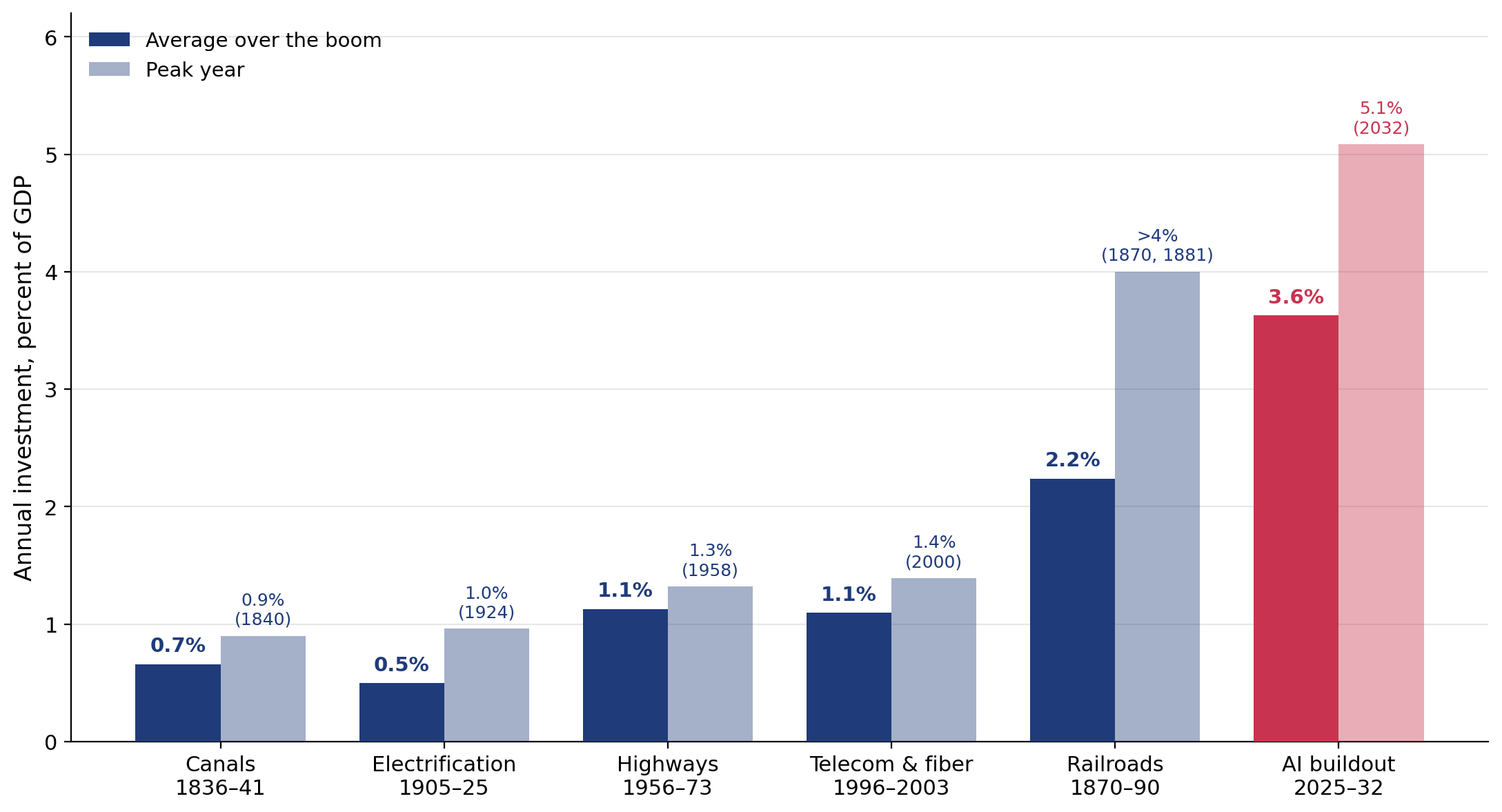
WALKER: Just for people’s context, there’s a good paper by the Brookings Institution, which I’ll link to, which estimates that spend between [2025] and 2032 is about 3.5% of US GDP [per year] on average, which already dwarfs – I think it’s probably three times the size of the telecom boom.
HEMPTON: Three times? Many, many times relative to GDP.
WALKER: I think the telecom boom was a bit over 1% of US GDP.
HEMPTON: Really? I thought it was less than that. Okay.
WALKER: And it also [eclipses] the railway boom.
HEMPTON: The railway boom is the big one. Yeah, that’s true.
WALKER: Yeah, but it [eclipses] even that in terms of the average annual percentage. Although it’s not quite a fair comparison, because the railway boom went on for 20 years, so it lasted a lot longer than the AI boom has so far. But anyway, I interrupted you.
HEMPTON: You get to $7 trillion. This is compute. You’re gonna have to assume that it has five-year lifespans –
WALKER: Is that more because the chips are superseded or because they physically degrade?
HEMPTON: Both. The chips will probably be – Google used to run its data centres full blast, and it changed the estimated lifespan of its chips from four to six years eventually. And I believe Google when they say that. And that change had multi-billion-dollar effects on Google’s stated earnings. So it was something that, if you followed Google’s accounts, you noticed. But it never changed them to seven years, and they just burn out.
But the second thing is that Moore’s Law still applies. The new chips will be more efficient, they will be better. The value of the chip is heavier when it’s cutting edge. So if you think about its depreciation, it’s probably functionally, economically a bit upfront. I mean, at the moment, compute’s worth a great deal. But, you know, in six months’ time, the price will be lower. So how should you depreciate your chip is a real question. But call it five years, call it six years. I’ve got five in my head. It’s not eight, right?
They use a lot of electricity to run, and a lot of cooling and some other stuff as well. You know, there are people there – not many in the data centre, but there are people. So in order to get your $7 [trillion] back, you need about $1.2 to $1.5 trillion a year, depending on your lifespan, in EBITDA – which means you probably need $2 trillion of revenue.
If you’re going to get it from the business, the place you’re going to get it from is firing staff. I mean, this is a very, very good productivity tool. Don’t kid yourself: the AI is after your job. And that applies whether you’re a carpenter or a stock analyst. But if you get it from firing –
WALKER: It almost has to be after your job as a consequence of the scale of the build-out.
HEMPTON: Yeah, yeah, you’ve got it.
WALKER: The only way to get the revenue to get a sufficient return is to cut the wage bill.
HEMPTON: Right. So let’s put this in perspective. If you’re going to get $2 trillion a year, you’ve got to save about $4 trillion of labour at the low end. Because people don’t fire somebody for a 10% saving. Because it’s high risk. You’ve spent money training the person, the person fits in your business, you’ve got to restructure your business. You don’t fire people for, you know, 10%.
So if you’ve got to find $4 trillion of labour savings, that’s a big number. And I’ll give you an idea how big a number. The total wage bill – every wage paid in the OECD – is about 40 trillion a year. So you’ve got to save 10% of the wage bill across the OECD. Now, at the moment, it’s probably going more after high-end workers than low-end workers. So it’s probably less than 10% of the employees in the OECD. But of people who are my friends, it’s more than 10% of them.
I can’t see how you get a return on that $7 trillion unless you cause a massive global recession and a massive global restructuring. And if you do cause that massive global recession, you ain’t getting the return anyway.
There is the second problem. And the second problem is I don’t think that this can get into business at the rate that makes that return possible.
WALKER: This is where the slow diffusion of the technology and the bubble question are kind of flip sides of the same coin.
HEMPTON: Yeah. Let’s go back to my original example. My original example was I wanted to train the AI to understand banks. And I took all of my understanding of banks and all the extreme examples I had in my head – Silicon Valley Bank or OZK or, you know, ANZ Bank as different ways of getting deposits – and I put all of those examples into the AI. And having spent many days putting just that bit of my knowledge into the AI, I had a working model that could replace me as an analyst of at least the deposit part of a bank.
But that agent doesn’t work unless I put my skills into the AI. And that’s going to be a general problem across society. There are plenty of jobs that middle management in companies do that can and should be replaced by an AI. But the incentive structure is such that the middle management won’t do it. Why would I do that if I thought [it] was going to result in me being fired?
Now, this is of course going to wind up being an incumbent’s curse. A new company won’t have that problem, because it doesn’t have the staff with the incumbency problem. And so new companies will displace old companies. But I can’t in my head make the AI spend get a reasonable return unless you sack 10% of the workforce of the Western world. And I can’t see how you sack 10% of the workforce unless the workforce train the AI, and I don’t know how that’s going to happen.
This doesn’t mean that AI won’t eventually displace 10% of the jobs. I think it will displace more than that. I get bearish about the very structure of capitalism if the AI can do almost everything. I mean, how do you distribute? You start winding up thinking about fantasy worlds that look like Star Trek, where the replicator makes whatever you want. And because the replicator makes whatever you want, there’s no factories. There’s no work as such. And the only work is exploring.
It’s a nice world, but I don’t understand how it’s organised. I understand how a capitalist world is organised. I understand how a democratic world is organised. I don’t understand how Star Trek is organised.
WALKER: RIP Patrick Stewart.
HEMPTON: Ah, I binge-watched Star Trek: The Next Generation when I heard he died.
WALKER: Oh, really?
HEMPTON: That said, his management lesson is very simple: “make it so”.
WALKER: So I want to come back to … well, let’s see. I mean, we have already touched on this, but do you have any just general takes on this question of how likely it is that frontier AI will be commoditised?
HEMPTON: I’m a finance guy. Ask Leopold.
WALKER: Okay, okay.
HEMPTON: I mean that. If I started opining about where the tech is going, I’m probably wrong.
WALKER: Yeah, I think we all fall into that category.
What survives a compute bust?
WALKER: So I wanted to pop back: I had a couple more follow-up questions on the telecom bubble that I didn’t get to ask. One was – so for me, the lesson to take from the telecom bubble is to never underrate the elasticity of supply. And you can see how this might apply to compute.
For example, we might find ways of decentralising training compute; we might find ways of building out orbital compute; we might find ways of doing photonic compute – there’s a good Substack post by Alex Turnbull on that I can link to. But I think that’s the main lesson I take.
HEMPTON: I think you overestimate just how much supply matters. In solar panels, you’ve bankrupted everybody three times with 2 or 3% efficiency gains each year. Warren Buffett gave up on the textile industry with a 7 or 10% efficiency gain staring him in the face. If you got 5% efficiency gains every year in a high-capital-cost business, everybody goes bust, even if the product changes the world. If you’ve got 50%, it’s just worse. The elasticity of supply just made it worse.
WALKER: So the supply coefficient doesn’t even need to be that big. Is that what you’re saying?
HEMPTON: No. All you need to do is have an incentive that’s big enough that someone builds the next plant every year. And then you’re guaranteed the excess supply.
WALKER: Okay, yeah, interesting. The other thing – so can you tell me what to do with this fact? One big difference between the AI boom and the telecom boom or the railway boom is the economic lifetime of the infrastructure. So optical fibre and railways are going to last for a very long time. The chips last for maybe five years.
HEMPTON: I think that just compresses this thing. No solar plant that has been built has lasted more than seven years. And the reason is the technology improvement is fast enough that they don’t last.
Now, railway – part of the trick is that we managed to get more and more out of the lines. So we made the trains longer, we digitised their separation so that you can now run trains separated by only a few minutes. “Precision railroad[ing]” was the jargon, which was their way of getting more and more and more out of their infrastructure. But the core infrastructure remained.
In the solar panel case, every ten-year-old solar panel plant does not exist. It’s already obsoleted by the next generation. Chips used to be that way, but they’re not anymore. And the only reason they’re not anymore is that we found large amounts of use for obsolete fabs.
For instance, my favourite use for those is what’s called MEMS chips, where – I’ll give you an example. You make a really bad capacitor, and the really bad capacitor has some hydrophilic plastic between the layers. And this can be a capacitor the size of a pinhead. And then you print that capacitor onto a silicon chip which has a minimal amount of computing and a minimal amount of NAND memory.
You put it in a room with 20% humidity at 20 degrees, 30% humidity, 40% humidity, etc. Then you calibrate it, [store] the [calibration] in the NAND chip, and now you have a humidity detector that is the size of a pinhead.
You might wonder what the hell the use of this is. Well, these are now so cheap that in a high-end car they put them in the air conditioning. And in the old days, I remember, you know, trying to dial up and down the air conditioning to get the demist right – so that if you put the air conditioning up too hard, it was too cold in the car; if you didn’t put it down, your front windscreen misted. And there was a magic point where it was just right. Well, now the car will work out that magic point, because it has a humidity sensor in it.
Now, that little device got used on an old chip. Because a 20-year-old or 15-year-old wafer is fine for that, because it doesn’t have very much. Those sensors are everywhere in our world.
And the example du jour is in electric car batteries. This was the trick that Elon worked out – or Tesla worked out – which is: in the old days you’d run all these batteries together and the cars blew up. And the reason the cars blew up was that you’d have one battery that ran away, got hot, misbehaved, it would burst, and then you’d get a consecutive flame and the flame would wipe out the whole battery.
And so the electric car company before Tesla was something called Fisker, and they only built 40 or something of those cars, and more than half of them ended in a fireball. And now electric cars don’t end in fireballs. And the reason they don’t end in fireballs is we’ve put a MEMS sensor, which tests temperature and things like that, on every single cell of the battery. And we know that this battery cell here is running away, so we turn it off, or we moderate how much power is going into it, so that we stop it bursting into flames.
And the Tesla battery was a computer-controlled battery. And so we put these little MEMS sensors – 7,000 of them – into your Tesla. Now, nobody – no Joe Sixpack – knows that 7,000 little bits of silicon are sitting on the battery in your Tesla, but I promise you they are. That sort of sensor technology is now everywhere in our society and we don’t notice it.
And so suddenly all these chips, these fabs that were not cutting edge, found a use. And so the return on old equipment turned out to be much better than my model would expect. And I’m always puzzled by, you know, how often I’m wrong on things, because I would have estimated that a 15-year-old fab was worth zero, and I would have been wrong. And maybe one day I’ll be wrong the same way, which is I’ll estimate that some 15-year-old data centre is useless and we’ll find a use for it.
WALKER: But the interesting thing about that story about fabs is it makes me think, if/when there is overbuild in this boom, the nice productive infrastructure left behind might not be the GPUs, but it might actually be the fabs and the energy generation.
HEMPTON: I think it's more likely to be the energy generation, but I am waiting to be wrong.
WALKER: All right, so a couple of questions about compute. So say an analyst was applying for a job at Bronte and you set them the problem question of forecasting compute demand for 2030: what do you want to see them do in an answer that would get them hired? So how should they go about trying to break down that problem?
HEMPTON: Well, I don't know what I would ask. If they're a techie person, I would actually ask them to explain all the tech and the scaling rules and explain where they can get to. And then I would ask them the questions of: “What do you think you can do with that model?” And if they're a techie person, they're going to sound like Leopold Aschenbrenner, and I don't know how to assess such a person. Because they're just sort of wide-eyed, and when I talk about tech, I'm an idiot. But at least one of the ways that I would assess such a person is I'd introduce them to one of my techie person friends and get their assessment.
The finance person, I would ask them to cost it out. What are the cost structures? What drives it? How do you learn enough about the technology to produce a reasonable cost structure? What difference does it make if you put it in Queensland versus the United States? That would be a nice costing structure. And in Queensland, your construction costs are higher, but your electricity costs are almost certainly lower. And they're lower for two reasons. One is the Queensland government wants to encourage coal, but the more realistic reason is that solar panels have Trump’s stupid tariffs going into the US. And you know, if the Chinese are going to waste large amounts of money building solar panel plants that make nice efficient solar panels, I don't understand why you'd want to tariff them. Thanks, I'll have those solar panels.
WALKER: Do you think it's easier to forecast inference compute demand or training compute demand?
HEMPTON: I have no idea. I mean, if I look at Anthropic's S1, I've been wrong on both. So I really have no idea.
WALKER: How problematic is the circular funding in AI, and … have you seen any examples that have struck you as particularly egregious?
HEMPTON: Oh, it's problematic like shit.
But I don't know how problematic it'll wind up at the end. I sometimes think the circular funding is there so that people can get control of the asset in the bankruptcy. But that's not a standard view. I mean, circular funding has almost always been bad news in finance. But in this case, people really do want to spend $7 trillion. It's got to come from anywhere.
WALKER: Just to make sure I have this really clamped down. If there is a bubble in AI, where specifically is it located?
HEMPTON: It's going to be – well, the one thing that's unambiguous is the compute, right? High capital cost, low marginal cost, subject to competition, and nothing's changed. It may be in the frontier models too… I used to think it was in the frontier models, and then the Anthropic S1 convinced me that Anthropic was 5x as efficient as everybody else, and now I'm not sure.
WALKER: And in Australia, I think when it comes to compute, we mostly build the buildings and the power, and then foreign hyperscalers would own the chips. Would that mean that we are more protected in a bust?
HEMPTON: We're more protected against change of chip technology. We're not more protected, but not as protected as you'd think, if the new chips use a fifth as much power, we'll have built all this excess solar capacity and we won't be able to sell it. I guess we'll find some aluminium smelters.
A data centre is a better neighbour than a prison
WALKER: In light of everything we've spoken about today: if you were advising the Australian government on its data centre push, what piece of advice or pieces of advice would you give it?
HEMPTON: Firstly, I'm just going to make an observation – apparently Anthropic has made this [point] to the Australian government as well – which is it doesn't matter if the data centre is in suburbia or not, right? The idea of a data centre put in central Melbourne was crazy. And once you started putting 70-foot-high power transmission poles down suburban streets in Victoria, you could expect and deserve a “not in my backyard” response.
Now, when I use Claude, I'm often giving it a task that takes five minutes, or I'm giving it an agent task that runs in the middle of the night anyway. I don't care when it runs, and it doesn't matter to me whether the data centre is in Timbuktu or suburban Sydney, because the difference is 0.15 milliseconds on a five-minute task.
WALKER: It’s a rounding error.
HEMPTON: So put it in regional Australia.
Now, you should have no restrictions on putting it in regional Australia, though you probably do want to force them to generate most [of] their own power. And the reason you want to force them to generate most [of] their own power is the politics, which is that if they bought it off the grid, they'd just push electricity prices up. And energy prices are, dare I say it, one of the hot-button political issues, for good reason. And you’d get an anti-data centre reaction.
Now, there is no NIMBY argument against putting it in regional Queensland. There are country towns in Australia that actually want to have a prison because it provides jobs. And no matter how I count it, a data centre is a better neighbour than a prison.
Also, in large amounts of regional Australia, we have big advantages: large amounts of sunlight, relatively large amounts of land, long transmission lines that travel across states that you can hook yourself to, and no tariffs on the Chinese batteries and solar. Solar is unambiguously – and for the reasons we explained – the cheapest form of electricity in the world. Batteries are going down the same path. If you look at CATL – CATL is the world's biggest battery maker. It's a Chinese company. They have finally cracked the issue of sodium batteries, and they're promising batteries assembled in shipping containers, ready to just plug into a grid, for $75 a kilowatt-hour next year.
You connect those batteries to solar panels – there's no question that Australia just has the beautiful combination. Very good fibre optic connections to the world, very stable governments, lots of land, populations that would actually take this happily. Most regional Australia would take this very happily. And no Chinese tariffs. No Donald Trump fucking you around.
So my advice to the Australian government would be to lean into that and to get the political buy-in in the places that want it. And the places that want it are going to be places with land that would otherwise want a prison. Clearly a better neighbour.
And also, don't be ashamed of, you know, being restrictive in urban areas. The 50-foot or 75-foot-high transmission lines going down suburban streets in Melbourne really were ugly. There is a genuine case for “not in my backyard” there.
WALKER: Well, I think there was an AFR article on Friday which said that the government is preparing to announce a moratorium on data centres in urban areas.
HEMPTON: It's fine. It's absolutely fine. It's unnecessary for AI anyway. So my first piece of advice is: lean into it.
My second piece of advice is: don't put your own money in it. The last thing I want to do is have the Australian government do what the Chinese government did with solar panels, where it feeds money in, feeds money in, and feeds money in for the benefit of the world. That's my money. I'm a taxpayer.
So it's this combination of lean into it but don't fund it.
WALKER: Because of the bubble possibility.
HEMPTON: Because it's high capital cost, low marginal cost, subject to competition. It's exactly the solar panel model.
WALKER: And even if there's no bubble, picking winners is impossible.
HEMPTON: No, this is almost guaranteed losers.
A bad business is not a bubble
HEMPTON: But bubbles are such a loaded word, right?
WALKER: Yeah, yeah.
HEMPTON: Are solar panels a bubble? No, we're using them all. They've changed the world. They've made the world better.
Did everyone lose money? Yes.
Did all the manufacturers lose money? Yes.
Is it a bubble? Well, we're using them.
WALKER: It's not a bubble. It's a bad business, like airlines.
HEMPTON: Yeah, it's a really bad business.
WALKER: Airlines aren't a bubble. But you don't want to run an airline.
HEMPTON: Well, airlines were exactly that. They were high capital cost. You had to build these really expensive planes. Once you were flying them, an empty seat has a marginal cost of four-fifths of three-eighths of sweet fuck all.
In the old days, they were subject to competition, and there was 3 to 5% technical improvement every year because the new planes were always better than the old ones.
Airlines had a pattern where every cycle they would make a fortune, and then they would blow up losses larger than all the cumulative profits that they'd earned since Orville and Wilbur Wright. And the next cycle, they would wipe all that out again and make a fortune, and then they'd blow it up again.
But in no sense has air travel been a bubble. It's just been a bad business. And this is roughly what I'm going to say about data centres. It's a horrible business.
WALKER: Yeah. Can I just summarise? Tell me if I'm understanding this correctly. There may or may not be a bubble or bubbles in the AI sector. It's hard to know what will happen, in large part because it's hard to forecast what's going to happen with the underlying technology. But we can say that elements of the sector appear to be what we would call bad business – which is to say, high capital costs, low marginal costs, and competition.
HEMPTON: I mean, it's a vastly bad business. And the $7 trillion is clearly wrong. Because nobody's gonna pay for it. I have no hesitation in saying that's too big.
The bubble word I like to apply to things that are complete nonsense. Tulips.
It's not tulips. It's more like fibre optics. It doesn't mean everybody's not going to get bashed up.
WALKER: Right. And the policy implication is that even if it's more like fibre optics than tulips, don't subsidise it.
HEMPTON: Don't subsidise it, but happily facilitate it. You know, lean into it. Accept the fact that people are going to invest large [amounts of money]. If somebody's going to lay a fibre optic cable across Australia and make communication between Sydney and Perth cheap, let them.
Don't necessarily put your own money in it, but let them. That's my advice to the Australian government. Let them.
WALKER: Right. Why not?
HEMPTON: Yeah. Now, I can say “why not” if it's a Melbourne data centre. But I can't say “why not” if it's one next to the prison in Grafton.
WALKER: John, it is always a treat speaking with you.
HEMPTON: Thank you.
WALKER: Thanks for your time.
HEMPTON: Okay, cheers. Thank you.